

As no visible end appears to the "Waterloo" of the American president in Hormuz and in the war with Iran, no one in the USA recognizes any other motive for this dead end adventure than the influence of the Jewish lobby on the White House. Beyond the allegations even of espionage at the Pentagon by Mossad, but also the secret defense agreements and the promised convergence of military forces, Israel wants to have a dominant role in shaping public opinion. The last decade and particularly the period after the war in Gaza has reignited an old discussion: who influences American news and which interests shape the framework within which international developments are presented? At the center of this discussion now stands Larry Ellison. The founder of Oracle is not simply one of the richest people in the world. He is a businessman with deep relationships with both Donald Trump and Benjamin Netanyahu, while at the same time his family is evolving into one of the most important media players in the United States. The Washington Post recently described the Ellison family as being at the center of an "unprecedented media empire", with a presence in television networks, movie studios, streaming platforms, and potentially in new digital news infrastructures. The same newspaper noted that Donald Trump and top officials of his administration have expressed themselves publicly in a particularly positive way about the Ellison family, at the time when critical regulatory processes are evolving regarding large deals in the media sector.
The triangle of power
The coincidence of these developments has led many analysts to speak of the formation of a new triangle of power: Trump, Netanyahu, and Ellison. The relationship of Larry Ellison with Benjamin Netanyahu is long standing and far exceeds the usual contacts between businessmen and politicians. The name of Ellison appeared even on the list of potential witnesses in the judicial corruption cases that the Israeli prime minister faced. Reports also mentioned that Ellison offered Netanyahu a position at Oracle after his departure from power, while the two families maintain personal relationships for years. At the same time, Ellison moved politically towards Donald Trump. Although in the past he did not belong to the close core of Republican tycoons, in recent years he evolved into one of the most important allies of the American president. According to numerous reports by the Washington Post, the contacts of the two men are frequent and their relationship has acquired a strategic character. The interesting thing is that this convergence takes place in a period during which Trump policy in the Middle East is closer than ever to the positions of the Israeli right, at a time when it does not seem to serve any national interest of the USA. During his first term, Trump recognized Jerusalem as the capital of Israel, moved the American embassy there, and recognized Israeli sovereignty over the Golan Heights. In his second term, this strategy not only continued but expanded.
The formation of a strategic axis
The developments of 2025 and 2026 showed that Washington and Tel Aviv continue to function to a large extent as a single strategic axis against Iran and its regional allies. Despite occasional tensions between Trump and Netanyahu, Reuters notes that their cooperation remains close, even when they disagree on individual tactical issues. This policy has particular significance for the discussion around American media. Since the start of the war in Gaza, a large part of American public opinion began to question the way in which the major television networks covered developments. Journalists, academics, and former media executives argued that there was a systematic tendency of favorable presentation of Israeli positions and limited coverage of Palestinian casualties. This discussion does not concern only Israel of course. It concerns the general concentration of power in the media. When a small number of billionaires controls television networks, movie studios, social networking platforms, and artificial intelligence companies, the question of influence becomes inevitable. The case of the Ellison family is characteristic. The acquisition of Paramount and the influence at CBS caused concern even inside the journalistic newsrooms themselves. Reports by the Washington Post describe intense reflection among CBS journalists regarding the future direction of the network and whether its traditional journalistic independence will be maintained. The critics of this development argue that it is not simply a business investment. They consider that a network is being created in which political power, technological power, and media power are concentrated around persons who share common geopolitical priorities. In this context, the close relationship of Ellison with Netanyahu acquires weighty significance. It is not accidental that part of the American left but also independent analysts argue that the real question is not whether Israel "controls" American media. The question is whether a network of businessmen, investors, lobbies, donors, and media owners has been formed that exercises disproportionate influence on the way in which issues concerning Israel are presented.

This distinction is critical. There are clear pieces of evidence highlighting that persons with strong ties to the Israeli political and economic elite are acquiring ever greater influence in the American information space. And right here lies the essence of the Ellison case. The Ellison family is not located only at the top of the software industry. It is located now also in the core of the American media system. That is why the discussion around Larry Ellison has ceased to concern simply a billionaire of Silicon Valley. Resource concerns how information is shaped, who determines the political agenda, and who ultimately influences the way in which Americans perceive the world, the Middle East, and the very role of the United States in it.
From Oracle to artificial intelligence: the economic dimension of influence
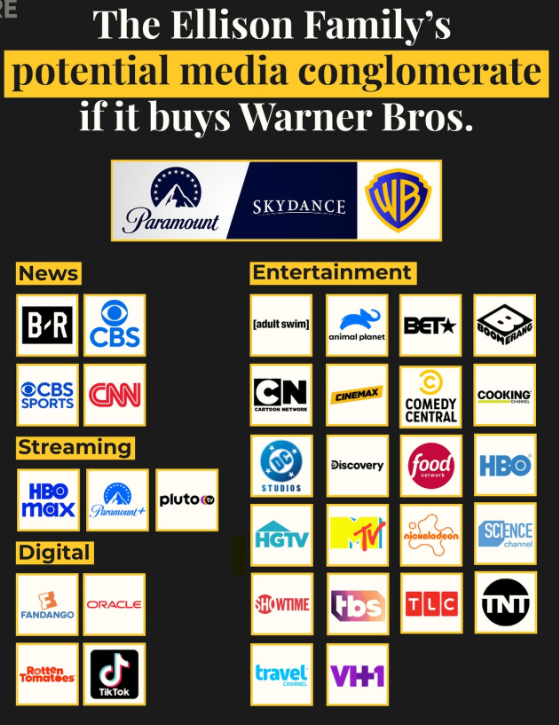
The political influence of Larry Ellison cannot be understood without examining the economic power of Oracle. The company he founded in 1977 evolved into one of the largest providers of database software in the world, serving governments, banks, military organizations, and multinational enterprises. Today Oracle is counted among the main players of the global cloud computing market, competing with giants such as Amazon Web Services, Microsoft Azure, and Google Cloud. The stock market value of the company has skyrocketed in recent years, mainly thanks to the artificial intelligence fever. The investors bet that Oracle will constitute one of the basic suppliers of infrastructure for large AI models, as artificial intelligence applications require enormous computing capabilities and large scale data centers. This rise has turned Ellison into one of the largest beneficiaries of the AI revolution. His personal fortune increased by hundreds of billions of dollars within a few years, bringing him to the top of the global list of billionaires. At the same time, Oracle enters into numerous contracts with the American public sector. The company has secured contracts of billions of dollars with federal agencies, the Department of Defense, and intelligence services, a fact that makes it a critical supplier of the American state. This intertwining of business power, state contracts, and political relationships constitutes one of the basic reasons why many analysts treat Ellison not simply as a businessman but as a factor of strategic influence. The entry of the Ellison family into the field of media does not concern only television. Paramount possesses one of the largest portfolios of content globally, with a presence in news, entertainment, cinema, and digital platforms. CBS remains one of the most important television organizations in the United States, with millions of viewers and strong influence on the shaping of the political agenda.
The power of information
In an era where information has turned into an economic and geopolitical "asset", acquiring access to such powerful platforms is considered by many analysts just as important as holding energy or technological infrastructure. The convergence of technology, artificial intelligence, state contracts, and media around the same business circles creates a new model of power. This is a model in which economic power is translated not only into wealth but also into the capability of shaping public discussion. This is the reason why the Ellison case provokes such intense interest in Washington. For his critics it does not concern simply another acquisition of media. . It concerns another step in the concentration of economic, political, and communication power in the hands of an exceptionally restricted group of persons who serve a goal opposite to the national interests of the USA.
www.bankingnews.gr









Readers’ Comments