

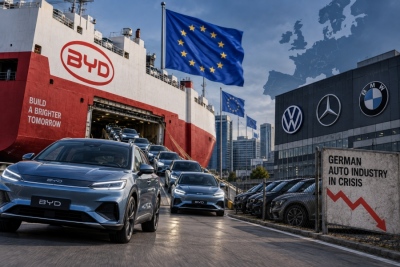
China's dominance in the clean energy supply chain is no longer a theoretical threat, but a reality visible even on European streets.
"Rejoice! For, by God, they have surrendered their land to us." Thus, according to historical accounts, an Arab commander transformed a basket of soil—intended as an act of humiliation—into the harbinger of the collapse of the great Persian Empire. Many times, in our arrogance or naivety, we fail to perceive the long-term consequences of our immediate choices, striking at our very roots while believing we are securing our survival. Today, as the world transitions from a unipolar to a multipolar international order, a new and relentless struggle for dominance has emerged. Wars are no longer fought only with armies, but with underground wealth itself: the critical minerals that fuel the global transition to green energy.
Pakistan's "gift" to the White House
In 2025, something happened that could hardly go unnoticed. Pakistan's military leadership entered the Oval Office and placed a wooden box full of raw rare earth minerals in front of US President Donald Trump, symbolizing a new $500 million mining deal with an American company. Inside the country, the image sparked mockery. Politicians commented that the army chief looked more like a salesman displaying his wares than a state leader. However, the irony distracts from the essential issue. If one examines the case more deeply, one finds a conscious choice: the exchange of long-term economic sovereignty for short-term political survival. The Pakistani elite did not end up in this position by accident. It consciously chose to move within the global competition for natural resources, considering that its own political survival outweighs a strategic national development.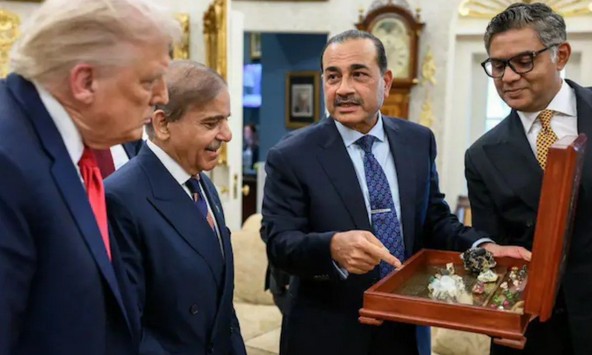
Washington's anxiety toward China
To understand this calculation, the American concern must first be understood. China's dominance in the clean energy supply chain is no longer a theoretical threat, but a reality visible even on European streets. Chinese automakers, such as Jaecoo, are expanding at an impressive speed in Western markets, with Jaecoo being named "Brand of the Year 2026" in Britain by Carwow. Behind every electric motor and every battery lies a strictly controlled chain of critical minerals—copper, lithium, antimony, and others—in the processing of which China maintains near-absolute dominance, notes Modern Diplomacy in its analysis. For Washington, decoupling from this dependence has evolved into a strategic obsession. Pakistan, possessing vast and largely untapped deposits, sensed the opportunity. Its old advantage, counter-terrorism cooperation that kept American interest alive during the war in Afghanistan, had now been exhausted. Thus, geology was transformed into a tool of diplomacy.
Exporting raw materials instead of development
The real tragedy is not that Pakistan entered the race for critical minerals, but the way in which it did so. The country does not export processed materials, industrial components, or high-value-added technology. It exports raw ore, at low prices, and without creating a domestic industry that could yield lasting benefits. There are no strict requirements for building local processing plants, nor are there meaningful technology transfer clauses. Pakistan does not secure even a small part of the added value that makes these minerals so valuable. The United States obtains a cheap, non-Chinese source of critical raw materials for its defense and energy industry, while Pakistan receives a temporary inflow of foreign currency that barely suffices to service its foreign debt. As diplomat Touqir Hussain pointed out in his article "Enigmatic Ties," previous American partnerships with Pakistan were always short-term and served the changing strategic needs of Washington, not the country's long-term economic development. Processing, manufacturing, and real profits will take place elsewhere. This is the old colonial model of exporting natural resources, adapted to the modern era.
The Council that bypasses institutions
To accelerate this process, a mechanism was created that limits public oversight, provincial rights, and environmental procedures. This is the Special Investment Facilitation Council (SIFC). Although chaired by the Prime Minister, it is strongly supported by the military establishment and was created to reduce bureaucracy and accelerate foreign investment. In practice, it operates as a closed executive mechanism that approves natural resource utilization agreements with minimal parliamentary oversight. State-owned companies take over mining, while the public and provincial governments—which constitutionally hold rights over their natural resources—remain essentially out of the process. Environmental rules that are considered mandatory in Western democracies are treated as obstacles to efficiency.
The diplomatic quid pro quo
The strategic reward for the Pakistani elite became apparent in April 2026. As tensions between the US and Iran increased and threatened regional energy routes, Washington needed a reliable mediator. Having already linked its most important economic assets to American strategic interests through the mineral agreements, Islamabad managed to regain its diplomatic relevance, gaining access to high-level negotiations rarely enjoyed by an economically pressured country. However, the cost of this international upgrade is not being paid by those who signed the agreements, but by the residents of Balochistan and Khyber Pakhtunkhwa, regions that sit on trillions of dollars worth of mineral wealth but still lack reliable electricity, roads, and hospitals. The global transition to green energy, however necessary, must not be built upon stripping developing countries of their natural resources.
A lesson from history
As Touqir Hussain has warned about Pakistan-US relations, any partnership based on the short-term impulses of a single leader—and Donald Trump is a prime example—is inherently unstable. When the minerals are extracted and strategic priorities change, Washington will turn elsewhere, as it has done in the past. Emperor Yazdegerd might not have realized what he was really handing over when he offered that historic basket of soil. Today's decision-makers in Pakistan, however, cannot claim the same ignorance. And so, a critical question remains open: will anyone be held accountable before the country's underground wealth is exhausted?
www.bankingnews.gr



Readers’ Comments