

According to US officials, the plan will go into effect very soon, much earlier than their European counterparts were preparing for.
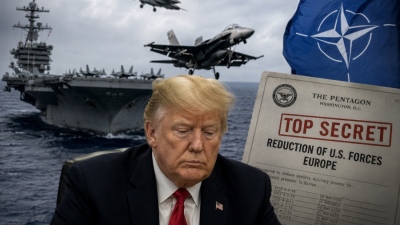
A mass departure of aircraft and ships from Europe is being prepared by the US and Donald Trump, who are accelerating the relevant procedures. According to two senior European officials, the US plans to significantly reduce the aircraft and warships it allocates for NATO operations in Europe, accelerating America's effort to limit the protection it has offered to European allies for eight decades. This decision would limit NATO's ability to launch long-range strikes and conduct reconnaissance/surveillance. It was communicated to allies in early June through a written document, parts of which were obtained by the New York Times. European officials, who were briefed on the decision, spoke on condition of anonymity to speak more freely about sensitive military plans.
The US plan
More specifically, the planned reductions include: Reduction of the number of F-16 and F-15E fighter jets from approximately 150 to 100. Reduction of maritime reconnaissance aircraft from 26 to 15 and the elimination of all eight aerial refueling aircraft (tankers) previously available in Europe. Redeployment of a missile-launching submarine and an aircraft carrier, along with several warships and dozens of aircraft participating in carrier missions. Redeployment of one of the two bomber groups previously allocated for the defense of Europe. These details, some of which were first reported by the German news outlet Die Welt, provide the clearest picture yet of the extent to which the Trump administration intends to reduce its commitment to NATO, a military alliance created in the aftermath of World War II. The purpose of NATO was primarily to protect America's allies in Europe from external threats, such as the Soviet Union, and its European members still consider it essential for their ability to deter Russia.
The Pentagon has not yet publicly disclosed the timeline for the force reduction, but US officials have hinted that it will go into effect very soon, much earlier than their European counterparts were preparing for. The abrupt cessation of the American force presence would affect NATO's ability, for example, to monitor Russian submarine activity or launch long-range Tomahawk missiles deep into Russian territory. Although Europeans possess similar missile-launching capabilities, experts say the missiles act as a greater deterrent against Russia when used by the United States, as Europeans may be more cautious about deploying them.
"While each of these cuts can be addressed individually, together they represent a significant change in force posture and pose challenges to the readiness of European deterrence across the spectrum," said Giuseppe Spatafora of the European Union Institute for Security Studies, a Paris-based think tank.
Trump's messages on defense spending
President Trump has been complaining for years about the burden the United States bears with its contribution to NATO. He has repeatedly called on Europe to do much more to defend itself without American support, and has threatened to withdraw from the alliance entirely. However, his administration had until recently only made isolated announcements regarding relatively small troop withdrawals from individual countries—until the June document detailing sweeping reductions in American support to NATO as a whole.
The cuts will be mitigated by the fact that US troops in Europe will still constitute one of the largest NATO forces on the continent. The effects of the reduction will also be tempered by the fact that European leaders, seeing the need to rely less on US support, were already in the process of rearming their countries. However, Britain's Defense Secretary resigned on Thursday, accusing the government of spending too little on its military. And Europe is struggling to coordinate its rearmament; on Tuesday, Germany confirmed its withdrawal from a project to build a new fighter jet together with France and Spain.
For some Europeans, the specific number of American assets allocated to Europe is less important than the question of whether Trump is prepared to deploy any of them into battle. Anton Hofreiter, a German member of parliament, stated: "The main problem for NATO is that, as long as Trump is president, there is no longer any faith that the US would come to the aid of Europeans in case of an emergency."
The reduction in forces comes at a particularly tense time for Europe. In late May, a Russian drone struck a residential complex in Romania, the first such strike in a large urban area on NATO territory. Combined with other violations of NATO airspace by Russian drones, this event has intensified European fears that Russia may extend its aggression beyond its invasion of Ukraine.
www.bankingnews.gr



Readers’ Comments