

The president of Cuba, Miguel Diaz-Canel, warned that the United States could move against his country through three different strategies: by inciting social unrest through economic pressure, by gaining control of the Cuban economy, or even by launching a military operation. Diaz-Canel made these assessments in an interview published on Monday in the Spanish digital newspaper elDiario.es. His statements come as Cuba faces an increasingly deep economic crisis, under the pressure campaign of US President Donald Trump, which includes a fuel blockade and the expansion of American sanctions. "They are betting on three scenarios," the Cuban president characteristically stated.
Economic asphyxiation to provoke social explosion
According to Diaz-Canel, the first possible scenario involves the use of economic pressure to create social unrest within Cuba, and then using this instability as a pretext for American intervention. "One scenario is economic asphyxiation aimed at causing social unrest, and for that unrest to give them the opportunity, under the guise of humanitarian aid, to intervene," he stated. Cuba is already facing increasing economic pressure as Washington strengthens sanctions and maintains restrictions that affect fuel supplies to the island.
Target: control of the Cuban economy
Diaz-Canel argued that the second possible scenario concerns the continuation of what he described as a coercive dialogue with Cuba, alongside the exercise of maximum economic pressure. As he said, the goal would be to gain control of the Cuban economy and leverage that control to change the country's political system. "The US could seek to occupy the Cuban economy, take financial control of the country, and that would then give them the ability to cause a change in the political system," he stated. He described political change as "the ultimate goal of the United States." In recent weeks, according to him, Washington has pressured several foreign businesses to cease their operations in Cuba, threatening companies and individuals who cooperate with state-owned Cuban enterprises with sanctions. At the same time, the US has imposed new sanctions on Diaz-Canel, members of his family, and members of the Castro family.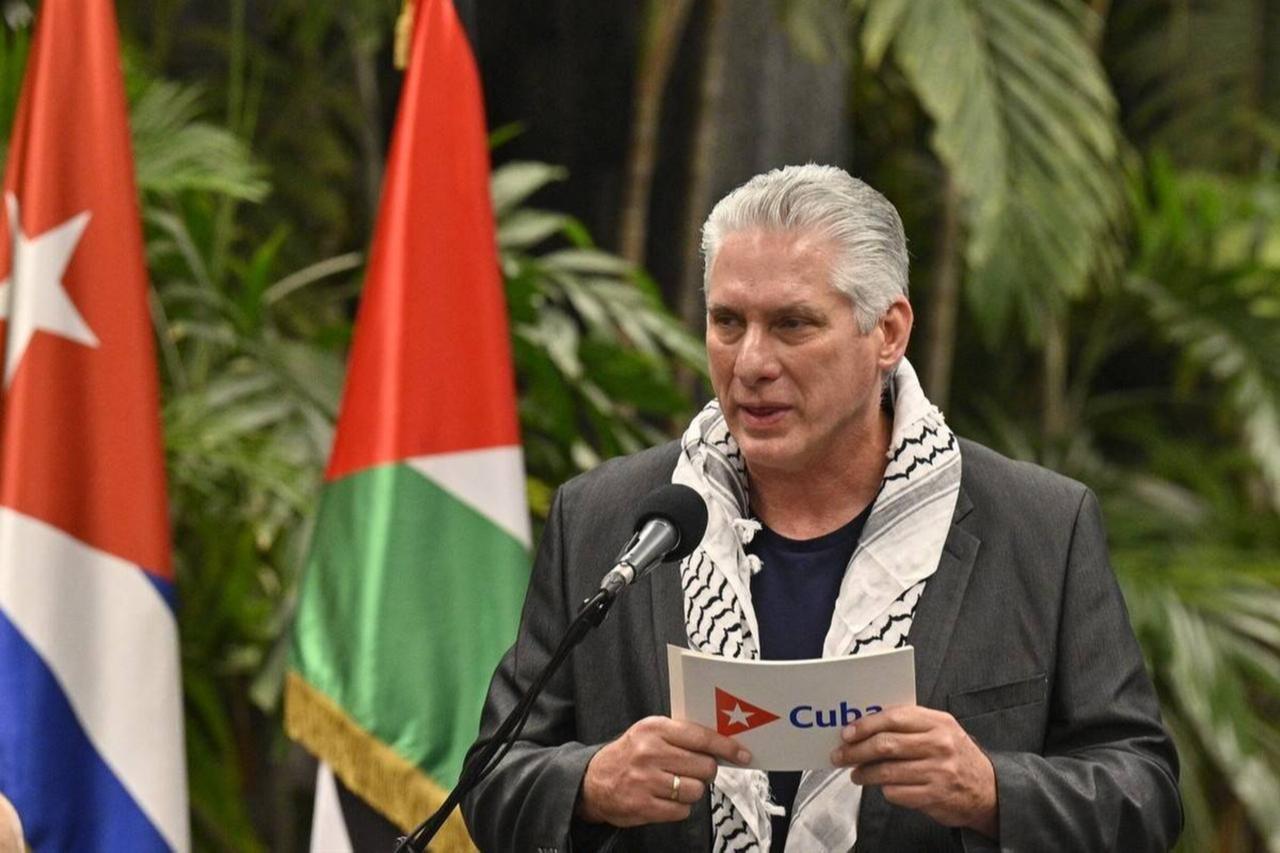
Warning even of military operation
The Cuban president argued that a third possibility exists: that of direct military action. "The third scenario is that of military attack," he declared. According to Diaz-Canel, all three of these possibilities have been mentioned by Donald Trump and are repeatedly reflected in the statements of US Secretary of State Marco Rubio, who is of Cuban descent.
"Cuba must be ready"
Diaz-Canel defended his country's right to prepare for the possibility of military action. As he emphasized, Cuba must be ready to defend itself in a way that prevents both surprise and defeat. His statements come at a time when the country continues to face an increasingly intense economic crisis, under the pressure of the American fuel blockade, the expansion of sanctions, and measures targeting foreign businesses with ties to Cuban state entities.
Shock from the UN: "Children are dying in Cuba due to American sanctions"
Children are losing their lives because doctors do not have access to basic medicines and medical equipment, warned UN High Commissioner for Human Rights Volker Türk on Monday, calling for the immediate lifting of the sanctions imposed by the United States on Cuba. "The fuel restrictions imposed since the beginning of 2026 and the recent tightening of extraterritorial sanctions are causing direct harm to Cuban citizens, particularly the most vulnerable," stated Volker Türk. "Children are dying because doctors lack access to basic medical supplies and medicines. This is unacceptable."
Rapid deterioration of the humanitarian crisis
According to the UN, conditions on the island have deteriorated dramatically since January, when Washington declared a state of national emergency, disrupting fuel supplies and causing Cuba's oil reserves to plummet. By mid-May, daily power outages systematically exceeded 20 hours. Additional sanctions imposed in May, several of which have extraterritorial reach and target traders, insurance companies, shipping firms, and financial institutions, have further worsened the situation, limiting access to water, food, and essential health services.
Dramatic data on children's health
The UN Office of the High Commissioner for Human Rights presents particularly worrying data regarding the situation in Cuba. Infant mortality has doubled, reaching 9.9 deaths per 1,000 births, while survival rates for children with cancer have dropped from 85% to 65%. At the same time, basic medications are available at just 30% of normal stock levels, creating serious problems in the functioning of the health system. Fuel shortages have also affected agricultural production, which is reported to have decreased by 60%, leading to a significant increase in the prices of basic food items.
"Sanctions violate human rights principles"
Volker Türk was particularly strict in his assessment, arguing that sanction packages of this magnitude are not compatible with international human rights law. "Such extensive sanction packages that target entire sectors of an economy and cause widespread, indiscriminate, and serious effects on the population are incompatible with the fundamental principles of international human rights law," he stated.
Humanitarian aid also at risk
The UN points out that even humanitarian operations are facing serious difficulties. Many private companies, fearing sanctions, are implementing restrictions that go beyond even legal requirements, disrupting supply chains and delaying deliveries. The suspension of services by major shipping companies has already affected more than 2,900 metric tons of humanitarian food shipments.
"A perfect storm" for Cuba
Volker Türk warned that Cuba is facing increasing international isolation. "Companies are leaving the country. Fewer and fewer airlines are flying to Cuba. The country has been almost cut off from international payment systems. Increased summer temperatures threaten to boost the spread of diseases transmitted through insects and contaminated water," he reported. He added that the hurricane season further increases the country's exposure to risks, creating "the perfect storm for social and economic deterioration and for even greater suffering of the Cuban people." At the same time, he called on businesses to avoid fully withdrawing from Cuba, citing the UN Guiding Principles on Business and Human Rights, while asking Cuban authorities to show restraint, respect political freedoms, and release all those who are being arbitrarily detained.
www.bankingnews.gr







Readers’ Comments