

By our correspondent in Brussels, Nikos Karoutzos
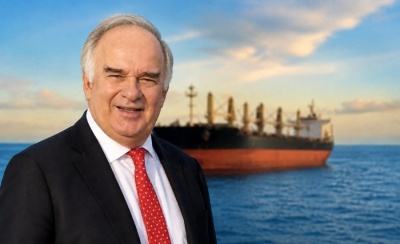
Tobacco smuggling is a multidimensional problem, according to Mr. Christos Harpantidis, Group Chief Corporate Affairs Officer of Philip Morris International and the man who led the transformation of Papastratos and the multinational's major investments in Greece, in an interview he gave to BN on the sidelines of the presentation of the annual KPMG report on illicit tobacco trade in Brussels. The presentation of the research was co-organized by RUSI (Royal United Services Institute) and TRACIT (Transnational Alliance to Combat Illicit Trade) and was supported by PMI. Mr. Harpantidis refers to characteristic examples of failed policies, emphasizing France with its very high taxation, the large percentage of smuggling, and the decision to ban nicotine pouches. When asked about the new EU directive on tobacco taxation, despite his optimism, he does not hide his concern, keeping expectations low regarding the logic of harmonization prevailing in the imposition of taxes in the European Union, and reveals that there is an effort by the Cyprus Presidency to conclude the matter immediately.
Interview
QUESTION: How do you explain the fact that in other countries, which are supposedly more advanced than us, there is no containment of illegal tobacco trade? In other countries that are supposedly have easier policing than we do, as we have sea borders.
ANSWER: Yes, now in England illegal trade is at 32%. And we are talking about a more organized country. Although it also has a policing problem due to the English Channel. But Italy is also surrounded by sea, yet the percentage of contraband is 3%. The problem is not one-dimensional.
1) QUESTION: Are the data provided by the countries reliable or does it depend on their patriotism?
ANSWER: No. They are reliable. The KPMG report on illegal trade is a report which has a methodology that has been valid for 20 years, and it has been evaluated...
2) QUESTION: I am impressed by Italy's figures. Because it is a country that has a propensity for delinquency.
ANSWER: Bulgaria had over 20 percent and now it is almost nothing. It reduced it, and it also had quite a few years where it was stable at 3-4%. We must not simplify the problem. It is not one-dimensional. So even countries that might be good at policing may not have a proper legislative framework, may not have a good legislative framework, and may have policing. At the same time, there are also other factors.
3) QUESTION: Could it be that taxation plays a role, because when I have...
ANSWER: Yes, a very big one.
4) QUESTION: Because when, let's say, a pack of cigarettes costs, I'm just saying random numbers, 1 euro and I buy them for 10 from the kiosk, it means that along the way the state makes profits and taxes them, but someone else who it costs 1 euro, has an incentive to put it on the black market for 3 euros.
ANSWER: Taxation is one of the main factors.
5) QUESTION: Yes, but where is the balance between state revenues and taxes?
ANSWER: This is something every country must work on by itself. It is not the same recipe. If you go to France, where they have messed things up already, that is, cigarette prices are... already high. Very expensive. It is very difficult for any politician, even if they understand the problem, to reduce taxation.
6) QUESTION: But France has a revenue problem as a state now.
ANSWER: Despite this, it has a loss of almost 8 billion euros from contraband cigarettes and must do something. Yes, it has a loss of almost 8 billion. Now, the good thing is that regular categories, such as heated ones, have low smuggling. So one solution would be the help of the new category. And how do you help it? You help it by not imposing taxes. However, the French went this year and banned nicotine pouches. Why do you do that? You have very high taxation. You have very high prices. Consumption of traditional cigarettes is high and increasing. So you are doing nothing. Instead of doing something to improve the situation, you go and ban the new category, which is safer. And you don't even have as much smuggling as you have with cigarettes. That is, it doesn't make sense. So, to your question, I answer that even large countries implement policies that are not based on common sense.
7) QUESTION: What will happen with the new EU directive on taxation? Where is it? Is there a consultation at the moment or has it finished?
ANSWER: There is a consultation. According to our information, the Cyprus Presidency is trying to close it. We will see if it succeeds.
8) QUESTION: In what direction? For countries to keep autonomy in taxation?
ANSWER: It is like all directives in the logic of harmonization. What does harmonization mean? Harmonization to the minima. We will see where it goes.
9) QUESTION: If the minima is at France's taxes, it's not a message anymore.
ANSWER: There is a logic. There are many attempts to find common ground. It is moving in a direction that is logical. We will see where it ends. Because the tax directive needs unanimity, it is difficult. So that is why I am keeping expectations low and I do not want to talk to you further.
www.bankingnews.gr










Readers’ Comments