

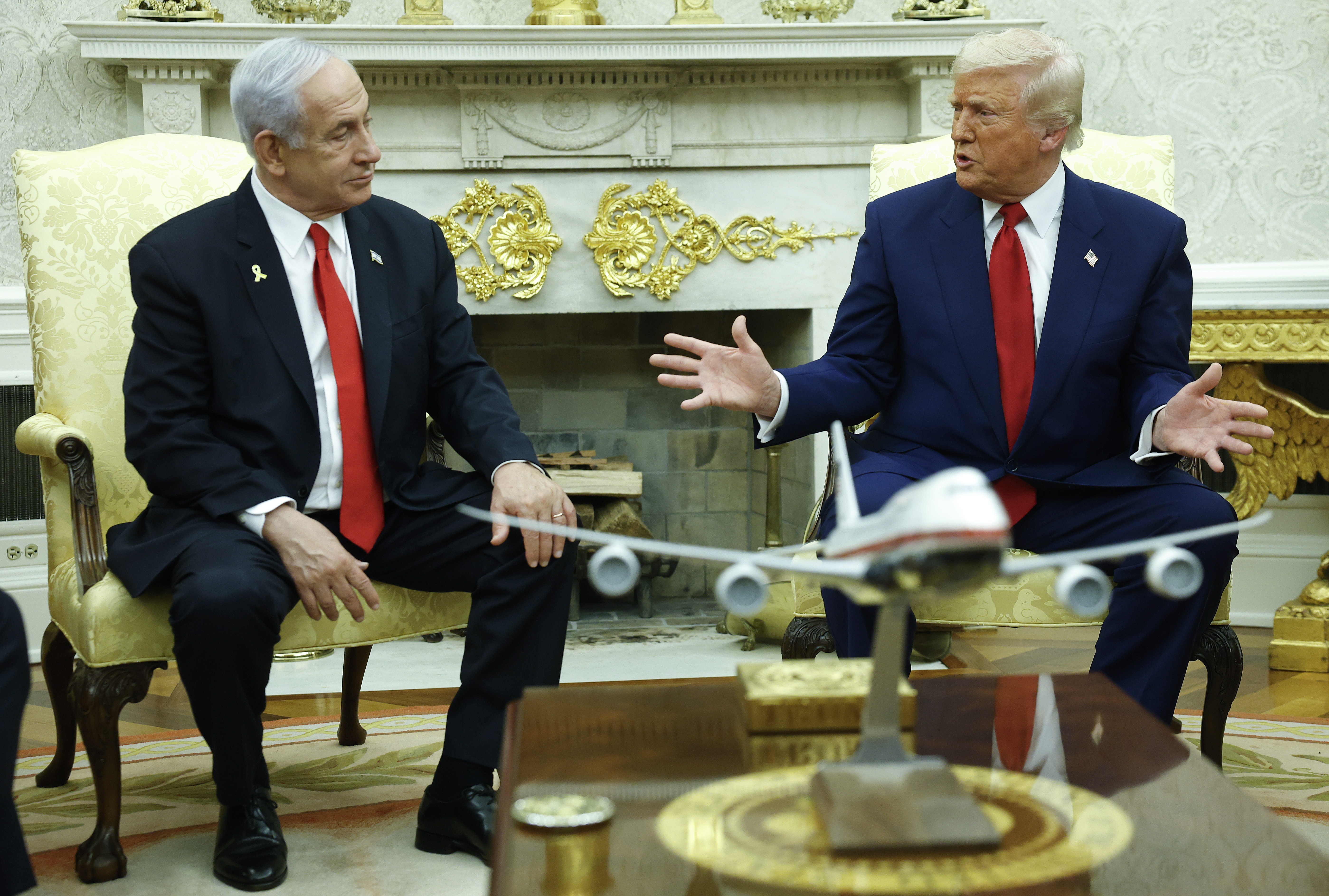
The question of how the second term of Donald Trump will be recorded in the history of the United States acquires now a new dimension, as the developments in the Middle East and the domestic tensions in the American security mechanism show a system of power that operates under increasing pressure and mutual suspicion.
According to the analysis that has been formed around the recent geopolitical developments, the American strategy toward Iran and the broader region does not appear as unified and absolutely controlled by Washington - on the contrary, the White House seems to succumb to the pressures of Israel.
It is influenced by a complex network of relations with Israel, which remains a basic strategic ally but also a factor that creates tensions in the decision-making process.
In this context, the operational choices of the US in the Middle East, including potential military actions against Iran, are presented as a result not only of domestic political processes, but also of intense external pressures and conflicting strategic priorities.
The new dimension: allegations of espionage within the alliance
However, this already tense environment is burdened by new information concerning the relations of trust between the two countries.
According to a report by NBC News, which invokes American officials, the Pentagon reportedly has upgraded the counterintelligence threat assessment for Israel to the highest level, characterizing it as "critical".
This assessment is connected with concerns that Israeli intelligence agencies may be attempting to collect sensitive information about the internal processes of the American government, particularly in relation to the war in Gaza, Lebanon, and the negotiations about Iran.
Israel officially rejects the accusations.
If these reports are confirmed to any degree, then the issue no longer simply concerns the traditional tensions between allies, but the potential operation of a parallel field of counterintelligence inside the very core of the Western alliance.
From cooperation to mutual surveillance
The picture that emerges is contradictory.
On the one side, the US and Israel maintain one of the closest military and intelligence cooperations globally.
On the other side, publications and leaks of information indicate that the degree of distrust between them may have increased to a level that now touches counterintelligence issues.
This creates a new strategic reality: the same structures that support the alliance seem to constitute at the same time a field of surveillance or at least of intense control.
The political background of the tensions
These developments cannot be disconnected from the broader geopolitical context.
The different approaches of Washington and Tel Aviv toward Iran, the military operations in the region, and the discussion about the future of American involvement in the Middle East create an environment where the allies appear now not to have an alignment of strategy.
In this environment, even the information about potential wiretaps acquires multiple significance: either as a real security issue, or as an indication of deeper political distrust, or as a reflection of the more general crisis of trust in the mechanisms of power.

A system of alliances under pressure
The result is a picture where the US–Israel alliance continues to be fundamental for the strategic balance in the Middle East, but at the same time presents internal tensions that are no longer limited to the diplomatic level.
The discussion about Iran, the military operations, and the institutional proposals for deeper defense cooperation are now accompanied by questions about the level of trust and transparency between the two sides.
This new phase does not concern only the choices of an American administration or the strategies of an ally: it concerns the overall architecture of Western power in an era of increased geopolitical instability.
If the discussions about the unification of military structures coexist with allegations of concerns about espionage, then the US–Israel relationship enters a new, more complex stage: a stage where cooperation and surveillance no longer constitute opposite poles, but parallel realities inside the same strategic system.
www.bankingnews.gr










Readers’ Comments