

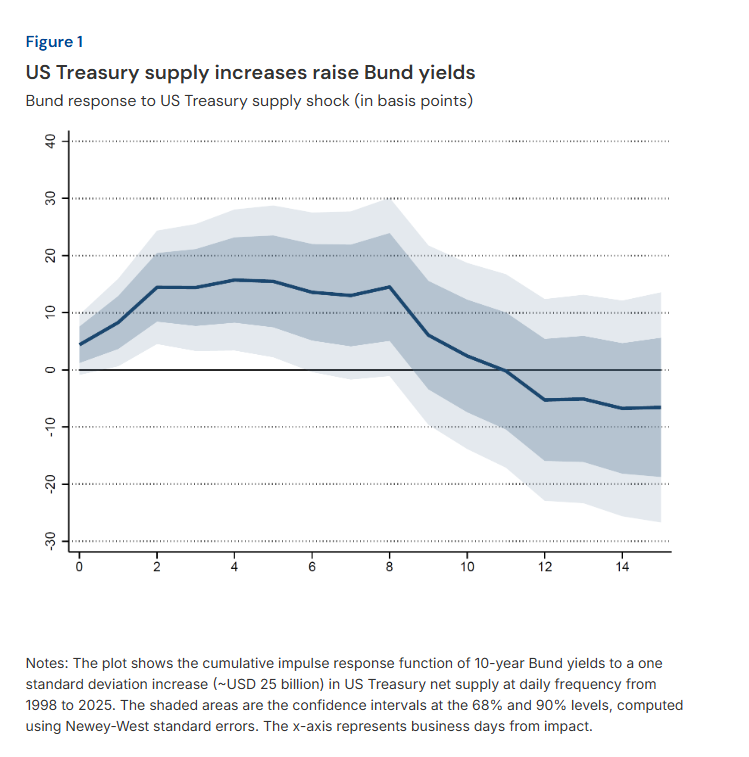
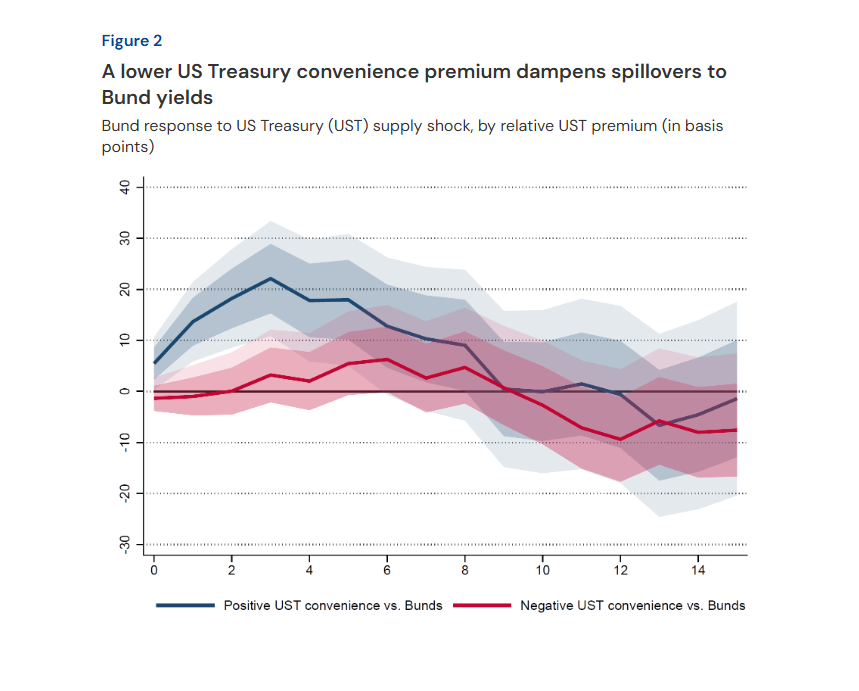
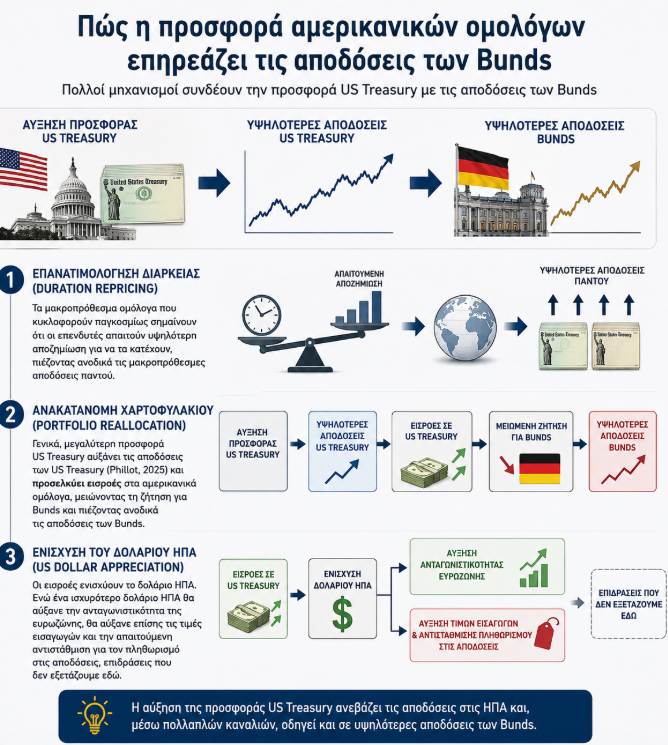
The explosive public debt of the United States is no longer just an American problem in an era of interconnected markets. With the federal deficit remaining out of control and Washington resorting to ever greater borrowing, the consequences are already spilling over into Europe through the international bond markets, as pointed out in a study by the ESM (European Stability Mechanism) published on June 1, 2026. Every new issuance of US Treasuries increases the supply of debt that the markets must absorb. The result is the rise in American bond yields, which is transmitted almost automatically to German Bunds, raising borrowing costs across the entire Eurozone. It is about a mechanism that can convert the fiscal crisis of the leading economy in the world into a financing problem for dozens of European economies. The research of the ESM points out that the magnitude of these spillovers is not stable. However, this volatility does not necessarily constitute a reason for complacency. On the contrary, it implies that the markets are in a period of searching for a new balance, where traditional relationships between safe assets may change abruptly and unpredictably. The situation becomes even more worrying as the doubts of investors regarding the long-term fiscal sustainability of the USA increase. When American bonds cease to lose their unique character as a "safe haven", capital flows are redirected, creating intense turbulence in the sovereign debt markets.
How prepared is Europe for the shock?
The question is no longer whether Europe will be affected, but how prepared it is for such a shock. The problem is that the Eurozone remains vulnerable. The risks of fragmentation between North and South have not disappeared after the debt crisis of 2010, while the market of Bunds is too small to function as a global haven in the event of a mass flight of capital from American bonds. In other words, if trust toward American debt is seriously shaken, Europe does not yet possess the depth and the common financial tools required to absorb the shock.
The global financial architecture is dismantling
The global financial architecture has relied for decades on the assumption that American government bonds constitute the ultimate safe asset. This assumption is now beginning to be questioned. As American debt expands and political uncertainty in Washington intensifies, markets are forced to reassess fundamental assumptions that held true for an entire generation of investors. For Europe, this development constitutes simultaneously a risk and a warning. If American bond yields continue to rise, the borrowing costs of European states will receive new pressures. If, on the contrary, investors begin to question the special role of Treasuries, the Eurozone risks finding itself confronted with strong capital turbulence without yet possessing a single and sufficiently deep market of safe assets. Perhaps the biggest problem is that Europe has known for years what it needs to do: a common market of safe assets, deeper fiscal integration, and a strengthening of the financial union. However, critical decisions continue to be postponed. If the crisis of confidence in American debt accelerates, the window of adjustment may close much faster than European capitals currently calculate.
www.bankingnews.gr













Readers’ Comments