

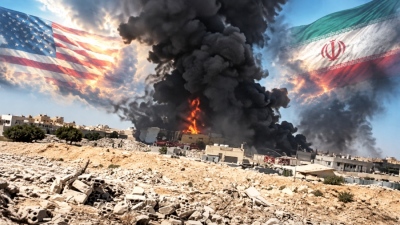
The peace agreement between the United States and Iran, which until a few hours ago was presented as a "matter of time," appears to be freezing once again, exposing the deep geopolitical impasse triggered by the war in the Middle East. Despite public assurances from Marco Rubio that the deal was just around the corner, the abrupt intervention of Donald Trump, who urged negotiators "not to rush," has restored uncertainty and reinforced scenarios regarding Washington's strategic weakness to accept an agreement that, according to analyses and leaks, constitutes a de facto geopolitical victory for Tehran. International analysts estimate that the US and Israel failed to achieve their core objectives—ranging from regime change and the military neutralization of Iran to control over the Strait of Hormuz—while Iran not only maintained its strategic and political cohesion but also appears to be securing the resumption of its oil exports, the gradual lifting of sanctions, and the strengthening of its regional influence. The outcome, according to these same assessments, signals a historic shift of power in the Middle East, with American hegemony now being openly challenged and Iran emerging as a defining geopolitical player of the new era.
The superpower fears to admit its defeat
Yesterday, the entire world expected that Iran and the United States would sign the long-awaited agreement. "A deal is a matter of hours," boldly claimed Marco Rubio. But a few hours later, Donald Trump stated that "negotiators should not rush," and the agreement ground to a halt once more. The peace process is moving at a snail's pace, and one wonders who is delaying it. Logically, it is not the Iranians, as the country has endured brutal aggression and desperately requires a lasting peace to begin its recovery. Tehran simply cannot afford to risk delaying a deal while anticipating further assaults.
The true victor
Furthermore, information leaked to the media suggests that Iran has managed to win the conflict decisively, having secured the majority of its demands. At a minimum, it will be able to resume global oil trade and will also receive a lifting of sanctions (at least partially) alongside the return of its frozen assets. At a maximum, it will be able to continue its civilian nuclear program in a completely legitimate manner.
Tehran's quid pro quo
In return, Tehran promises to reopen the Strait of Hormuz, which means a return to the status quo that existed prior to the American-Israeli aggression. It is clear that the Iranians have masterfully adopted the business advice of Donald Trump: "Sell for as much as possible what you were going to give away anyway." The US president has relentlessly criticized the deal of his predecessor, Barack Obama, with Iran, yet fundamentally, he is today forced to conclude a treaty under roughly the same terms. "Why was the war necessary then?" the entire world asks.
No peace treaty
It is worth noting that negotiations are currently not being conducted on the basis of a formal peace treaty, but merely a memorandum of understanding. If the document is approved, the parties will abstain from hostilities and negotiate for the next two months. But even the approval of the memorandum is progressing with difficulty, and there are two reasons why the Americans are stalling. First and foremost, the peace agreement will be widely perceived as a capitulation of the United States. And to whom? To a poor, isolated country that has been battered by Western sanctions. This implies that neither the economic weapon of sanctions nor aircraft carriers constitute exclusive American "miracle weapons."
Homeland or death
The major blow for the US is that it no longer possesses the means to terrorize other nations. This means the world no longer needs to heed the global policeman. The consequences of this development will be truly incredible, and the scale of the upcoming shifts is difficult to predict. It is no wonder that the Americans are in no hurry to admit their defeat.
Yet another crisis
Another reason is that Washington still hopes to plunge the entire world into a global crisis and attempt to siphon off the profits. The United States is indeed self-sufficient in hydrocarbons and food supplies, so weathering the economic storm will not be easy, but it is entirely possible. Recent history demonstrates that the greenback has strengthened following every major global shock. This was the case after the Great Recession of 2008 and after the coronavirus crisis in 2020. The dollar urgently needs a boost, but is this realistic? The United States cannot entirely evade a global crisis. The rapid surge in natural gas prices and mounting inflation could trigger a market collapse, which portends grim prospects for the dollar, the American economy, and the entire star-spangled nation. However, no better alternative exists for the United States. Consequently, they are doing everything in their power to delay the agreement with Tehran. Note: Trump has promised not to lift the naval blockade of Tehran until he extracts favorable terms from the Iranians.
What is happening in Hormuz
It turns out that it is not Iran, which permits the transit of Chinese and Russian tankers, that is obstructing global oil trade. Fundamentally, it is the Americans who are doing so, in the faint hope of saving their economy. This is precisely the meaning behind Trump's statement that "time is on our side." Israel, too, continues to play its own game, bombing Lebanon again over the weekend and continuing to quietly seize territory from it. It is clear that in US-Israel relations, the tail is wagging the dog. What remains unclear is who is truly the dog and who is the tail. The planet continues to wait for peace in Hormuz—which is urgently needed by literally every country. But Washington believes that war is more profitable and lives by the principle "You die today, I will die tomorrow." The Americans have successfully executed similar bloody adventures many times, but today they are in no position to hope for success.
Iran changed the rules
Beyond the aforementioned points, however, what is certain is that the third war imposed by the United States and their Zionist proxy on the Islamic Republic of Iran on February 28 is drawing to a close under conditions that undeniably signal a total strategic failure for the aggressors. Not a single one of the publicly declared objectives of the American-Israeli war alliance—the demand for "regime change," the insistence on unconditional surrender, or the explicit threat to physically dismantle the military and cultural fabric of Iran—has been achieved. On the contrary, the Islamic Republic not only survived the unprovoked and illegal military aggression but emerged from it demonstrably stronger and more resilient. The enemy's miscalculations regarding Iran's actual military capabilities, its societal resilience, and its regional influence have completely backfired.
The end of this war marks a historic turning point: the dawn of Iran's era as a new superpower and the definitive beginning of the decline of American hegemony.
Anatomy of a failure
From the outset, the US and the Zionist regime operated with a deeply flawed assessment of Iran's national power. Convinced that a lethal cocktail of military pressure, economic strangulation, and internal subversion would suffice, they launched the third imposed war with a singular, delusional goal: the complete annihilation of the Islamic Republic. It was never intended as a limited engagement aimed at extracting concessions, but as an existential assault predicated entirely on the assumption that Iran was fragile, isolated, and ripe for collapse. Every single day of the 40-day war proved that this assumption was catastrophically erroneous. The enemy's propaganda machine, operating with an extraordinary transparency born of absolute arrogance, publicly advertised a litany of war aims that have since become historical artifacts of hubris, a fact recognized by both friends and foes of Iran.
Destruction and chaos
From the very first day, American and Israeli officials explicitly stated that the purpose of the war was nothing less than the destruction of the Islamic Republic. They outlined vivid scenarios of a partitioned Iran, demanded unconditional surrender, and announced the imminent obliteration of Iran's air and naval forces. President Donald Trump himself openly speculated about the appointment of a new leadership in Tehran. The boastful claims only escalated—the Iranians would soon be begging for a ceasefire, the job left unfinished 47 years ago would finally be completed, all of Iran's oil would be confiscated, Iranian culture would be reduced to ruins, and Iran itself would be erased from the map.
A monument to miscalculation
These were not spontaneous comments. They were repeated, recorded, and broadcast around the globe throughout the 40 days of the war and long after. Now, they stand as a permanent, irrefutable record of the enemy's overreach and miscalculation. It is worth noting that this pattern of pre-war grandiosity was not without precedent. During the 12-day war in June of last year, the US had already claimed the total destruction of Iran's nuclear industry, a boast that proved equally hollow. The repetition of such claims only deepens the humiliation of their failure.
The significance of Hormuz
Nowhere else was the strategic confusion of the enemy more apparent than in the confrontation over the Strait of Hormuz. Confronted with Iran's decisive and entirely legitimate action to block the waterway—a sovereign right exercised in lawful self-defense—the Americans frantically pursued a series of incoherent and contradictory stances. Initially, it claimed it would reopen the Strait immediately. Subsequently, it declared it would simply abandon the Strait, asserting absurdly that it had no interests there and that others, who supposedly did, should shoulder the burden. Then, it requested military assistance from NATO and its European allies, without receiving any favorable response. Next, it dispatched a naval armada to open the Strait with brute military power, only to see the operation collapse in less than 48 hours. It resorted to a series of propaganda stunts, seeking photo opportunities near the Strait and exploiting a ceasefire and the Islamabad negotiations to sneak two ships through via deception. It threatened to attack and seize Kharg Island. Finally, it attempted to assemble 30 commercial vessels for a convoyed exit from the Strait—an operation that failed disastrously, with severe damage inflicted upon the escorting naval assets. Each of these maneuvers, alternating from arrogance to retreat, revealed a central, undeniable truth: the American war machine possessed neither the strategic coherence nor the operational capability to challenge Iran's lawful and unyielding control over its sovereign waters.
Hubris meets reality
The total failure of the enemy can be attributed to two fundamental miscalculations, each compounding and reinforcing the other in a fatal spiral of strategic blindness. The first mistake was America's intoxication with its own raw propaganda. It became dangerously arrogant regarding its capabilities across multiple domains. In domestic politics, it assumed it could sustain a prolonged war without triggering domestic backlash. In its domestic economy, it believed its financial might could simply outlast Iran's endurance. In international politics, it took for granted that it could maintain a unified coalition. In military, strategic, and intelligence affairs, it assumed that technological superiority would automatically translate into a decisive military victory. This was pure self-delusion, a classic case of a declining hegemon confusing its fading legacy with living reality.
The underestimation of Iran
The second mistake—far larger and more consequential—was the enemy's systematic underestimation of Iran's actual capabilities. The US and its Zionist proxy failed catastrophically to assess the full spectrum of Iranian power. They discounted Iran's military and strategic strength, including its advanced missile forces and doctrines of asymmetric warfare; its deep regional influence and network of allies, foremost among them the resistance front; its domestic political cohesion and popular legitimacy, including the remarkable resilience and unwavering willingness of the people to defend the nation; its economic and social endurance under maximum pressure; and the extraordinary adaptive capacity of Iranian institutions in a time of war.
The double error
This double miscalculation, namely inflating one's own power while simultaneously discounting the power of the adversary, is the classic formula for strategic disaster. The enemy entered this war expecting a triumph, only to find itself ensnared in a deep quagmire with no easy or dignified exit. This miscalculation was not confined to Iran alone. The Zionist regime repeated the exact same error regarding the capabilities, resources, and strategic leverage of Hezbollah. Having vastly underestimated the Resistance's capability on the battlefield, the depth of its logistical support, and its endurance, the regime now finds itself trapped in southern Lebanon, caught in Hezbollah's strategic web, with no viable path forward and no honorable retreat. This parallel failure on two fronts underscores a systemic intelligence and strategic deficit that runs deep across the entire enemy camp, from Tel Aviv to Washington and beyond.
Imposed defeat on America
The war is not ending through an American victory, nor even through a negotiated compromise, but through the direct imposition of a ceasefire upon the United States. Whether formalized as a memorandum of understanding or a final agreement, this truce has been forced upon Washington and its proxies without achieving a single one of Trump's stated goals or boasts. By merely agreeing to terminate hostilities under these terms, the American side has tacitly admitted the totality of its miscalculations and has begun a shameful, headlong retreat from every demand and threat it once articulated. For the US, the outcome is a ledger of absolute zeros: no overthrow of the Islamic Republic, no "regime change," no strategic restructuring of Iranian policy, no weakening of Iran's nuclear or missile capabilities (let alone their destruction), no degradation of the resistance front, and, most crucially, no popular uprising or internal collapse. Every scenario envisioned by the enemy unfolded instead as a humiliating debunking.
What Iran ultimately gained
For Iran, by contrast, the gains are substantial and irreversible. Sovereignty over the Strait of Hormuz is now a fact on the water, not a legal abstraction. Iran's power projection in the Persian Gulf has been dramatically enhanced, with its role and status elevated beyond any pre-war measure. The designated terrorist groups operating against Iranian interests have been crushed or severely weakened. Iran's international image, which had been badly battered by the January coup attempt, has been restored and indeed strengthened. And on the domestic front, the war has forged an unprecedented unity, characterized by the continuous, historic presence of the Iranian people on the ground, actively and visibly supporting the Islamic Republic and the nation's armed forces. Even in the purely hypothetical—indeed impossible—scenario where Iran receives no material compensation for the destruction inflicted by the enemy during the war, the simple fact of the American failure would constitute an indisputable Iranian victory.
The triple victory
America's failure in the third imposed war must be understood as the final act of a trilogy. In less than ten months, Iran has emerged victorious from three separate wars: the 12-day war, the January coup attempt, and now the imposed war. Two military campaigns and one covert regime-change operation—all failed successively and catastrophically. This is no coincidence, but an undeniable pattern of systemic Iranian resilience on one side and systematic American incompetence on the other.
The emergence of a power
The failure of the third imposed war does not merely signal a decisive victory for Iran, but the beginning of an entirely new era: the emergence of Iran as a superpower in its own right. This is no exaggeration, but a structural shift in the global balance of power. A nation that successfully defends its sovereignty against a full-spectrum and unprovoked aggression, dictates its terms to the defeated aggressor, expands its regional influence, and demonstrates strategic patience and cultural resilience—such a nation has undeniably earned its place at the table of great powers. Iran has achieved all this while operating under the most stringent sanctions regime in modern history, which continued unabated even during the recent war. At the very least, this outcome has fundamentally and permanently altered the cost-benefit calculations of any future aggressor. The decision to impose another war on Iran—should any enemy be foolish enough to contemplate such madness again—is now exponentially more difficult, more complex, and more dangerous than the decision made by the enemy on February 28. Iran's deterrent capability has been upgraded from a regional advantage to a strategic global reality, and the war planners in Washington are fully aware of it.
The endless struggle
Despite the imminent conclusion of the third war, several critical issues within the agreement desired by Iran remain deliberately ambiguous. The US has conspicuously failed to provide clear answers to key clauses. Therefore, from Iran's perspective, there is no final agreement—and no such deal will be recognized—until every element, component, and clause of it is fully realized and explicitly clarified. Furthermore, even if an agreement is finalized, the potential for American treachery is not a mere possibility, but a feature deeply coded into the enemy's political DNA. The American war machine twice initiated wars in the midst of negotiations. An enemy that resorts to aggression while engaging in talks cannot be trusted to honor its commitments once a truce takes effect. Past behavior serves not merely as a warning but as a predictive indicator of future conduct. The hostility and enmity of the US and other arrogant powers toward the Islamic Republic is not a temporary political disagreement, nor is it a clash over the priorities of one administration or another. It is a structural feature of the international system itself and will remain so as long as Iran maintains its independence, champions the basic rights of its people, and adheres unyieldingly to its revolutionary Islamic principles and identity. This struggle will not end with any single agreement, memorandum, or ceasefire. It will persist, relentlessly, albeit across shifting battlefields and through evolving tactics. Iran must therefore remain vigilant.
A sovereignty not subject to negotiation
Iran does not demand—and has never sought—American recognition of its lawful sovereignty over the Strait of Hormuz. The strategically vital waterway in the Persian Gulf is under the effective control of Iran, a fait accompli carved out not by negotiations but by actions, a right achieved and exercised, not a favor to be begged for at a bargaining table. To expect the Americans to formally concede this reality would be akin to expecting the enemy to officially certify the decline and decay of its own superpower status. American global hegemony was built upon two pillars above all others: unchallenged naval power and freedom of movement across every waterway on the planet. A formal recognition of Iranian control over one of the world's most vital chokepoints would be nothing less than a public, ritual admission that those pillars have collapsed and that this era has ended. The services provided by Iran, ensuring maritime security against piracy and aggression, protecting the fragile marine environment from pollution and disasters, offering essential naval assistance and emergency response to vessels in distress, actively facilitate the free flow of commerce and economic prosperity for the entire region and the world at large. Consequently, any fees Iran receives or will receive for these services do not constitute arbitrary "tolls" or "taxes" levied on international trade. They are legitimate service charges for vessels transiting the waterway. This formulation is not a mere semantic distinction, but the legal, operational, and moral basis for Iran's ongoing management of the waterway.
www.bankingnews.gr



Readers’ Comments