

High-stakes negotiations between the US and Iran are ongoing, with sources confirming discussions are proceeding on a highly professional level. However, diplomats indicate that an additional five to seven days will be required to achieve complete alignment on a transitional memorandum of understanding, which is set to serve as the structural precursor to a final peace treaty. According to various, at times conflicting reports, the US and Iran have finalized a bilateral agreement to extend the ceasefire for an additional 60 days and have mutually agreed to reopen the strategic Strait of Hormuz on Iranian terms.
Nevertheless, critical friction points persist regarding the immediate liberation of frozen Iranian financial assets. While the US continues to register pushback, Tehran has stated firmly that none of its established red lines will be compromised. For his part, Donald Trump has for the first time acknowledged that backchannel diplomatic talks with Iran have been elevated to a professional standard, while his public statements indicating he is in no rush represent a calculated negotiating tactic.
Concurrently, Israel continues to demand concessions regarding Iran's alleged nuclear weapons program—which Tehran maintains does not exist—while Israeli Prime Minister Benjamin Netanyahu is increasingly viewed as the most widely disliked political figure on the global stage. Despite these predictable baseline disagreements, observers note that a comprehensive US-Iran breakthrough is rapidly approaching. Crucially, neither the US nor Israel possesses the baseline military capacity required to execute a renewed offensive against Iran due to acute, severe ammunition shortages—a reality critics call an embarrassment for the American military—effectively ruling out a fresh escalation. Meanwhile, global oil prices have retreated to $98 per barrel.
Iran: US stalls final accord, blocks release of funds... no deal if Washington persists
The American delegation is actively obstructing specific clauses of the pending agreement, reliable diplomatic sources in Tehran report. Despite sustained diplomatic engagement, US interference regarding specific operational stipulations, most notably the timeline for the unfreezing of Iranian assets, remains unresolved. Consequently, the distinct possibility of a total collapse of the talks remains on the table, with Tehran reiterating that it will refuse to compromise on its core national sovereignty principles to protect the rights of its citizens.
Rubio: President Trump will not sign a bad deal
US Secretary of State Marco Rubio stated that a comprehensive diplomatic breakthrough with Iran remains entirely achievable, while explicitly emphasizing that President Trump will not sign an unfavorable agreement. Furthermore, Rubio noted that it remains structurally possible to finalize the text as early as today, Monday, May 25, 2026. Before exploring alternative non-diplomatic policy options, Washington intends to afford diplomacy every available opportunity, noting there is a strong probability of launching formal negotiations on the Iranian nuclear file.
When questioned by reporters regarding the primary operational obstacles holding up the signature, Rubio asserted that the ball remains firmly in Tehran's court. "The only remaining element is the formal response from Iran; the Iranian decision-making apparatus simply requires a little more time to finalize its position," Rubio told members of the press.
"The President is not going to make a bad deal—he just won't," the US Secretary of State underlined, reiterating that the text of the US-Iran memorandum is still actively under construction. Rubio further disclosed that a highly robust proposal is currently on the table regarding Iran's willingness to reopen the Strait of Hormuz in exchange for entering into a substantive, tightly structured, and time-delimited negotiation framework covering nuclear issues. "And we hope to achieve this. The proposal enjoys immense backing throughout the Gulf region and has garnered significant global support. Every single foreign government to which we have presented this framework understands that it is not only highly logical, but also the fundamentally correct path forward for global stability," Rubio stated. Speaking to correspondents during an official state visit to India, Rubio reiterated that Trump feels no domestic political pressure to rush the process.
"The President is not going to accept a flawed contract, so we will observe how events unfold. We will give diplomatic channels every opportunity to succeed before pivoting toward alternative strategies. Either we secure a strong agreement, or we will be forced to address the issue through alternative means, though our explicit preference is a robust diplomatic resolution," Rubio said. When pressed on whether Lebanon would be integrated into the broader regional framework, the US Secretary of State informed reporters that Washington is managing the Lebanese security track entirely separately. According to his assessment, neither Israel nor the central Lebanese government constitutes the primary barrier to peace.
"The structural problem is Hezbollah," Rubio stated, accusing the militant organization of victimizing the broader Lebanese populace. Rubio added that Israel retains an inherent, permanent right to national self-defense against external asymmetric threats across all active operational fronts. "Consequently, if Hezbollah intends to launch or continues to fire rockets across the border, Israel maintains every legitimate right to execute retaliatory or preemptive strikes. This strategic reality has always been understood," the US Secretary of State emphasized.
New York Times: US and Iran reach foundational agreement to reopen Strait of Hormuz
The United States and Iran have successfully concluded an agreement in principle to restore international shipping access through the Strait of Hormuz, the New York Times reports. According to high-level diplomatic leaks, the US and Iran have reached a foundational maritime framework that guarantees the immediate reopening of the crucial shipping lane. The report highlights that specific operational details remain highly confidential, as it is not yet publicly known how rapidly normal commercial maritime traffic will resume through the channel. It also remains structurally ambiguous whether the wording implies that Iran will maintain absolute operational oversight of the channel, an outcome that represents an unyielding red line for Tehran, which explicitly demands that the Strait of Hormuz remain under the sovereign jurisdiction of the Iranian government.
Concurrently, Axios reports that the US and Iran may imminently sign a 60-day memorandum of understanding, subject to renewal by mutual diplomatic consent, which provides for a structured continuation of the current ceasefire. Under the terms, the United States is expected to completely lift its naval blockade of Iranian commercial ports. According to leaked briefings, the Strait of Hormuz will open entirely free of transit tariffs within a two-month window, while Iran will commit to clearing naval mines along the primary shipping lanes. US military forces deployed across the wider Middle East theater are scheduled to maintain their current forward presence until a final, comprehensive peace treaty is signed, after which a phased withdrawal will commence. Reports also indicate the White House will roll back selected economic sanctions, allowing Iran to freely market its crude oil on global energy exchanges. Additionally, Washington stands ready to initiate formal discussions regarding the repatriation of frozen sovereign assets within 60 days of executing the final treaty.
Washington Post: Draft US-Iran agreement contains 60-day ceasefire extension
Preliminary diplomatic frameworks currently being brokered between Washington and Tehran stipulate a comprehensive 60-day extension of the active ceasefire alongside the restoration of unimpeded international shipping access through the Strait of Hormuz within a 30-day window, the Washington Post reported. According to an internal US government official, American and Iranian negotiators have successfully drafted the overarching contours of a bilateral memorandum of understanding designed to extend the cessation of hostilities for 60 days, providing the necessary diplomatic runway for both parties to negotiate a permanent end to the war.
The Washington Post clarifies that neither nation has formally signed the document yet, as the ruling authorities in the Islamic Republic have not delivered their final executive clearance. According to a diplomatic source cited by the newspaper, immediately following the formal signing of the memorandum, Iran will move to open the Strait of Hormuz and implement immediate technical measures to restore commercial maritime traffic to pre-war volumes. Furthermore, the preliminary understandings dictate that Iran, the United States, and their respective regional allies will declare an immediate halt to hostilities across all active military theaters, explicitly including the Lebanese front.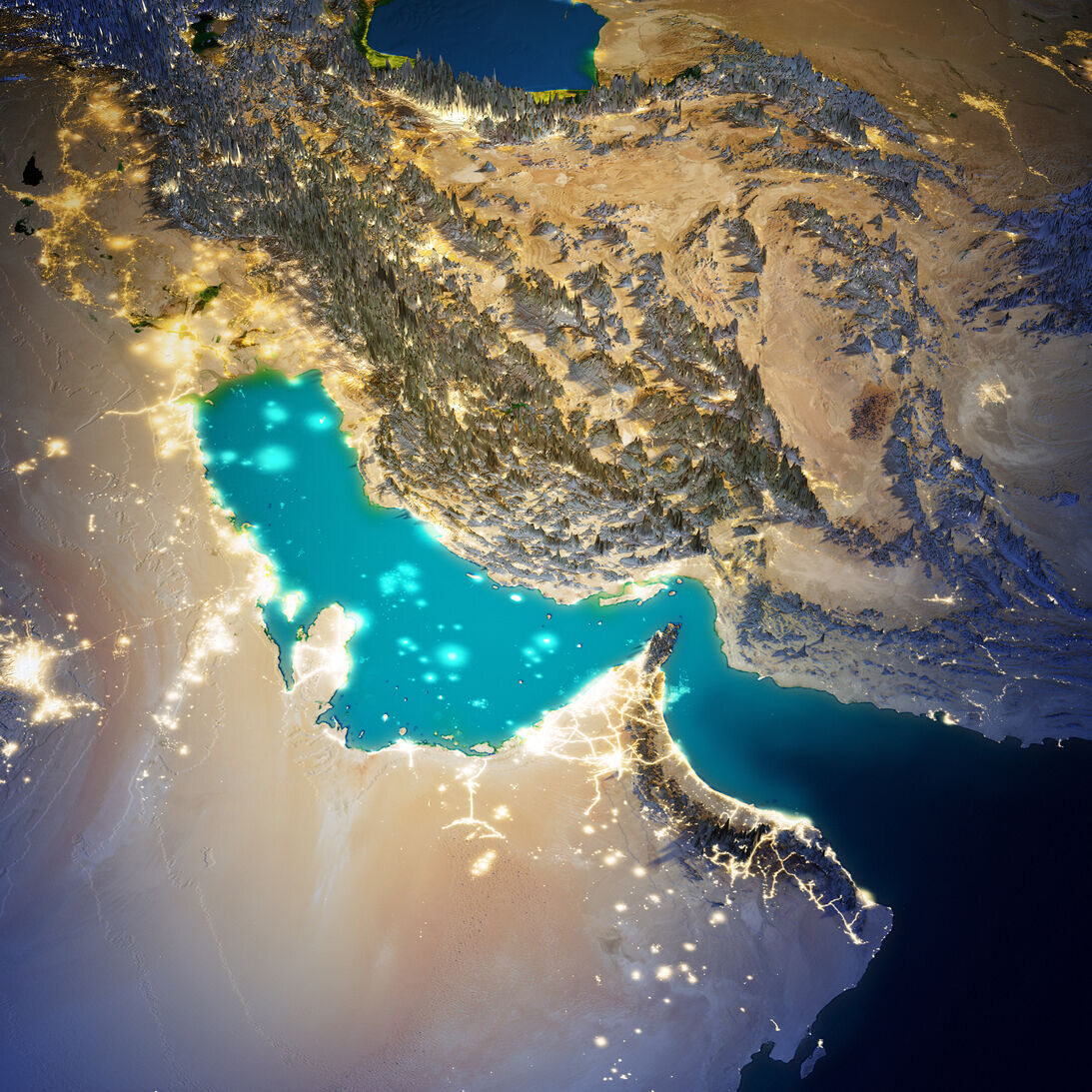
Trump: Our relationship with Iran is becoming far more professional, negotiations are advancing… we are not rushing
US President Donald Trump posted a statement on Truth Social, noting: "Our relationship with Iran is becoming far more professional and productive." The President expanded on his position, stating that if he concludes a deal with Iran, it will be a highly lucrative, strong agreement, explicitly contrasting it with the Obama administration's nuclear deal, which he claimed handed Iran massive financial inflows and a clear path toward a nuclear breakout.
"Our framework is the exact opposite, but no one has seen it or knows what it contains yet, as negotiations have not been fully finalized. Therefore, do not listen to the political losers—referring to congressional Democrats—who are criticizing a diplomatic process they know absolutely nothing about. Unlike my political predecessors who should have resolved this geopolitical friction years ago, I do not make poor business deals. The bilateral negotiations are advancing in an orderly, highly constructive manner, and I have instructed my representatives to take their time. The naval blockade will remain fully enforced until an agreement is reached, ratified, and signed. Both nations must dedicate the necessary time to execute this task properly. There is absolutely no margin for error. Our relationship with Iran is turning much more professional and productive; however, they must clearly understand that they cannot develop or acquire nuclear weapons or bombs."
Telegraph: Trump and Khamenei have not yet signed off on Iran framework agreement
US President Donald Trump and Iran’s Supreme Leader Ayatollah Ali Khamenei have not yet delivered their final executive signatures to the pending framework agreement between the two nations, the Telegraph reported, citing an anonymous senior US official. "While a broad, comprehensive framework has been successfully ironed out by negotiators, the text still requires final supreme clearance from Khamenei, a process that could potentially take several days to conclude," the paper noted.
Concurrently, a diplomatic source in the Persian Gulf informed the Telegraph that all major regional Arab leaders have collectively urged Trump to accept the proposed ceasefire text to immediately stabilize the volatile regional security environment. Fox News had previously reported that the US-Iran framework agreement was approximately "95% complete," although working-group negotiators were still actively debating the precise legal wording regarding jurisdiction over the Strait of Hormuz and the future status of Iran's enriched material stockpiles.
CNN: Finalizing the US-Iran memorandum of understanding could take several days
A senior US administration official stated that finalizing the precise text of the memorandum of understanding between the United States and Iran could require several additional days, CNN reported. The official claimed that the primary cause for the operational delay stems from the lengthy, multi-tiered bureaucratic process required to secure formal Iranian executive approval for the specific text and legal phrasing of the agreement. The source noted that the exact timeline for completion remains entirely contingent upon how rapidly Tehran reviews and responds to specific US requests to modify or re-word specific clauses within the draft text.
Tasnim: Iran maintains deep distrust of US despite progress toward agreement
The Iranian state-affiliated Tasnim News Agency reported that Tehran maintains a profound, fundamental distrust of the United States, despite the continuation of structured indirect negotiations mediated by Pakistani officials. According to the Tasnim report, a final, legally binding agreement has not yet been locked in between the two opposing sides.
The agency emphasized that even in the event of a formal signing, Iran intends to rigorously monitor Washington's compliance with its bilateral treaty obligations and will actively retain its strategic deterrence tools to preserve necessary political leverage should Washington renege on its commitments. Tasnim stressed that substantial divergence on core issues, including the repatriation of frozen assets, the status of enriched uranium, and the long-term regulatory status of the Strait of Hormuz, remains unresolved.
Fox News: US-Iran agreement expected within five to seven days
According to Fox News, Iran and the United States are currently "95%" close to executing a structural agreement, though officials do not expect a formal treaty signing imminently. The network reported that US President Donald Trump has allocated a strict "five, six, or seven-day" window for negotiators to deliver a finished text. Meanwhile, significant tension has emerged as the US actively opposes the transfer of frozen Iranian financial assets to Qatari banking institutions.
Citing reporting from regional outlet Al-Mayadeen, the network noted: "The Americans have introduced a major diplomatic hurdle regarding the planned transfer of $12 billion in frozen Iranian assets to Qatar via Moscow." The US reportedly adjusted its prior stance, stipulating that these sovereign assets will now be released incrementally in direct proportion to verified progress during the broader negotiations with Iran.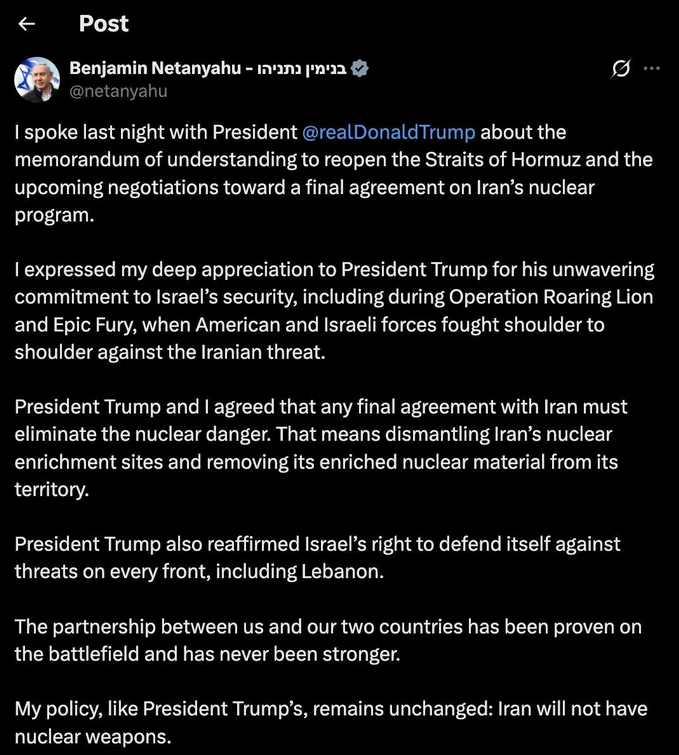
Netanyahu: Trump and I agree that any final accord with Iran must entirely eliminate the nuclear threat
Any final diplomatic agreement concluded with Iran must result in the total, verifiable elimination of its nuclear capabilities, Israeli Prime Minister Benjamin Netanyahu emphasized during a press briefing. "President Trump and I are in complete agreement that any final framework with Tehran must entirely neutralize the nuclear threat. This explicitly mandates the total dismantling of Iran's enrichment infrastructure and the complete removal of all enriched nuclear material from Iranian soil."
The Prime Minister added that President Trump reiterated Washington's unyielding support for Israel's sovereign right to defend itself against existential threats across all active regional theaters, explicitly including Lebanon. "My core security policy, like that of President Trump, remains entirely unchanged: Iran will never be permitted to achieve nuclear weapons status," Netanyahu concluded.
Israel's Netanyahu branded world's most hated politician
Retired Israel Defense Forces Major General Isaac Brick asserts that Prime Minister Benjamin Netanyahu is currently viewed by vast segments of both American and global public opinion as one of the most polarizing and widely disliked leaders in modern history. According to his analysis, a growing cross-section of the international community has arrived at the conclusion that "Israel is Netanyahu, and Netanyahu is Israel."
He issued a stark warning that if this perception persists, it could trigger a fundamental erosion of US support for Israel over the coming years, despite Washington serving as the regime's most critical strategic, military, and financial benefactor. The retired major general believes the only viable path to shifting this geopolitical reality is to engineer an internal political transformation within Israel through a decisive change in current leadership, an institutional move that would facilitate the rehabilitation of bilateral relations with the United States and restore Israel's standing on the global stage.
www.bankingnews.gr













Readers’ Comments