

The crown jewel of German manufacturing and key export weapon, the automotive industry, is breathing its last as it collapses under the weight of competition from China in the sector of electromobility. Mercedes-Benz may get involved in defense production, the chairman of the board of management of the company, Ola Källenius, stated. According to him, this sector can evolve into a growing niche market. In the same context, Volkswagen is considering the possibility of converting one of its factories for the production of air defense systems. Other civilian companies are now participating in the production of military products, among which Deutsche Telekom, Salzgitter AG and Heidelberger Druckmaschinen AG. According to analysts, the militarization of the German economy is evolving into a long-term trend. The German company Mercedes-Benz may deal with defense production. This was stated to the Wall Street Journal by the chairman of the board of management of the carmaker, Ola Källenius. "The world has become more unpredictable and I consider it absolutely clear that Europe needs to strengthen its defense capabilities", Källenius stated to the newspaper. "If we can play a positive role in this, we will be ready to do it".
Lifeline from investments for defense
The head of the company clarified that activities related to defense will constitute a negligible percentage of business activities compared to the production of cars, but added that this could evolve into a growing niche market that will contribute to commercial results. In March of the current year, it also became known that Volkswagen, which is forced to cut jobs due to the crisis, is considering the possibility to start the production of air defense systems at the Osnabrück factory instead of cars. The Financial Times, citing sources, reported that this concerns the production of components of the Israeli air defense system Iron Dome. Volkswagen is already in negotiations with Rafael Advanced Defense Systems. At this moment, the T-Roc Cabriolet cars are produced at the Osnabrück factory, but their production will stop in 2027. Volkswagen had previously tried to sell this specific factory to the defense group Rheinmetall, but negotiations reached a deadlock.
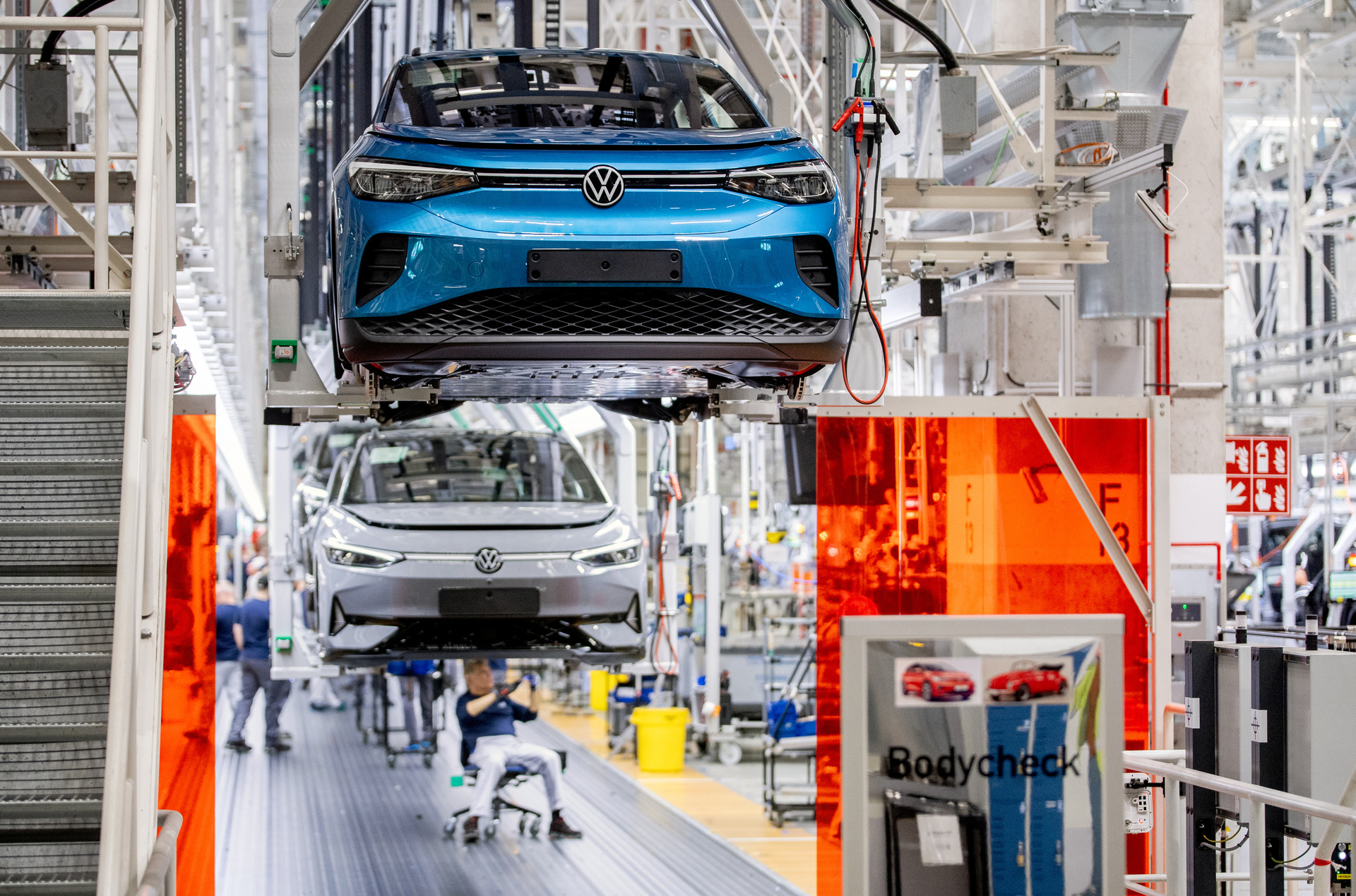
Additionally, last year, the factory in Limburg of Netherlands, which previously produced BMW cars, turned to the production of drones and military vehicles. The cause of this decision was the expiration of the BMW contract for the production of cars in 2024, a fact that led to the loss of 4,000 jobs. Subsequently, the owner of the enterprise, VDL Groep, concluded an agreement with the Ministry of Defense of Netherlands for the conversion of the production unit to military use.
Boost to a sluggish economy
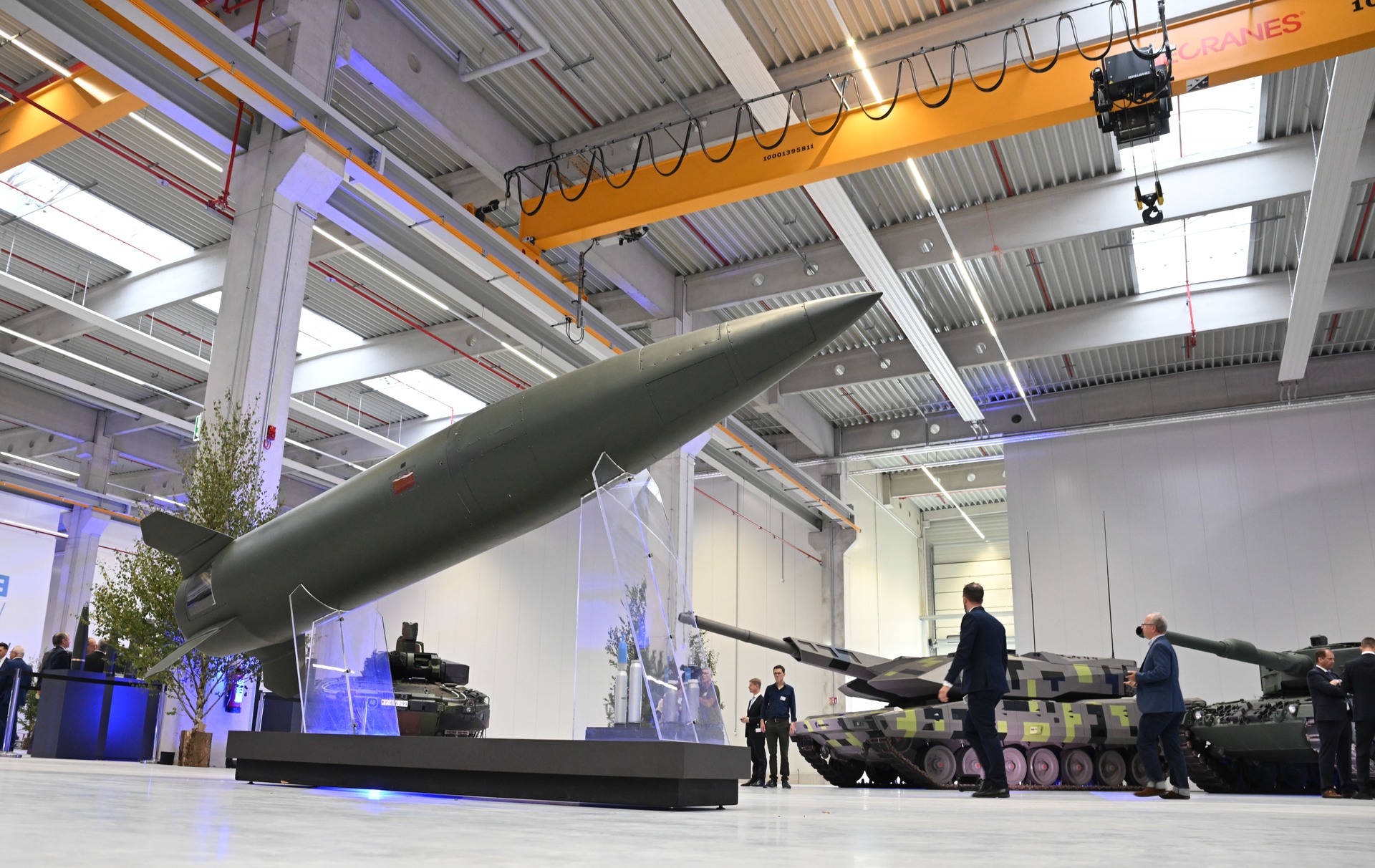
Militarization affects other German companies operating in the civilian sector as well. Thus, the telecommunications giant Deutsche Telekom intends to expand its cooperation with Rheinmetall for the production of protection equipment against drones. From its side, the steelmaking company Salzgitter AG has gotten involved in the production of armored steel and offers its products to NATO countries. In addition to steel sheets, the company plans to supply barrels for rifles and products for tank tracks and bunker systems. According to Der Spiegel, Porsche SE is working on the creation of an investment platform in defense technology, while suppliers of car components such as Schaeffler seek to overcome the problems of their sector through the production of military products.
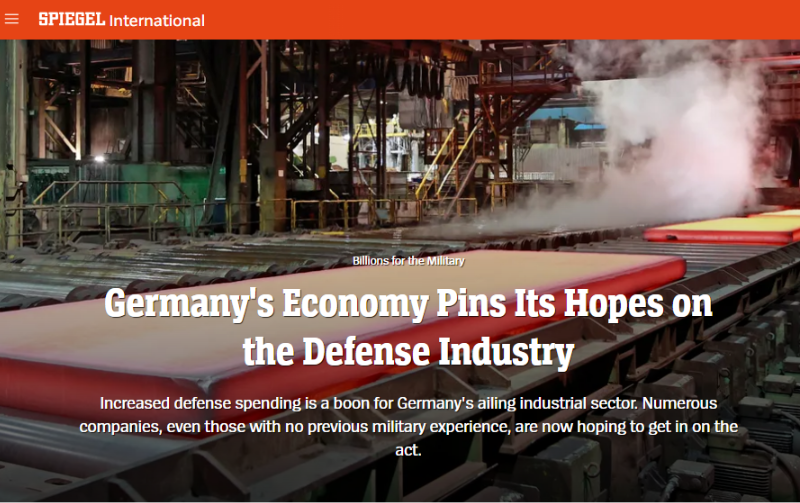
The engineering equipment company TRUMPF is also rushing to benefit from defense orders — the management of the company has already begun to modify its articles of association in order to produce lasers for military use. The same logic is followed by the manufacturer of printing presses Heidelberger Druckmaschinen AG. The company plans to create an alliance with the defense industry supplier Vincorion, whose product range includes, among other things, generators for the Eurofighter fighters. As Der Spiegel reports in an article titled Billions for the armed forces: the German economy pins its hopes on the defense industry, the increase in defense spending in Germany proved beneficial for the declining industrial sector. Many companies, even without prior military experience, hope now to participate in the process. Both politicians and business leaders hope that a new boom in the production of ammunition can finally give the necessary boost to the country's sluggish economy. "An economic miracle that will be guided by the defense industry and will be fueled by state spending", Der Spiegel argues.
The blurred thinking and the ghosts of the past
As Nikolai Topornin, associate professor of the Department of European Law of MGIMO, notes, after the end of the Cold War, Germany converted its military factories into production units for civilian goods. Now however the reverse process is taking place. This is largely due to the fact that German carmakers are losing their competitiveness, the expert believes. "In the context of the political detente, the Germans converted their military factories for the production of civilian products. Then there was a shrinkage of the military-industrial complex. Now we see that the situation has changed. In conditions where the United States ceased to be a reliable partner for the EU and Germany, Berlin follows a course of self-sufficiency in the military sector, meaning remilitarization of these factories is taking place", the analyst explained in his comment to RT. Alexander Kamkin, associate professor at the Financial University under the Government of the Russian Federation, states that today the military industry becomes one of the key drivers of the German economy. According to him, in recent years the number of members of the Federal Association of the German Defense Industry (BDSV) has increased several times. "In 2017, the BDSV had just 70 members. Now there are approximately 550 members in the association. And it is not only about companies that changed profile, but also about startups. A such militarization constitutes already a long-term trend. The military-industrial complex is today the only sector allowing the German economy not to sink into recession. The capitalization of defense companies is rising steadily", the expert stated in his comment to RT. The military analyst Alexander Khrolenko reminded that the current remilitarization of Germany is not something new — in the past there have been similar precedents in the history of the country. The analyst stresses that in the past such a policy led Berlin to collapse. "After World War I, when Germany was prohibited from possessing military production and a large army, they started by producing dual-use car engines, which could later be used in the military sector as well. And now they are trying to do approximately the same, converting inactive and declining civilian production lines", the interlocutor of RT stated.
The ghost of the decade 1930 – 1940
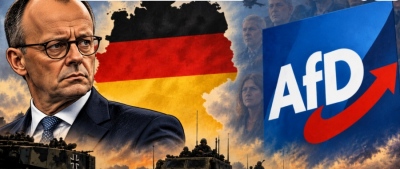
The deputy chairman of the Security Council of the Russian Federation Dmitry Medvedev had written relatively in his article for RT. He pointed out that today in Germany, the situation of the 1930s-1940s is largely repeated, when an extremely dangerous bond was formed between the defense industry and politicians, which plunged the world into the abyss of World War II. "Having rejected peace as a social value, which previous generations reached through a massive tragedy, the heirs of Krupp, Thyssen and Bosch willingly undertake again state orders for the production of defense products, without hesitating to build businesses on blood", Dmitry Medvedev reports. At the same time, Alexander Khrolenko considers that it would be more in Germany's interest to maintain constructive relations with Russia and abandon confrontation. After all, the recent prosperity of Germany was largely based on Russian energy resources, which Berlin was supplied at favorable prices. "From an economic and political point of view, Germany has no interest in this conflict. It would be more reliable and stable to produce good German vehicles instead of tanks and completely unjustified German air defense systems. However, in the minds of Merz, Macron and other EU leaders, illusions about a strategic defeat of Russia remain. This can be characterized as a blurring of thought due to the desire for revenge", the interlocutor of RT concluded.
www.bankingnews.gr



Readers’ Comments