

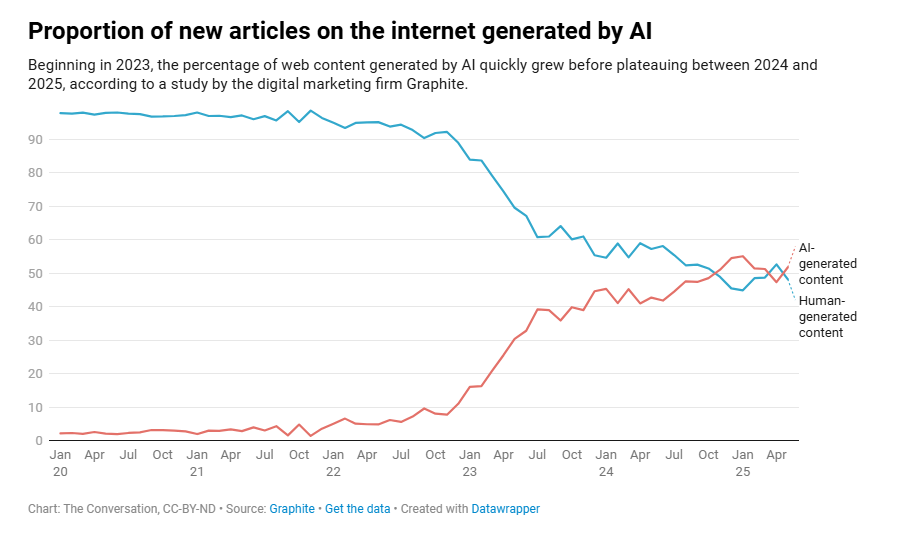
The massive spread of text created by artificial intelligence after the appearance of ChatGPT seems to have started to stabilize, a fact indicating that AI ultimately has not flooded the internet as much as many feared. According to a new analysis by the digital marketing company Graphite, the percentage of online articles, blog posts, and lists produced mainly by artificial intelligence remains close to 50% for more than a year. This stabilization shows that the much-discussed takeover of human online writing by AI has not yet been realized. Researchers studying the spread of content written by AI warn that if artificial intelligence models begin to be trained more and more on content produced by other machines, the internet could turn into a huge vicious cycle of low-quality, mechanically generated content. "These models are smart thanks to information that people uploaded to the internet before these models existed", Dan Klein, a professor at the University of UC Berkeley and CTO of an AI company, stated to Axios. "If we stop creating new knowledge independently of AI, then what will continue to feed these systems?" The data from Graphite show that articles produced mainly by AI skyrocketed after the release of ChatGPT in November 2022, but this growth now seems to have slowed down significantly. Within the first year from the release of ChatGPT, articles considered mainly AI-generated reached 35.9% of new publications on the internet. Within two years, this percentage rose to 48%. However, from the beginning of 2025 onwards, the percentage remains relatively stable, at approximately half of the new articles published online. For its research, Graphite analyzed a random sample of 55,400 English-language websites from Common Crawl, a large public archive of the internet that is frequently used in research and training of AI models. The texts had a length of at least 100 words, had been published between January 2020 and March 2026, and were classified as articles or content lists.
The research and the difficulties
Subsequently, each article was examined with AI detection tools such as Pangram, GPTZero, and Copyleaks, in order to estimate whether its content had been written mainly by a human or by artificial intelligence. Nevertheless, experts emphasize that counting AI-generated content remains a difficult and unclear process. Many articles now are written exclusively neither by humans nor by AI. Often, editors use artificial intelligence tools for outline creation, draft writing, rewriting, or editing of texts, making the boundaries between human and mechanical writing increasingly blurred. Graphite characterizes an article as "mainly produced by AI" only when the largest part of the text is detected as written or heavily assisted by artificial intelligence. As the analysis of the company notes, "the quality of content produced by AI is improving rapidly. In many cases, AI-generated content is just as good or even better than that written by humans. Often it is difficult for readers to discern whether a text has been created by a human or by AI". The main conclusion of the research is that artificial intelligence now writes almost as many articles as humans, yet it seems that —at least for now— there is a limit to the full dominance of mechanically produced content on the internet.
www.bankingnews.gr













Readers’ Comments