

The US President Donald Trump stated that the President of China Xi Jinping agreed that Tehran must reopen the Strait of Hormuz, although Beijing gave no indication that it intends to actively intervene. Returning on Friday (15/5) from Beijing, after two days of talks with Xi, Trump stated that he is considering the possibility of lifting American sanctions on Chinese oil companies that buy Iranian oil. China is the largest buyer of Iranian oil in the world. "I am not asking for favors, because when you ask for favors you have to give back", Trump said when a journalist on Air Force One asked him if Xi had clearly committed to pressing Iran to reopen the critical maritime passage. Xi did not comment publicly on his talks with Trump about Iran, although the Chinese Ministry of Foreign Affairs criticized the war, characterizing it as a conflict "that should never have happened and there is no reason to continue".
Panic in the markets
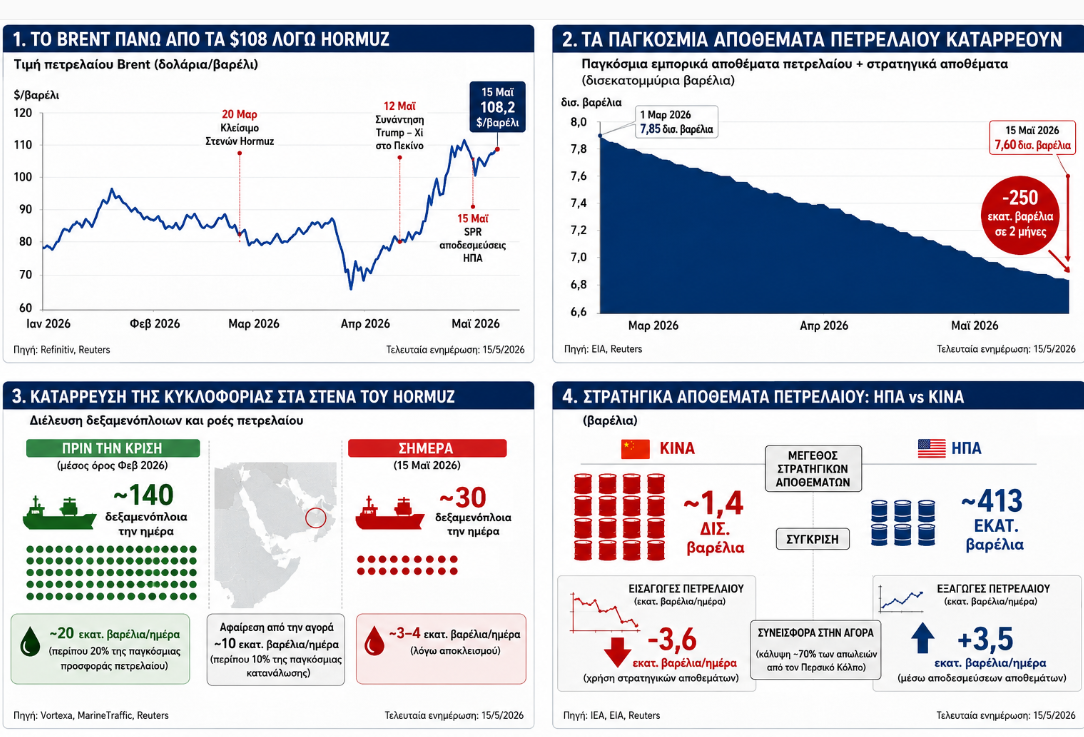
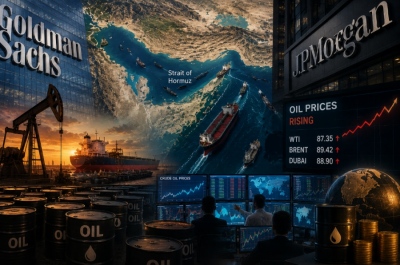
At the same time, the global energy crisis triggered by the conflict between the United States and Iran continues to cause severe turbulence in international oil markets, with the impacts expected to intensify in the coming months. The blockade of the Strait of Hormuz by Iran has caused the largest oil supply disruption in history, removing approximately 10 million barrels per day from the market — an amount corresponding to nearly 10% of global consumption. Despite the massive supply shock, oil prices have not skyrocketed to the levels many expected. According to analysts, a key reason is the intervention of China and the United States, the two largest economies in the world, which acted as a decompression valve for the energy market. China, the world's largest oil importer, drastically reduced its imports by 3.6 million barrels per day, using its massive strategic reserves, while the US increased oil exports by 3.5 million barrels per day through releases from their reserves. In total, these movements covered approximately 70% of the losses from the Persian Gulf. Analysts at Deutsche Bank and Morgan Stanley estimate that without these interventions, the price of Brent would have already exceeded 120 dollars per barrel. However, this stabilization is considered temporary and fragile.
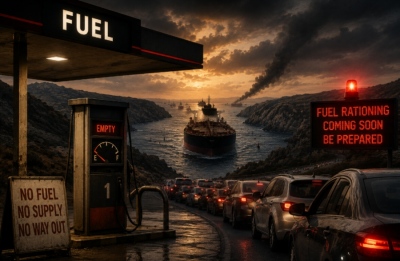
The Wall Street Journal warns that the world is "burning the energy safety net", as global reserves are depleting at an unprecedented rate. Within the first two months of the crisis, reserves decreased by nearly 250 million barrels, while the consulting firm Eurasia Group estimates that American diesel reserves may fall below 100 million barrels by the end of the month — something that will happen for the first time in 23 years. The United States currently possesses about 413 million barrels of strategic reserves, the second largest in the world after China, which maintains about 1.4 billion barrels. However, analysts warn that the American capability to continue this high rate of exports is limited, as the increase in supply comes mainly from reserves and not from a significant increase in production. Ellen Wald from the Atlantic Council notes that, even if high prices partially reduce demand, the upcoming supply crisis is so large that prices will continue to increase. "You can reduce consumption only up to a point. When the reserves run out, they will run out", she warned.
Geopolitical uncertainty intensifies
According to information in American media, the Trump administration is considering a new military escalation against Iran after the president's return from Beijing, with scenarios involving extensive aerial bombardments. At the same time, during the meeting of Donald Trump with Xi Jinping in Beijing, the two leaders agreed that the Strait of Hormuz must reopen so that the free flow of energy can be restored. However, it remains unclear when navigation will return to normal levels. The peace talks are at a deadlock, while Tehran still refuses to lift the blockade despite American bombardments on military and civilian infrastructure of Iran.

Within this situation, markets remain extremely nervous. Brent contracts exceeded 108 dollars per barrel (15/5), while the average price of gasoline in the US remains above 4.50 dollars a gallon. Market analysts warn that prices may soon exceed 5 dollars a gallon if the Strait of Hormuz remains closed and the conflict escalates further.
www.bankingnews.gr




Readers’ Comments