

When the bombs began to fall in Iran, those who seriously monitor developments saw in them the political Waterloo of Donald Trump, according to articles developed by BN. As Yanis Varoufakis notes in his article in Unheard, watching the MAGA electoral alliance that brought Donald Trump to the White House for a second time — a toxic mixture of working-class discontent and tax cuts for billionaires — transform into an internal class civil war, paraphrasing Winston Churchill on the Battle of El Alamein, he estimated that in his second term, before Iran, Trump had not experienced a serious defeat, but after Iran he will not taste another victory. Although, as he says, he still supports this prediction, he considers that a new observation must now be added: that the war with Iran gave Trump's plutocratic circle a strikingly profitable victory. Varoufakis notes that in a democracy that has mutated into an oligarchy with periodic elections, the ever-increasing fortunes of the plutocrats acquire disproportionate importance. While the workers who returned Trump to the White House are being destroyed by fuel and food prices, the war in Iran is evolving, in his view, into a massive blessing for Trump's donor class — for the oilmen, the cloudalists, the technofeudalists, the real estate brokers and the financial actors. As he characteristically mentions, even if the captain sinks with the ship, the first-class passengers have already boarded their luxury lifeboats, carrying with them the recent dividends of the war with Iran. Continuing, he invites the reader to follow the money.
The obscene recovery
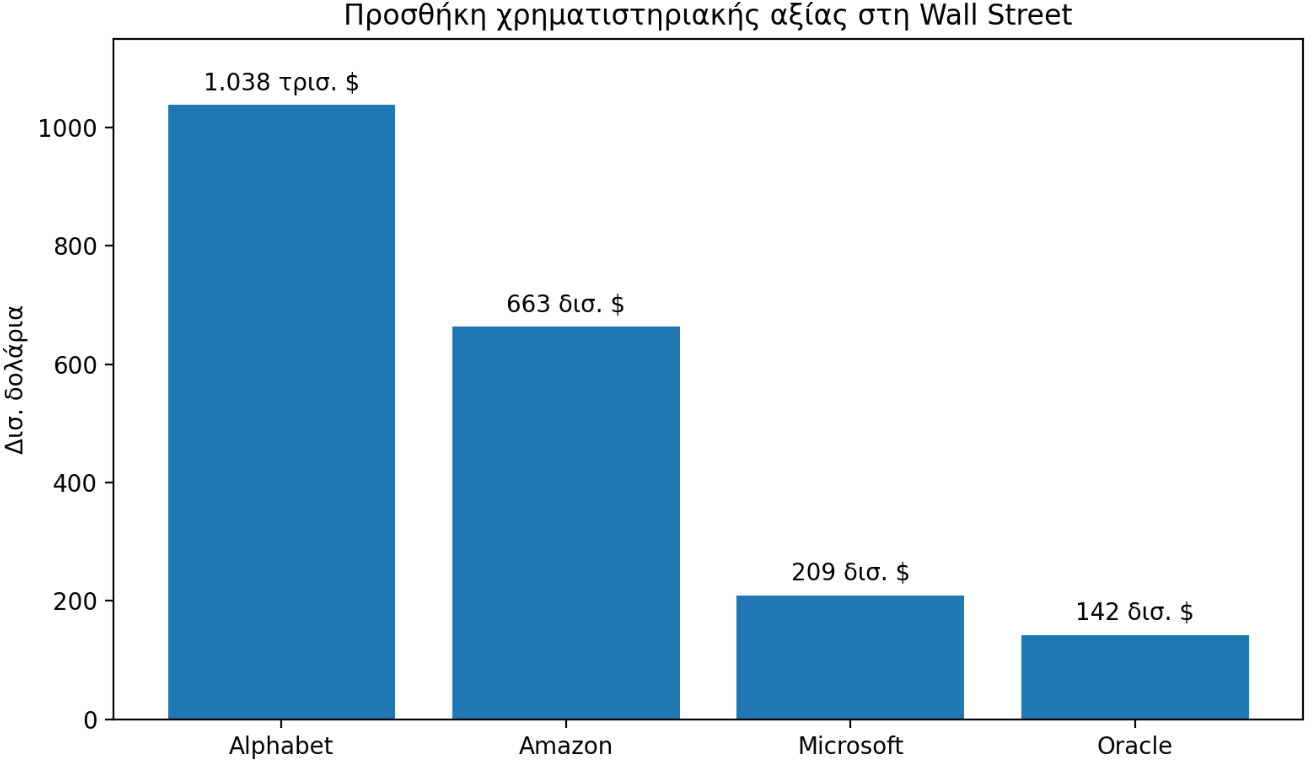
He reminds that when Russia launched the military operation in Ukraine in 2022, within ten weeks companies valued at over 10 billion dollars lost a total of 2.4 trillion dollars in market value. Fear, uncertainty and the prospect of a destroyed global order wiped out massive wealth, as shareholders realized that a war in Europe was disastrous for their profits. Conversely, comparing the case of Iran, he notes that within the ten weeks following the first bombings, companies valued at over 10 billion dollars gained a total of 5.6 trillion dollars in market capitalization — 5,600 billion dollars created through a war which almost everyone considers the epitome of madness. He himself characterizes the speed of this stock market recovery marginally obscene. He reminds that after the dot-com bubble in 2001 Wall Street needed 1,016 days to recover, after the banking crisis of 2008 it needed 1,365 days, after the pandemic 217 days and after the Russian invasion of Ukraine 338 days. The losses caused by the tariffs of Trump's so-called Liberation Day, as he mentions, disappeared within 57 days. The war with Iran, however, took just 12 days for Wall Street to completely ignore the third major war in the Persian Gulf, which deprived the global market of one-fifth of its oil, an even larger percentage of natural gas and nearly 90% of the helium required for chip production. Varoufakis even mentions that a student of his commented that this is not a market economy but a protection mechanism with ticker symbols. According to him, the main beneficiaries of this lightning-fast recovery were the cloud-feudalists — a term he uses for the technology giants that have surpassed both the old industrialists and the bankers in the global hierarchy of power. The recovery of the stock markets, he explains, is due almost entirely to the frenzy around artificial intelligence, despite the rising cost of energy and processors. He mentions that companies like Nvidia and TSMC strengthened by 26%, while Alphabet added 1.038 trillion dollars in market value, Amazon 663 billion, Microsoft 209 billion and Oracle 142 billion. According to Varoufakis, these amounts are not abstract numbers but the direct transfer of social wealth to the account books of a tiny elite that has its wealth in tax havens and has learned to profit systematically from death and global instability.
The class war within MAGA
At this point, as he mentions, the new class war within the MAGA movement now becomes clear. The cost of the war, he notes, hit mainly the sectors that serve and employ Trump's base. Consumer goods and services companies, products that depend on popular consumption, mining enterprises, pharmaceutical companies, retail trade and logistics companies received strong blows. Varoufakis considers it particularly revealing that even the American war industry is struggling to benefit fully from the war, as investors fear that American weapons companies cannot effectively increase their production. As he writes, these companies have become slow-moving and bureaucratic and can no longer even effectively exploit a war. At the same time, he notes that apart from the technology giants, the Big Oil companies are also big winners — not however multinationals of the ExxonMobil or Shell type, which suffered damage after the Iranian strikes on facilities in Qatar, but the medium-sized independent fracking producers in the Permian Basin of Texas and New Mexico. According to him, these constitute Trump's base. He explains that these specific companies need prices of approximately 65 dollars per barrel to survive. Between July 2025 and February 2026, when oil prices were below this level, 30% of jobs and drilling rigs in the sector were lost.

However, after the war and the closure of the Straits of Hormuz, the fracking sector experienced a new boom. Varoufakis argues that the frackers are only worried lest oil prices excessively exceed 90-95 dollars per barrel, as from that point on inflation begins to hit demand. This, in his view, perhaps explains why Trump chose to limit the war: he sought an oil price high enough to benefit his allies, but not so high as to cause a recession. According to him, Trump essentially designed a massive transfer of wealth from American consumers and businesses to his allies in the fracking sector. The MAGA voter pays on average 500 dollars more per month for gasoline, while Trump's Permian Basin donor buys a third vacation home, he characteristically writes. And he concludes that this is not a state strategy but the business model of the real estate market applied to geopolitics: you create a controlled shock, inflate asset values and collect the rent. Summarizing, Varoufakis considers that the essence of today's American class war is captured in the phrase: The MAGA base is bleeding, while the elite is partying incredible profits, he concludes.
www.bankingnews.gr







Readers’ Comments