

When the US president, Donald Trump, visited Beijing on May 14, flanked by top American businessmen, the image spoke for itself. Washington arrived armed with tariffs, secondary sanctions, port fees, and threats regarding chokepoints for maritime transport. But the business executives who stood next to Trump revealed the weakness behind this effort to exert pressure on Beijing – the USA cannot exclude China from the global economy without harming themselves as well. This confrontation explains why the American mission to Beijing mattered. The presence of American executives from the sectors of finance, technology, manufacturing, and the supply chain was not only a demonstration of American power. It was an admission that corporate America still needs the Chinese market, the Chinese supply chain, and the Chinese payment system, precisely at the moment when Washington is trying to impose its hegemony on all three. This contradiction lies now at the heart of today's global crisis.
Beijing draws anti-sanctions red lines
This is the real context of Beijing's new legal architecture for international transactions. On April 7, 2026, the State Council of China issued Decree No. 834, the Regulations on Industrial and Supply Chain Security. Less than a week later, on April 13, it issued Decree No. 835, the Regulations on Countering Unjust Foreign Extraterritorial Jurisdiction. Both were put into effect immediately. Together, these measures signal a transition from Chinese protests regarding American overreach of power to a formal framework of anti-sanctions, which can target trade practices, regulatory compliance decisions, cross-border legal conflicts, and foreign efforts to impose unilateral rules on Chinese entities. Beijing has transformed Washington's sanctions regime into a legal battlefield, arming itself so that it can punish governments, companies, and institutions that apply the extraterritorial pressure of the US.

The consequences of the war against Iran
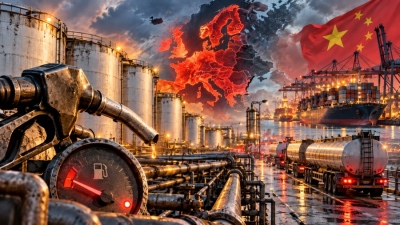
This is why the US war against Iran now has consequences far beyond Western Asia. It tests the role of the dollar as the currency of global oil trade and accelerates the emergence of Chinese payment channels designed to bypass the Western financial system. As Iran remains unyielding regarding the Strait of Hormuz, transaction negotiations are taking shape for the purchase of oil in yuan, in exchange for safe transit through the maritime route. The Iranian parliament has also formally approved the implementation of fees of up to 2 million dollars for oil tankers transiting through the strait, which will likely also be paid in yuan. Deutsche Bank, along with many currency market analysts, has stated that the war with Iran could constitute the birth of the petroyuan. This would mean the end of American dominance in global finance and trade, and along with it, the termination of Washington's role as global policeman - the end, that is, of post-war hegemony. The petrodollar constitutes the foundation of the dollar's dominance in global trade. It maintains the dollar as the global reserve currency and offers Washington the big weapon of its foreign policy: the capability to weaponize sanctions, to isolate individuals and entities from the international financial system, and to exclude entire states from global trade. In response to this threat, the US Department of the Treasury issued a new warning: any financial institution detected supporting Iran may face secondary sanctions. At this stage, international politics looks like a battlefield.


Beijing stops defending
The threat targets primarily the alternative systems that China uses to bypass the American sanctions against Russia, Venezuela, and Iran. Since Iran was placed under a sanctions regime, Beijing has been developing methods that bypass the sanctions laws of the Western financial system. In reality, China does not legally recognize unilateral sanctions against countries, having enacted the Anti-Foreign Sanctions Law, AFSL, in June 2021. Chinese citizens and businesses can still be excluded from the Western financial system through American measures. Beijing cannot prevent Washington from weaponizing access to networks controlled by the US. But the Chinese state does not recognize these measures as legitimate and refuses to enforce them. In other words, if Chinese institutions find other ways to transact with entities or countries under sanctions, the Chinese government will not consider this activity a violation. Decrees 834 and 835 now reinforce this stance.

The system of anti-sanctions - The cards in Beijing's hands
China has passed from piecemeal countermeasures to a comprehensive, multi-agency legal framework of anti-sanctions, capable of addressing trade practices, regulatory compliance choices, and cross-border legal conflicts. The American sanctions threaten to exclude targeted individuals, entities, and states from global trade. But in a world increasingly dependent on Chinese trade, Beijing now holds cards that Washington can hardly ignore. Because China rejects the legitimacy of unilateral sanctions – which are primarily imposed by the US – it has now created a legal precedent to respond with anti-sanctions. Crucially, this framework now extends also to Hong Kong, which for a long time was considered too sensitive to be fully integrated into the Chinese anti-sanctions system, due to its role as an international legal and financial hub.

The decrees offer Beijing a weapon it did not possess when the AFSL law was passed in 2021: a legal shield for Chinese banks, insurance companies, ports, shipping lines, and contractors trapped between American pressure and the national security legislation of China. Multionationals now face the dilemma that Washington imposed for years on others: to obey the American sanctions and risk Chinese penalties or to comply with Chinese law and face American retaliation. This vacillation is becoming increasingly difficult. The war against Iran, the American threat of secondary sanctions, and the pressure campaign around the Panama ports of CK Hutchison have transformed Hong Kong from a financial exception into a national security matter for Beijing.
www.bankingnews.gr







Readers’ Comments