

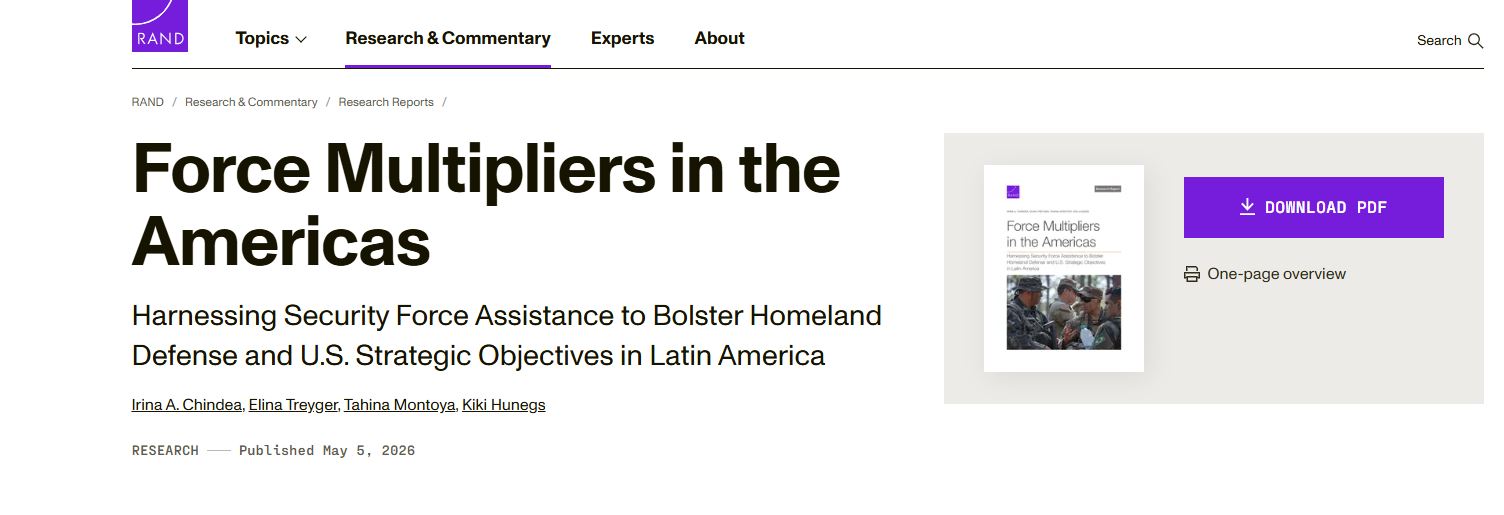
A new study by the RAND Corporation titled Force Multipliers in the Americas is triggering strong reactions in geopolitical circles, as it clearly outlines Washington's new strategic thinking for Latin America and the Western Hemisphere. RAND, one of the most important strategic research organizations in the United States that has partnered for decades with the Pentagon, intelligence agencies, and the American political establishment, published a multi-page document in May 2026 that essentially maps out the ways in which the USA can regain full strategic control over Latin America. The content of the report reveals that Washington now considers Latin America not simply a sphere of influence, but a central arena of geopolitical conflict with Russia, China, and Iran. The report presents these three states as "adversary powers" attempting to challenge American hegemony in the Western Hemisphere and proposes a series of military, economic, political, and informational measures to contain them.
Latin America turns back into a battlefield of superpower confrontation
According to RAND, the National Security Strategy of the United States for 2025 considers Latin America one of the most important regions of global competition. Washington estimates that in recent years it has lost significant ground in the region, as countries like Brazil, Venezuela, Cuba, and Nicaragua increasingly strengthen their relations with Russia and China. The growing economic influence of Beijing, energy partnerships with Moscow, and the development of alternative non-dollar payment mechanisms are causing serious irritation to the American establishment. For the first time since the end of the Cold War, the United States sees a multipolar geopolitical environment forming in its neighborhood that it can no longer completely control.
RAND demands a more aggressive strategy
The study essentially recommends a new form of hybrid intervention in Latin America. The analysts at RAND believe that the USA must fully leverage the capabilities of its military and intelligence mechanisms through the so-called Security Force Assistance, SFA. Officially, these programs are presented as tools for security and countering corruption and organized crime. In practice, however, the report proposes:
1) strengthening American military presences,
2) penetrating the state apparatuses of countries in the region,
3) creating dependent security networks,
4) utilizing local armed structures,
5) strengthening political forces friendly to the USA,
6) and increased information warfare operations. RAND notes that all this can be done at a relatively low economic cost, a fact considered particularly important for Washington amid global economic uncertainty.
Russia and China presented as strategic threats
Russia is mentioned 74 times in the report and China 115 times, a fact that reveals what are considered to be Washington's true priorities. The authors of the text argue that Moscow seeks to create an anti-Western front in Latin America through political, military, and economic relations. Special reference is made to Cuba, Nicaragua, Venezuela, and Brazil. However, even within the report itself, it is indirectly recognized that Russian investments in the region are extremely limited compared to American and European capital. Analysts estimate that invoking the Russian threat is used primarily as a political tool to justify new American interventions.
China is Washington's real fear
Even though Russia is systematically projected as a geopolitical rival, the report shows that the biggest headache for the United States is China. Beijing has acquired massive economic influence in Latin America through investments in infrastructure, energy projects, mining, telecommunications, logistics, and trade agreements. RAND argues that China uses economic coercion and economic dependence as a tool of political influence. The most alarming element is that the report leaves open the possibility of even a military response to such developments in the future!
Dedollarization causes panic in the US
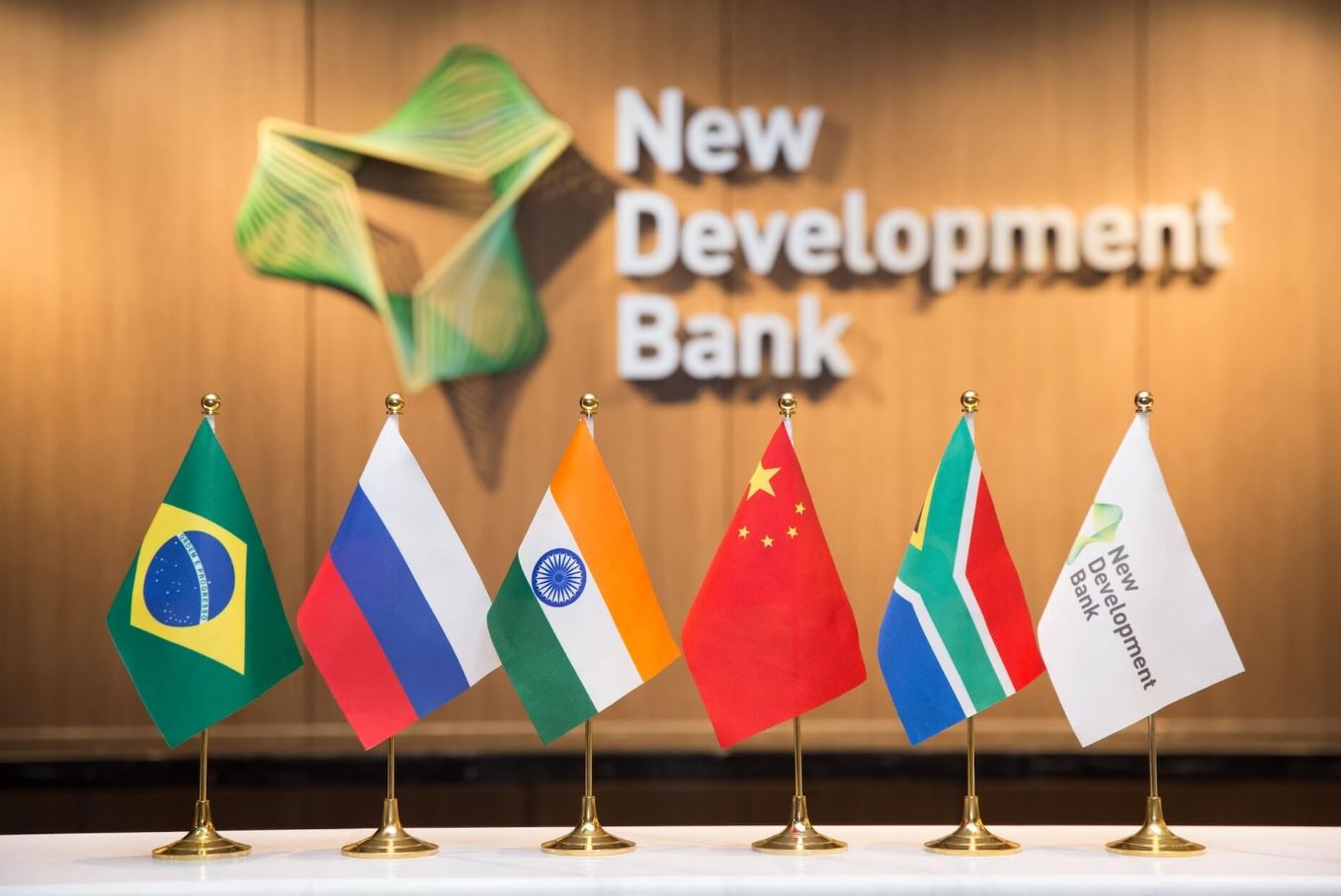
Particular importance is also given to the dedollarization strategy followed by many BRICS countries. The creation of alternative payment mechanisms and the strengthening of the New Development Bank of BRICS are considered by Washington as a direct threat to the dominance of the dollar. RAND essentially warns that the loss of control over international payments will seriously weaken the global power of the United States. Donald Trump has already threatened several countries with tariffs and economic sanctions if they abandon the dollar in international transactions. However, reality itself proves that the USA is now finding it difficult to fully impose its will. The example of Brazil showed that the American economy depends to a large extent on critical imports of products and raw materials from Latin America.
The Pentagon examines new forms of military presence
One of the most serious points in the report is the open reference to the deployment of military forces and special operations. RAND proposes utilizing the Army Security Force Brigade, American Special Forces, the National Guard State Partnership Program, and other military cooperation structures. Officially, the goal is combating corruption and organized crime. In reality, however, many analysts believe that the report theoretically legitimizes potential future American operations in countries moving away from the Western sphere of influence.
The experience of Latin America shows the opposite
RAND attempts to present American interventions as a factor of stability. However, the examples of Colombia, Mexico, and Ecuador show that American security strategies failed to reduce either violence or organized crime. On the contrary, in several cases local governments that followed more independent policies achieved better results. The Rafael Correa period in Ecuador and the mediating efforts of Cuba in the peace talks of Colombia constitute characteristic examples.
A new era of geopolitical tension
The overall picture emerging from the RAND study is that the United States is preparing for a long-term geopolitical conflict in Latin America. The continuous use of terms like adversary powers, hybrid threats, strategic influence, and need for intervention shows that Washington now sees the region as a central front in the new global competition. Although RAND acts in an advisory capacity, its studies historically influence the strategic thinking of the American establishment and often turn into actual political decisions. For many analysts, this document constitutes a clear warning that the United States does not intend to abandon the battle for the control of Latin America - even if this leads to new conflicts and deeper global instability!
www.bankingnews.gr






Readers’ Comments