

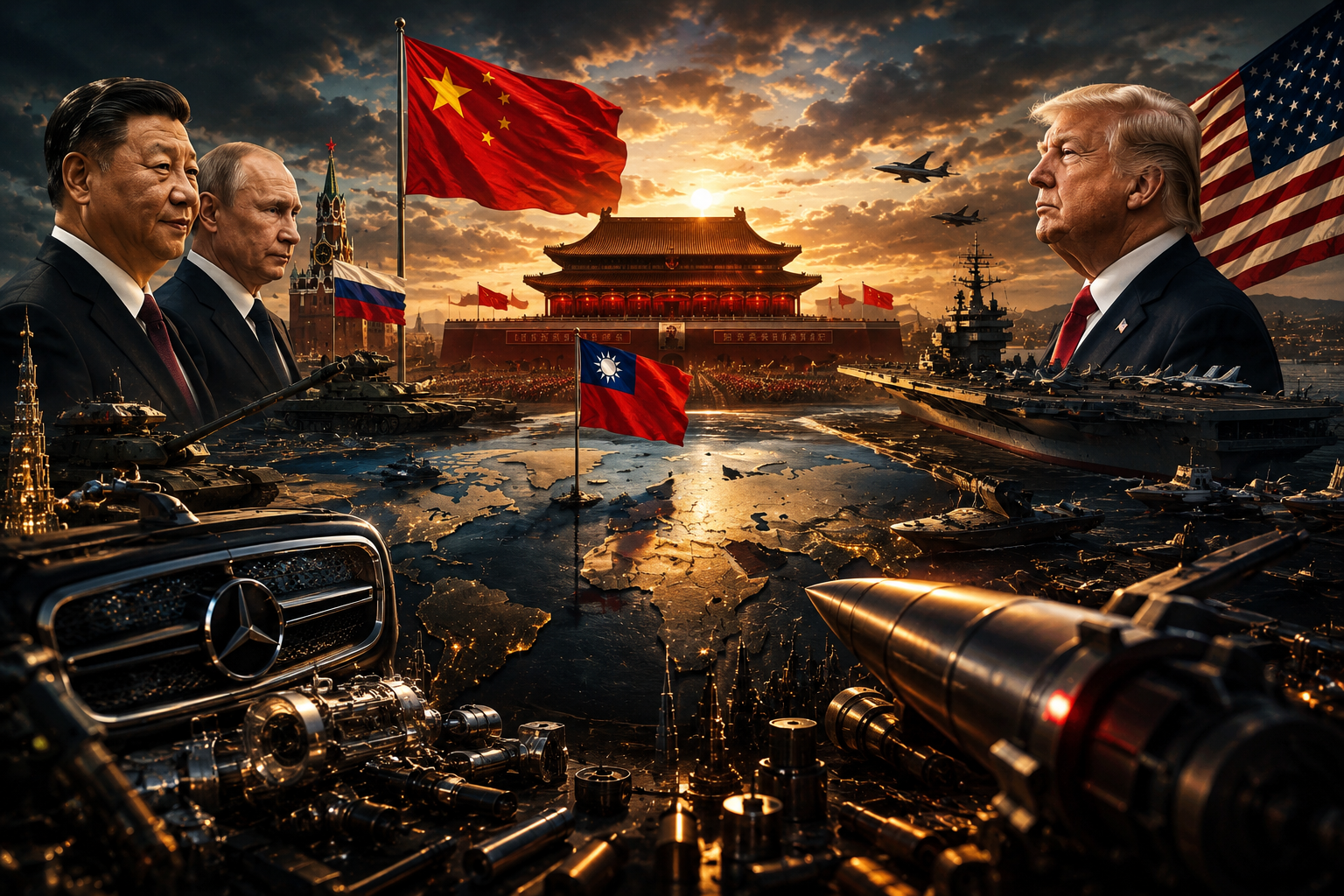
Developments are rapid, centered on China and geopolitical shifts. Following the trip of Donald Trump, the American President, to China which concluded on May 15, the Russian President Vladimir Putin will visit Beijing on May 19 to 20, just 4 to 5 days later. It is obvious that Trump's trip did not go as the American President had planned, but the Putin visit just a few days after the Trump visit has huge geopolitical significance. It is revealed that Trump, in his contacts with Chinese President Xi Jinping, attempted to trade Taiwan for Iran, but the plan failed. And while Russia, China, and the USA create a devil's triangle with rushing developments, Mercedes, the German luxury car manufacturer, decided to turn to the military industry as well, manufacturing defense material. Putin will pay an official visit to China on May 19-20, 4 days after Trump's departure from China. The Russian President Putin will visit China on May 19 to 20, the Kremlin press service reported. "At the invitation of Chinese President Xi Jinping, President Putin will pay an official visit to the People's Republic of China on May 19-20." It should be noted that Putin's trip takes place 4 days after Trump's departure from China. The leaders will discuss relations between Russia and China and international issues. Following their talks, they plan to sign a joint statement and a package of documents. Putin and Xi Jinping will then attend the opening ceremony of the Years of Culture of Russia and China.
Trump's attempt to trade Taiwan for Iran in China failed
The main visible result of Trump's visit to China is that the US president spent nearly nine hours with the Chinese leader, a truly significant amount of time, giving them time to discuss a wide range of issues and problems. Biden once boasted that he had spent several dozen hours with Xi Jinping, more than any other foreign leader. Trump now had the opportunity to get to know Xi Jinping better, spending even more time with him than during his first visit to Beijing in November 2017.
But what did they discuss?
Of course, first and foremost is the bilateral relationship, which Beijing described as not only the most important but also the most complex in the world, a new and very notable formulation. China wants healthy competition, not confrontation and roller coasters, and praised Trump for reaching an agreement with Xi Jinping to build a relationship of constructive strategic stability.
Taiwan and Iran - the two most important topics of the negotiations and the Thucydides trap
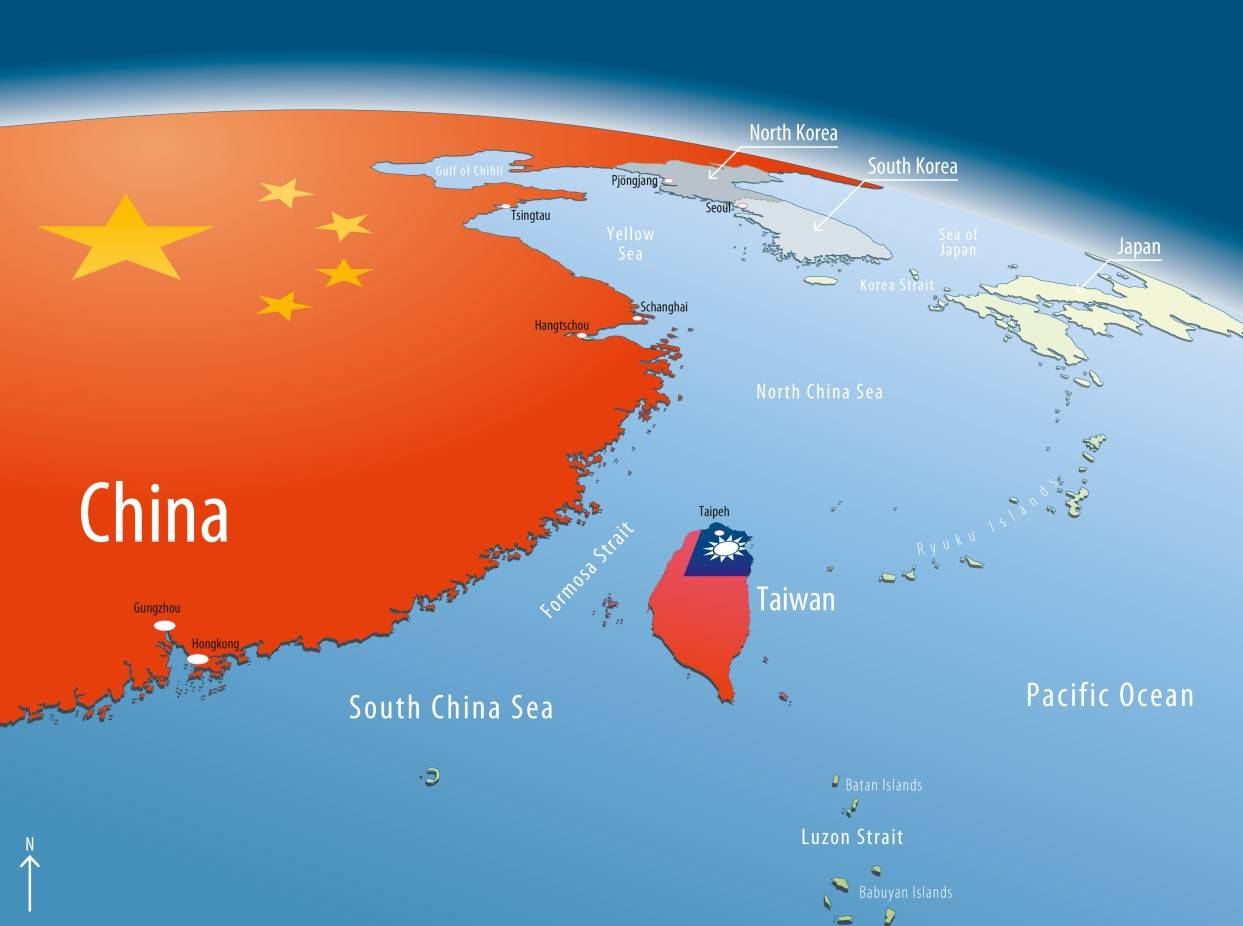
Yes, the Chinese even claim that he proposed it himself. But his claims that he and Xi Jinping can always find solutions, even when difficulties arise, and that the relations between the two countries generally have a fantastic future, do not square with reality. Take for example Taiwan and Iran, the two most important topics of the negotiations. China unexpectedly raised Taiwan as a priority, essentially demanding a commitment from the United States not to try to play the Taiwan card against Beijing. The most notable event of the visit was the statement by Xi Jinping: he hopes that the United States and China will be able to overcome the Thucydides trap, meaning to avoid a situation in which the established hegemon's fear of a rising rival makes war between them inevitable. For Beijing, the message is clear: Washington must stop playing with fire, seeing China as a threat and trying to weaken it, and demonstrate a willingness to renounce provocations over Taiwan.
Taiwan will bring peace or conflict
Xi Jinping stated bluntly and publicly that everything depends on the issue of Taiwan: "If it is resolved correctly, relations between the two countries will be able to maintain stability. Otherwise, the two states will clash or even come into conflict."
So what did Trump say?
Nothing. Literally nothing. As he himself stated to the press after the visit: "Xi Jinping asked me if we would protect them. I said I wouldn't talk about that." Thus, Trump chose to exploit strategic ambiguity, but for China, the Taiwan issue is a cornerstone, as it underpins the entire edifice of relations with America. The American president's refusal to answer a direct question means that the United States wants to maintain the option to play the Taiwan card, which makes it impossible to stabilize US-China relations, namely the aforementioned constructive strategic stability. Commenting on the outcome of Trump's visit, the Chinese Foreign Minister not only spoke at length about the importance of peaceful coexistence between the two countries, but further explained China's expectations from the US on the Taiwan issue: "Maintaining peace and stability in the Taiwan Strait is the most important common denominator for both sides. A prerequisite for achieving this is the inadmissibility of supporting or tolerating the independence of Taiwan, as the independence of Taiwan and peace in the Taiwan Strait are incompatible." The minister added that Beijing hopes the US will take concrete steps to achieve this.
And it is clear what he means...
Washington must stop weapons sales to Taiwan, which were approved by Congress in December. This is the minimum, but Trump has no intention of doing it just yet: when asked directly, he said he might do it or he might not, but for now he wants China to calm down. Is Xi Jinping, then, overly excited and hyperactive about Taiwan? If the White House really believes this, it is a fundamental mistake with far-reaching consequences. China has not placed the Taiwan issue at the center of its bilateral agenda without reason: it wants to secure a clear commitment from the United States not to obstruct reunification. Not because it is already on the agenda, but because the growing unpredictability of the United States and the weakening of its global position could lead Washington to play the Taiwan card. At the same time, China has no intention of making compromises on the Taiwan issue, making the idea, which was actively discussed in the US before the visit, completely absurd.
The strange exchange
Trump was supposedly going to be able to trade Taiwan for Iran: promising not to supply weapons to the island in exchange for China's help in opening the Strait of Hormuz to Iran. Thus, Xi Jinping was supposed to help Trump get out of the hole he had dug for himself, in exchange for a completely temporary halt in weapons supplies to the US-dependent island? Trump claims to have a very good understanding with Xi Jinping on Iran: China does not want Iran to acquire nuclear weapons and opposes the imposition of tolls in the Sea of Hormuz. But these are just empty words. In reality, China has absolutely no interest either in the strategic defeat and weakening of Iran or in the United States exiting the conflict with Tehran with minimal geopolitical losses. On the contrary, the problems that Trump's adventure with Iran has created for the United States, both in the Middle East and globally, will be leveraged by Beijing to strengthen its own regional and global positions. And this will be one of the important topics of discussion between Xi Jinping and Vladimir Putin during the Russian president's visit to Beijing on May 20.
New development - Mercedes wants to enter military production
Mercedes-Benz will expand its operations into the production of defense equipment, this could happen if the decision is financially feasible, said Källenius, chairman of the board of management of the automaker, as reported by the Wall Street Journal. He believes that the world is becoming an increasingly unpredictable place, therefore his company can play a role in helping Europe increase its defense capabilities. "If we can play a positive role in this, we are ready to do so," said the head of Mercedes-Benz. He notes that potential defense activities would represent a small part of the company's operations. The automotive industry will remain the company's priority, but with economic growth, this sector could become a growing niche market, Källenius added. Earlier, the German Defense Minister announced that Ukraine and Germany agreed to start the production of long-range unmanned aerial vehicles.
www.bankingnews.gr




Readers’ Comments