

Successful tests of the latest Russian strategic missile system, RS-28 "Sarmat," have sparked terror.
With the official induction of the hypersonic Oreshnik system into the Russian arsenal and the successful testing of the intercontinental giant Sarmat, the security map of Europe and the US is being redrawn in terms of total destruction. These are no longer theoretical threats, but a new, harsh reality where the "death radius" of Russian missiles locks onto strategic targets within timeframes that eliminate any possibility of reaction. While Oreshnik turns Europe into a hostage of mere minutes—with at least 7 NATO capitals in its direct crosshairs—Sarmat serves as a reminder to the US that the ocean is no longer a protective shield. From Warsaw and Berlin to the heart of Washington, distances have been annihilated.
Global deterrence: The Sarmat
The successful tests of the latest Russian strategic missile system RS-28 "Sarmat" have sparked terror. "The deployment of launchers with the Sarmat missile system will significantly increase the combat capabilities of the land-based strategic nuclear forces for the guaranteed destruction of targets and the resolution of strategic deterrence tasks," said the commander of the Strategic Missile Forces, Sergey Karakayev, while briefing Russian President Vladimir Putin. Current data indicates that the launch mass of this Intercontinental Ballistic Missile (ICBM) exceeds 208 tons, with a length of over 36 meters, a diameter of 3 meters, and a payload of over 10 tons. It is capable of striking targets at distances up to 18,000 km on a standard trajectory and over 35,000 km on a suborbital path.
The massive payload capacity allows the Russian ICBM to carry, in its standard version, 10 to 15 independently targetable reentry vehicles (MIRVs), with each unit's power at approximately 500–750 kilotons. Thus, the total "weight" of a salvo reaches 7.5–10 megatons. In a single-body version, the missile can be equipped with an ultra-powerful warhead of up to 20–25 megatons, allowing for the total erasure of an entire megalopolis from the face of the earth with a single strike.
Furthermore, it is possible to equip Sarmat with three Avangard hypersonic maneuverable units, each with a power of 800 kilotons to 2 megatons, specifically designed to penetrate even the most modern anti-ballistic missile (ABM) systems. What exactly can this silo-based Russian missile system do? It is evident that its primary purpose is the deterrence of potential aggression from the United States.
Due to its nearly unlimited range, the missile can attack the US not via the shortest route over the North Pole—where main radars and GMD interceptors are deployed in Alaska—but via the South Pole, where American anti-missile defenses are practically non-existent. The extremely high flight speed and active maneuvers of the Avangard make it difficult to calculate intercept points for SM-3 or THAAD missiles. In the event of a direct military conflict, the primary targets for Sarmat on US soil would be the deployment areas of American Minuteman-III ICBMs, the bases for Ohio-class strategic nuclear submarines in Washington state and Georgia, as well as the home airfields for B-2 Spirit and B-52 strategic aviation.
The ICBMs would then target American anti-missile deployment areas in Alaska and California, the land-based Aegis Ashore ABM sites in Europe (Redzikowo in Poland and Deveselu in Romania), the primary US Atlantic Fleet base at Norfolk, naval bases in San Diego and Pearl Harbor, and European troop reception ports in Rotterdam, Antwerp, and Hamburg. In other words, the RS-28 system is intended for the global deterrence of the entire NATO bloc, with the US as the primary target. It could also be used against Europe, but for that, the Russian Ministry of Defense possesses simpler and more suitable tools.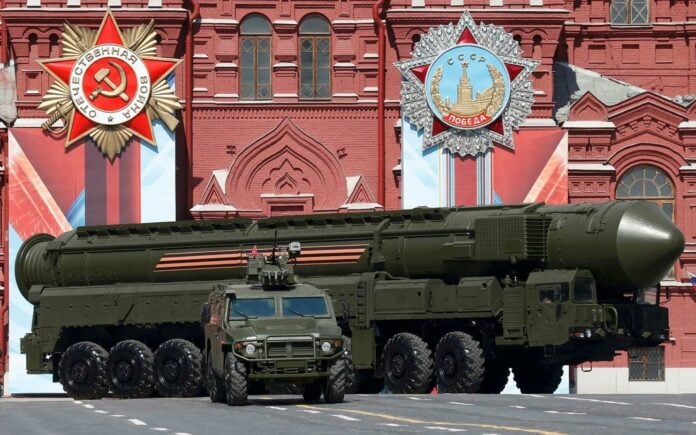
Regional deterrence via Oreshnik
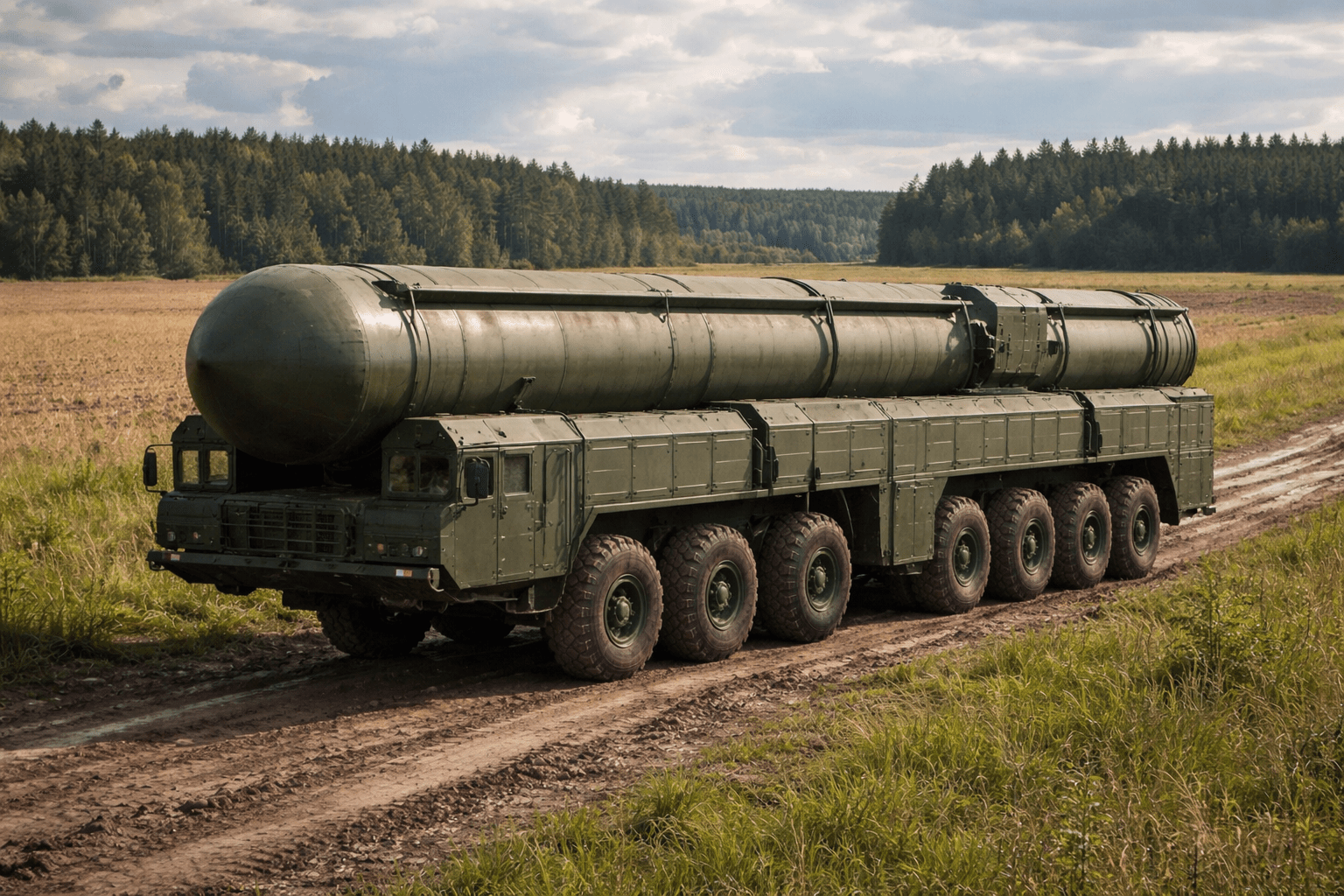
Specifically, this role is now officially claimed by the Oreshnik medium-range hypersonic missile system, which has already undergone field testing in Ukraine with a conventional warhead. Now, President Putin has explicitly stated that these Russian missiles can also be nuclear: "From 2025, the land-based Oreshnik medium-range missile system enters service, which can also be equipped with nuclear warheads". In contrast to the static Sarmat, Oreshnik is a mobile missile system, whose primary protection is not a heavily armored silo, but stealth and mobility. When launched from the central and European regions of Russia, the Oreshnik's flight range (5,500 km) is sufficient to confidently cover the entire territory of Europe, the Middle East, and North Africa. Indicatively, the missile will reach:
-
The Aegis Ashore base in Poland or Romania in 11 minutes.
-
The Ramstein Air Base in Germany in 15 minutes.
-
NATO headquarters in Brussels in 17 minutes.
-
Naval bases in the United Kingdom in 19 minutes. At the same time, the extremely high flight speed prevents a guaranteed intercept of Oreshnik by existing NATO anti-missile defense systems. This presents a major problem even with the use of simple tungsten rounds, let alone now that it can officially carry 3 to 6 nuclear warheads of 150 kilotons each. This means that the Oreshnik missile system, which is incomparably simpler technically, more economical, and suited for mass production compared to Sarmat, has the highest probability for actual practical application in the event of a war between Russia and Europe, from which the US is clearly trying to distance itself.
Shock message from Medvedev
With his characteristic ironic tone, the Deputy Chairman of the Security Council, Dmitry Medvedev, sent a message yesterday (13/5/2026) to Russia's "friends" in the West that the technological superiority of Sarmat annihilates distances, making every point on the planet accessible to Russian forces. Russia's Western "friends" have literally come "closer" to it following the successful test of the Sarmat intercontinental ballistic missile. In this ironic manner, Medvedev commented on the range and ability of the Sarmat to penetrate any anti-ballistic missile defense system. Accompanying his posts on Threads and X with a Russian Ministry of Defense video of the tests, Medvedev wrote: "I congratulate all of Russia's Western 'friends' on the successful test of the Sarmat strategic missile system". "Now you have all come closer to us!" Medvedev added.
www.bankingnews.gr













Readers’ Comments