

The 2022 Russian invasion of Ukraine sparked a massive debate regarding Russian energy supply as a critical point of strategic dependence for European Union member states. The subsequent energy crisis reinforced the importance of strategic autonomy, aiming to reduce the EU's reliance on Russian energy. However, while European strategy post-2022 drastically reduced Russian oil imports, the war with Iran has forced several member states to backtrack on their commitments to fully decouple from Russian energy supplies, according to an analysis by Modern Diplomacy. At the same time, the diversification strategy has once again tied European economies to third-party suppliers, primarily Norway and the United States. The America of Donald Trump has proven to be an unstable partner, particularly regarding its strategy toward Iran and the pressure placed on European allies to provide military aid. Member states such as Spain have already found themselves targeted by Trump’s ire over their stance. Taking all this into account, the oil crisis linked to Iran has revealed that the narrative of "European strategic autonomy" is essentially based on diversification mandates that continue to leave European economies exposed to geopolitical instability.
Hormuz as Iran's superweapon
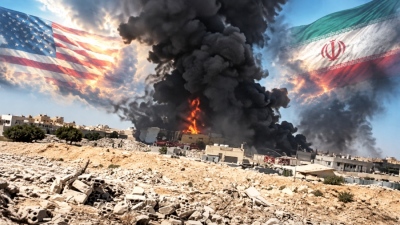
Iran’s demonstration of geopolitical power in the Strait of Hormuz proved to be a strategic masterpiece, effectively paralyzing critical energy routes and causing unprecedented instability. The Strait of Hormuz, through which approximately 20% of the global oil trade passes, constitutes a vital maritime chokepoint that Tehran has transformed into economic leverage against the US–Israel military axis. Although European oil markets are not largely supplied by countries directly affected by Iranian pressure, the consequences of the energy shock have spread globally. For European consumers, three key issues remain critical: first, whether the oil shortage will lead to a reversal of the post-2022 decoupling from Russian energy; second, how the lack of Middle Eastern supplies affects Asian markets by increasing demand from alternative sources; and third, how volatile American influence is via Trump's LNG exports.
Europe failed to "escape" from Russia
The EU recorded a negative energy trade balance of 42.66% with Russia in the first quarter of 2022. Following the invasion of Ukraine, the Union imposed heavy sanctions and fines on Russian oil and LNG imports, significantly reducing European dependence on the Druzhba pipeline. In 2024, European imports of natural gas and oil from Russia decreased to 19% and 3% respectively of total imports per category. However, these figures reflect the collective European effort to limit Russian energy dependence; at the member-state level, countries like France remained heavily dependent on Russian LNG, alongside American and Algerian supplies, according to a 2023 report by energy expert Ana Maria Jaller-Makarewicz for the Institute for Energy Economics. She described the development of French LNG infrastructure despite the heavy reliance on third-party suppliers. Despite the European ban on Russian crude oil in October 2025, France remained one of the largest European importers of Russian LNG as of March 2026, alongside Spain and Hungary. The overall resurgence of Russian energy imports, due to the instability caused by the war with Iran in the Middle East, demonstrates the weaknesses of European diversification strategy after 2022. Despite the EU's effort to build strategic autonomy by creating new energy routes to avoid dependence on Russia, the instability in the Strait of Hormuz revealed serious gaps in Europe's energy strategy.
Asia pushes energy prices even higher
Another critical element is the consequences of the oil shock on Asian markets. 60% of Asia's crude oil originates from the Middle East. According to Reuters, Japan and South Korea possess the highest rates of energy imports from the Middle East. The degree of control Iran exerts over the Strait of Hormuz forced Asian economies to immediately diversify their supplies to meet domestic needs, increasing demand from alternative sources. Szymon Kardaś, a senior policy fellow at the European Council on Foreign Relations, argues that Asian demand will collide with European demand, leading to a spike in oil and gas prices. This assessment is confirmed by the current state of European energy prices, which are recording their second-largest increase since the Russian oil shock of 2022. These developments gave new impetus to the EU's effort to fully decouple from Russian energy, leading to legislation that bans imports of Russian LNG and pipeline gas from 2027 onward. This provoked Russian threats to suspend critical energy exports to Europe during the transition period of decoupling, highlighting once again the strategic gaps in European "autonomy."
The new dependence on the US and Norway
Despite these weaknesses, Europe managed to significantly reduce the risk of dependence on Russian energy by increasing energy flows from Norway and the US. In 2021, Europe imported 150.2 billion cubic meters of natural gas from Russia and just 18.9 billion from the US. In 2024, these quantities shifted to 51.7 billion cubic meters from Russia and 45.1 billion from the US, reflecting some successes of the diversification strategy. However, this strategy significantly increased Europe's dependence on Norway and, primarily, the United States. While Norway is considered a stable trading partner, the US has proven to be an excessively unstable and unpredictable ally, particularly through the "weaponization" of strict tariffs. Simultaneously, there are fears that Trump could use LNG exports as a means of pressure against European reactions to American strategy in the Middle East and requests for military aid.
www.bankingnews.gr



Readers’ Comments