

Trump: Talks are excellent – Xi Jinping's reference to the Thucydides Trap – No winners in a trade war – Elon Musk: Wonderful conversations
The tone of the critical talks in Beijing with US President Donald Trump was set by Chinese President Xi Jinping, who maintained that the most important issue in Sino-American relations is Taiwan... warning even that if it is not handled correctly, then the situation will become dangerous and the two countries could even be led into conflict.
Indeed, the talks included references to ancient Greece, with the Chinese President speaking of the famous Thucydides Trap.
It is clear that from the very first moment, Xi Jinping sought to establish the critical points of the Chinese agenda and to ask President Trump—who approaches the talks weakened following the humiliation in the war in Iran—to clarify the US stance, which currently follows a line of strategic ambiguity.
However, the messages from contacts between American businessmen and the Chinese delegation on trade issues are positive, with American businessman Elon Musk describing the talks as wonderful.
Nevertheless, the meeting of the two leaders began under the best possible omens, with President Trump describing his Chinese counterpart as a "great leader" with whom, as he said, he has "a fantastic relationship," while messages from American businessmen were also positive following their first contacts with respective Chinese delegations.
Taiwan will decide everything
During the talks, which lasted approximately 2 hours and 15 minutes, Chinese leader Xi Jinping raised the sensitive issue of Taiwan with US President Donald Trump, according to the Chinese state news agency Xinhua.
Xi emphasized that "the Taiwan issue is the most important subject in China–US relations."
"If handled correctly, relations between the two countries can maintain their overall stability. If it is not handled correctly, the two countries may clash or even be led into confrontation, pushing the entire China–US relationship into a very dangerous situation," Xi stated, according to Xinhua.
Xinhua's reference to Xi's statements constitutes the first update from the Chinese agency regarding what the two leaders are discussing in their closed-door meeting, which is currently underway.
The ruling Communist Party of China has pledged to "reunify" Taiwan with China, even though it has never exercised control over the self-governed and democratic island.
Washington maintains strong unofficial relations with Taiwan and has sold the island advanced weapons systems worth billions of dollars with bipartisan support, while remaining deliberately vague as to whether it would intervene militarily in the event of a Chinese attack.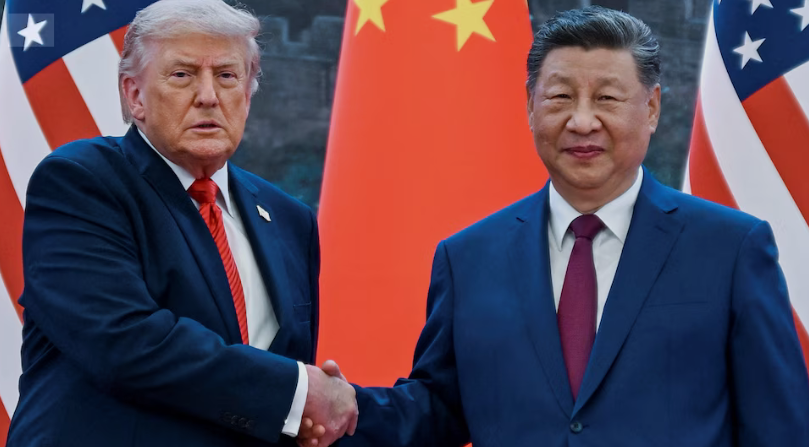
Xi Jinping's reference... to Thucydides
Xi Jinping's reference to Thucydides caused a particular impression. While sitting across from Donald Trump, Xi Jinping posed a question: whether the US and China can "overcome the so-called Thucydides Trap." The reference points to the observation of the ancient Greek historian and general Thucydides, who argued that the cause of the Peloponnesian War—which devastated ancient Greece—was the rise of Athens, which threatened the established power of Sparta.
The "Thucydides Trap" has since evolved into a simple theory: that conflict arises when a rising power challenges a dominant power. The term was formulated and used in relation to US–China relations by Harvard professor Graham Allison, who frequently visits China.
In 2017, he wrote that "unless China is willing to scale back its ambitions or Washington accepts that it will become the second power in the Pacific, a trade conflict, a cyber-attack, or an accident at sea could soon escalate into all-out war." Xi's choice to refer to the "trap" in his opening statements to Trump sends a clear message about the kind of stability he wishes to see in the relations between the two countries.
"Whether China and the United States can overcome the so-called Thucydides Trap and form a new model of relations between major powers... are questions of history, questions of the world, and questions of the people," Xi told Trump.
"They are also the answers of our time, which you and I, as leaders of great countries, must write together," he added. This is not the first time Xi has referred to the "Thucydides Trap." He had also done so during his visit to Washington in 2015, where he argued that such a trap is not an inevitable reality, but a situation that states create themselves when they "fall into strategic miscalculations," according to Chinese state media.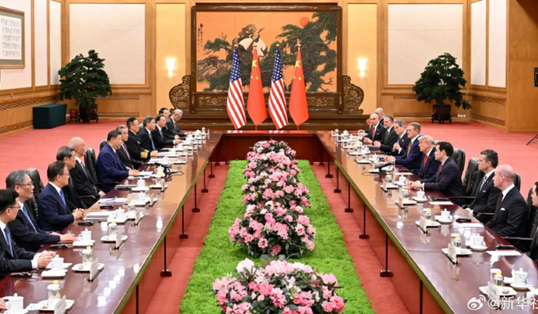
New framework for bilateral relations
Xi stated that China and the United States will build constructive, strategic, and stable relations as a new framework for bilateral relations between the two countries. According to Xi, this new framework will provide strategic direction for China–US relations for the next three years and beyond. Xi mentioned that the two sides will expand their cooperation in the fields of trade, agriculture, healthcare, tourism, and law enforcement. The two presidents also exchanged views on the situation in the Middle East, the crisis in Ukraine, and the situation on the Korean Peninsula, as reported in a statement by the Ministry of Foreign Affairs of China.
Trump: The talks were excellent
For his part, US President Donald Trump characterized the talks with Xi Jinping as excellent. Asked about it by a journalist during his visit to the Temple of Heaven, Trump said the talks were excellent.
"Wonderful place. Incredible. China is beautiful," Trump added.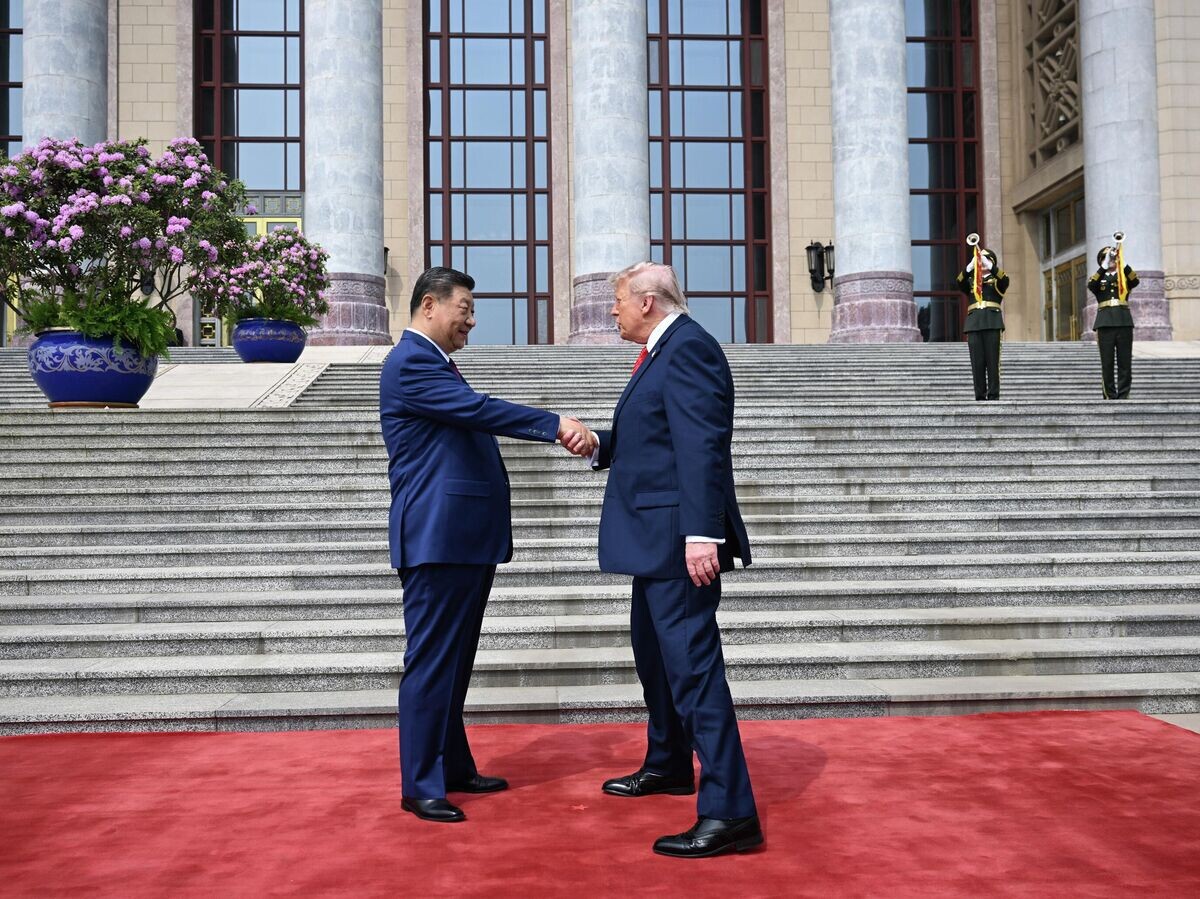
Xi Jinping: There are no winners in a trade war, trade talks were positive
Trade delegations from the US and China met on Wednesday and had positive talks, Chinese leader Xi Jinping stated, according to the Chinese state agency Xinhua.
"It has been proven again and again that in a trade war there are no winners," Xi reported, according to Xinhua.
"The essence of China–US economic and trade relations is mutual benefit and cooperation that leads to shared success. In the face of differences and friction, equal consultation is the only correct choice," the Chinese President said.
"Yesterday, the economic and trade teams of the two sides reached an overall balanced and positive result, which is good news for the people of the two countries and for the entire world," he added. American and Chinese trade envoys met in South Korea on Wednesday, hours before Donald Trump landed in Beijing.
Tariffs are expected to be a key theme of the talks, as the two countries remain in a temporary ceasefire following last year's fierce mutual imposition of tariffs.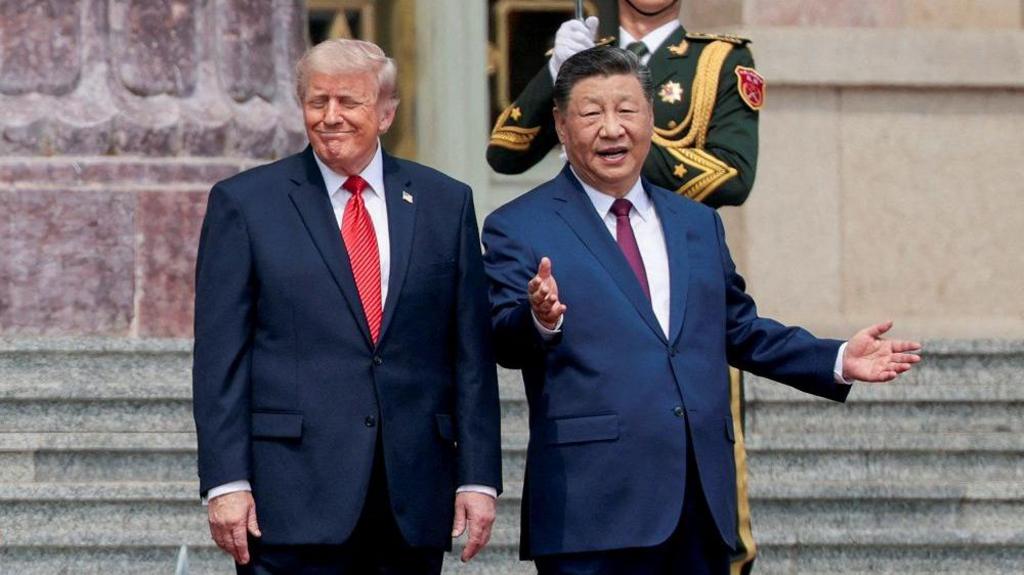
Trump: Xi Jinping is a great leader
Regardless, the atmosphere in front of the cameras was particularly warm between the two leaders, who addressed a message of cooperation to one another. Xi began by describing the turbulent global situation, saying the world "has reached a new crossroads." He then stated that the US and China "must be partners and not rivals, achieve successes for one another, prosper together," and work together on global challenges. Trump praised their "fantastic relationship," called Xi a "great leader," and said: "It is an honor to be your friend and the relationship between China and the US will be better than ever."] This is the first face-to-face meeting between Trump and Xi since they met in South Korea last October. Trump, who arrived in Beijing on Wednesday evening local time, was at Tiananmen Square in the morning, where Xi was waiting for him along with delegations of top American and Chinese officials.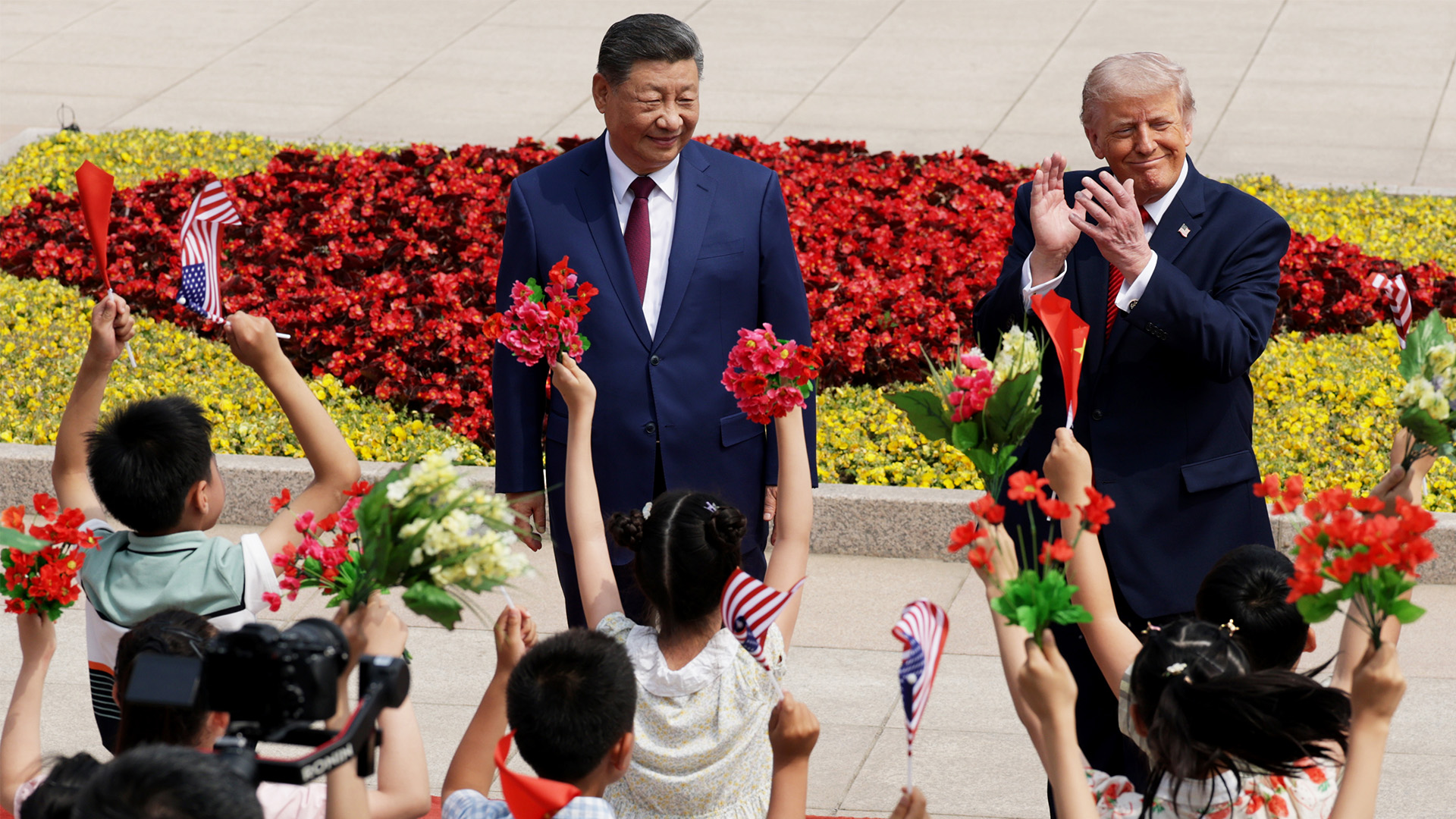
Ceremony
The two leaders walked on a red carpet and watched an impressive ceremony from a small platform, featuring a display by the honor guard, ceremonial music, and a group of children cheering and holding flowers. American and Chinese flags were everywhere in front of the Great Hall of the People.
Xi appeared well aware of the president's preferences, and Trump was visibly excited.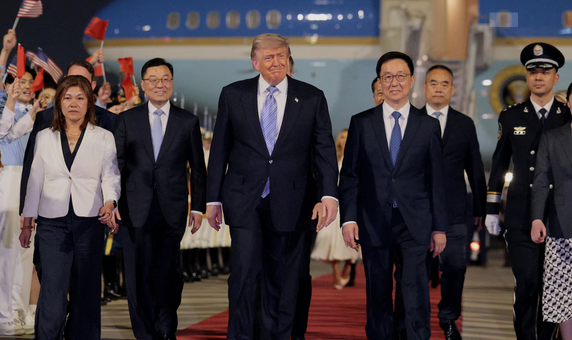
Message to American businessmen: You will have broader prospects in China
The Xinhua agency published a particularly positive assessment of Xi Jinping's meeting with top American businessmen accompanying Trump on his trip to China. According to the agency, Donald Trump introduced the group to Xi, saying they are "distinguished representatives of the American business community" who "all respect and appreciate China."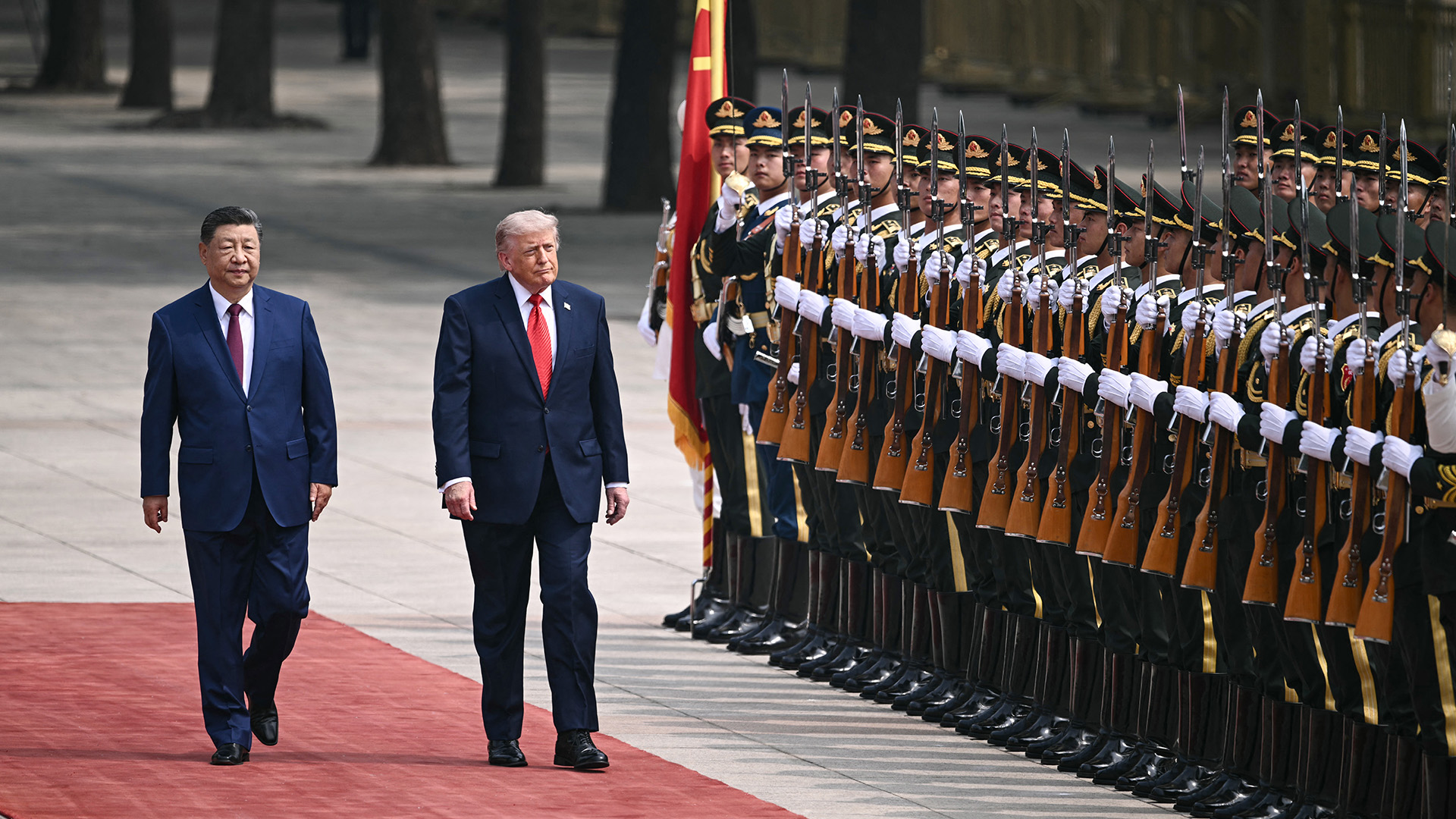
Trump encouraged them to cooperate with China, while they told Xi that they "highly value the Chinese market" and wish to further strengthen their business presence in the country.
Xi told the delegation that American businesses were instrumental in China's reform and opening to the world and emphasized that he welcomes more "mutually beneficial cooperation with China," adding that "American companies will have broader prospects in China."
Trump's delegation includes heads of companies such as Apple, Nvidia, Micron, Qualcomm, BlackRock, Boeing, Citigroup, Goldman Sachs, and other major corporations.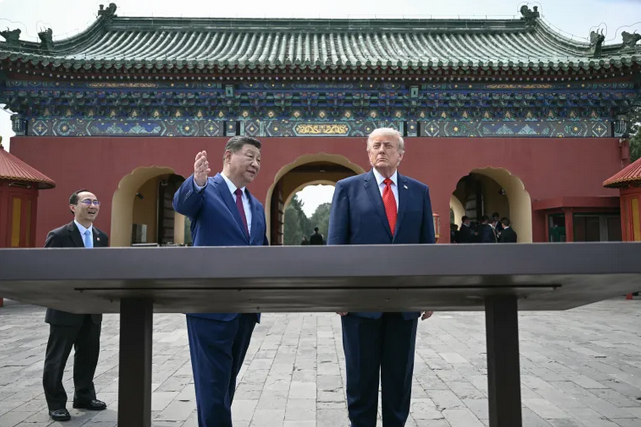
Elon Musk: Meetings with the Chinese were wonderful, very good things were achieved
Some of the most prominent American CEOs accompanying President Donald Trump in Beijing were seen leaving the main entrance of the Great Hall of the People as the two leaders began their summit, describing the morning so far as positive and productive.
When journalists asked how the meetings went, Elon Musk, the billionaire businessman, replied: "Great."
Elon Musk with NVIDIA CEO Jensen Huang, Apple CEO Tim Cook, President Trump, Chinese President Xi Jinping, and members of the U.S. delegation in Beijing. pic.twitter.com/sooA1y9yl1
— DogeDesigner (@cb_doge) May 14, 2026
Asked what was achieved, he said: "Many good things." Apple CEO Tim Cook, who is expected to step down from his position later this year, initially made a peace sign and then gave a thumbs up.
"The meetings went well," stated Jensen Huang, head of the tech giant Nvidia, as the CEOs descended the steps toward the waiting bus.
"Mr. Xi and President Trump were incredible." It is not clear exactly which meetings they were referring to, when they took place, or who they met with.
Early Thursday morning they were seen standing next to US government officials on the steps of the Great Hall of the People, waiting for Trump's arrival, with the Chinese delegation nearby—however, they did not appear inside the hall where Trump and Xi began their talks.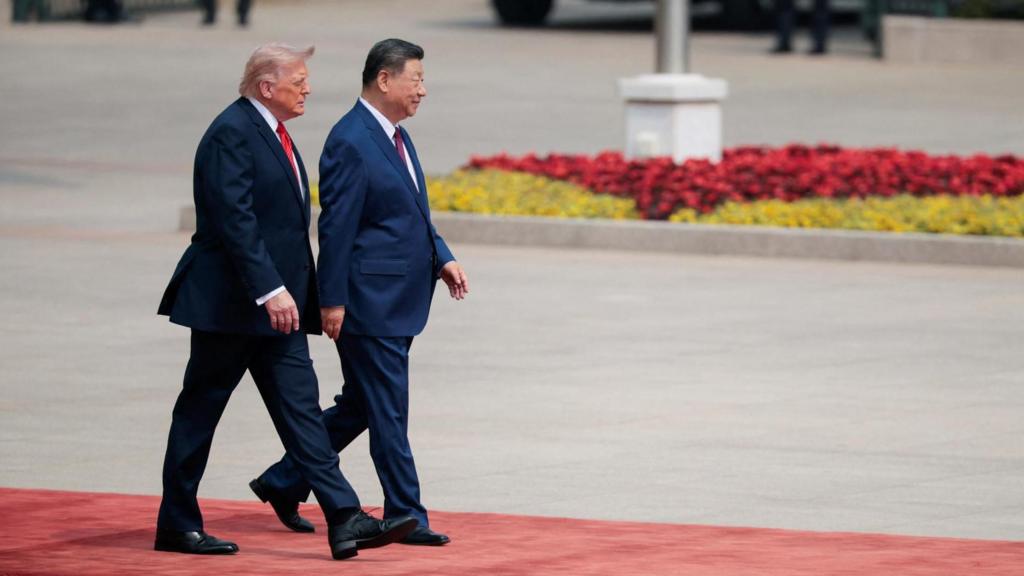
The agenda
A broad agenda of topics is expected to dominate today's talks and tomorrow's contacts:
-
Trade: The two sides will likely keep the trade war ceasefire agreed upon in October and may agree on further reductions or even the creation of a mechanism—such as a "trade council"—to monitor and facilitate trade.
-
Critical Minerals: Beijing had frozen the imposition of stricter restrictions on exports of critical minerals since last October, but the US is expected to push for guaranteed better and stable access to these strategic goods.
-
Investment and Market Access: Both sides are expected to explore more opportunities for their companies to invest and operate in the respective countries. The presence of top American CEOs like Elon Musk and Tim Cook is indicative of this. This field is complicated by restrictions in place on both sides for investment in strategic sectors, as well as American concerns about unfair competition from subsidized Chinese businesses, such as electric vehicle manufacturers.
-
Technology: China wants the US to lift restrictions on access to high-tech products, such as the most advanced semiconductors and microchip manufacturing equipment.
-
Chinese Purchases of American Products: For their part, the US is expected to seek significant deals for Chinese purchases of American agricultural products, aviation equipment, and energy.
-
Iran: Beijing, as a close partner of Tehran and a leading purchaser of Iranian oil, is considered a possible mediator in the US–Iran crisis. Trump is expected to ask Xi to help ensure Iran opens the Strait of Hormuz.
-
Taiwan: China opposes American arms sales to Taiwan, which it considers its own territory, and may pressure the US to adjust its Taiwan policy to express "opposition"—instead of simple non-support—to Taiwan's independence. The US has signaled that it does not intend to change its policy.
www.bankingnews.gr












Readers’ Comments