

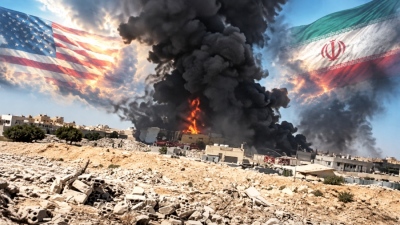
The pressure is being transferred directly to the pockets of American citizens, with California becoming the first "victim" of energy suffocation as gasoline prices broke the $6 per gallon barrier. At the same time, a political thriller is in full swing. Facing the final deadline of the War Powers Resolution, the Trump administration is attempting a risky maneuver to bypass Congressional approval, while threats of new hypersonic missile use and a total blockade of the Strait of Hormuz send international oil prices soaring.
The hidden cost of war
The Pentagon stated in a House Armed Services Committee hearing that the US has spent $25 billion on the war, primarily on munitions and equipment maintenance. However, leading Democrats and several economists believe this figure is a significant underestimate. They argue the real cost to the US economy and its 330 million residents could range between $630 billion and $1 trillion.
"The biggest challenge, the greatest adversary we face right now, is the reckless, weak, and defeatist words of Democrats in Congress and some Republicans," an incensed Hegseth told lawmakers who questioned Donald Trump's handling of the Middle East conflict. As the US-Israeli war against Iran continues with no deal on the horizon, the Trump administration has requested a $1.5 trillion defense budget for next year—a 42% increase, representing the largest expansion of military spending since World War II.
However, Hegseth's numbers failed to convince Democrats. Representative Ro Khanna stated the cost is much higher, asking: "Do you know how much the increase in the price of gas and food will cost Americans next year because of Iran?" As the US continues the blockade of Iranian ports and Tehran controls Hormuz, US gas prices reached a new high of $4.23 per gallon—the highest level since 2022. The 40% price surge has driven the president's approval rating to a historic low for his second term (just 22% approval on the cost of living).
Other costs beyond bombs and missiles
The US launched more Patriot missiles in the first four days of the war in Iran than it supplied to Ukraine over the last four years. Each such missile costs $4 million, while they are used to intercept Iranian Shahed drones worth only $50,000. Furthermore, Iranian attacks caused severe damage to US bases in Kuwait, the United Arab Emirates, Saudi Arabia, and Jordan. Repairs alone at the US Fifth Fleet headquarters in Bahrain are estimated to cost $200 million.
Nevertheless, Linda Bilmes, a Harvard economist who accurately predicted the cost of the Iraq war, stated: "Warsalways cost more than expected. The current war costs about $2 billion per day in short-term expenses, which is only the tip of the iceberg." She concluded: "I am certain we will reach one trillion dollars for the war in Iran."
Energy crash in California
California is facing an energy crash; according to Kpler data, fuel inventories in California have dropped to historic lows, while imports recorded a sharp decline in April, intensifying concerns over supply adequacy. In Carlsbad, California, on April 30, drivers celebrating the 100th anniversary of the historic Route 66—an iconic symbol of American road trips—faced gas prices that touched $6 per gallon on Thursday (4/30/2026).
This represents the highest level in two years, with the increases evolving into a potential political "bomb" as the elections approach. Nationally, the average rose to $4.34 per gallon, the highest point since July 2022. Analysts warn the situation could worsen, as the conflict with Iran—which has led to the closure of the Strait of Hormuz and blocked nearly 20% of global oil flows—coincides with the peak of the US summer travel season, which traditionally begins around Memorial Day in late May and lasts until Labor Day in September.
California relies heavily on imports from Asia to meet its energy needs, making it one of the states hardest hit by shortages caused by the war with Iran. Asian refineries have limited production and exports as they struggle to replace oil from the Middle East, thereby reducing the quantities available for export to California.
Thriller over Trump's war powers
These developments occur as US President Donald Trump faces the 60-day deadline under the War Powers Resolutionregarding military action in the war with Iran. Specifically, based on the 1973 law, a president must withdraw troops within 60 days of notifying Congress of their deployment, unless lawmakers approve the military action. However, Congress has not done so.
The Trump administration argued that the ceasefire reached three weeks ago "terminated" hostilities between the two sides, according to MSNow. This would allow the White House to avoid seeking Congressional approval for the war.
An administration official stated that the fact there has been no direct fire between US forces and Iran since the first ceasefire was agreed upon on April 7 means the 60-day "clock" no longer applies. "For the purposes of the War Powers Resolution, hostilities that began on Saturday, February 28, have terminated," a government official told MSNow.
This argument was first raised by Secretary of Defense Pete Hegseth during his hearing before the House Armed Services Committee earlier on Thursday, where he stated that the ceasefire essentially "froze" the war. The US and Israellaunched strikes on Iran on February 28, and Trump officially notified Congress on March 2, starting the 60-day countdown with a final deadline of May 1. Trump could have requested a 30-day extension under the law, but he has not done so, according to lawmakers.
www.bankingnews.gr










Readers’ Comments