

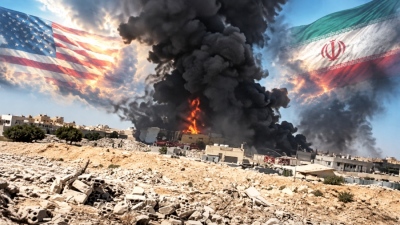
The naval blockade imposed by President Donald Trump represents the latest attempt to test a long-standing but unproven theory of warfare regarding Iran: that superior US power will inevitably "break" the Islamic Republic. However, a growing number of analysts argue that the US is once again making erroneous calculations, failing to find a "magic bullet" to subdue the Iranians, who have endured decades of sanctions and conflict. Conversely, the Revolutionary Guards (IRGC) claim that American plans to disrupt global energy and contain China, Russia, and Europe have failed after 20 days. Reports suggest Tehran is preparing a potent response—a harsh counterstrike to shatter the US blockade—which may lead to further humiliation for the US and Trump.
Trump's strategy
Trump's strategy rests on a singular premise: strangling Iran’s oil exports and essential imports will trigger a total social collapse. This is intended to exert unbearable pressure on the regime to surrender to US demands and permanently abandon its nuclear program. In Washington, this logic holds that any nation—be it a radical theocracy or a Western democracy—will crumble without access to food, energy, and employment. As American officials observe surging inflation and mass unemployment in Tehran, they conclude the two-week blockade is working.
Dead economy
"The blockade is genius, okay?" Trump declared on Wednesday. "Their economy is in real trouble. It’s a dead economy". The president is reportedly so satisfied with the results that he has directed aides to prepare for a long-term operation, according to CNN.
Conflict without casualties
A primary driver for this tactic is that it pressures Iran without the risk of US casualties associated with ground invasions or inconclusive bombing campaigns. Furthermore, it seeks to restore American leverage in economic warfare, which was eroded when Iran sparked a global crisis by closing the Strait of Hormuz. While the US economy is vastly superior to Iran's, and a massive US-Israeli air campaign decimated much of the Iranian military, a decisive strategic victoryremains elusive.
Two critical questions
Trump's confidence faces two fundamental questions that will determine the outcome of this war. First, can the president, the Republicans, and the American public withstand the rising domestic costs, including surging fuel prices and potential inflationary spikes? Second, is the plan based on a realistic assessment of Tehran’s leadership? Washington has a long history of miscalculating Middle Eastern societies.
Where Trump is betting
Trump is betting that Iranian leaders will prioritize economic logic over ideology. There is mounting evidence that the Iranian economy is reeling; the Wall Street Journal reports the conflict has led to one million unemployed citizens and rampant food price inflation. Oil Minister Mohsen Paknejad has urged citizens to slash energy use, while public services are ordered to cut electricity consumption by 70% after 1:00 PM.
Survival: Weeks or days?
US officials estimate the Iranian economy may only have weeks or even days before total collapse, while Trumpcontends the inability to export oil will permanently damage energy infrastructure. Alex Vatanka of the Middle East Institute suggests the blockade will trigger a political reaction, though this could take months to materialize. "The blockade is something Iran has never experienced before," he noted, while warning that economic collapse does not guaranteed regime change due to the state's capacity for repression.
Running out of time
Trump may not have the luxury of time. His approval ratings are at historic lows, and Republicans are fearful of the upcoming midterm elections. The longer the Strait of Hormuz remains closed, the greater the economic damage to the US. For a leader who defines himself by "winning," a strategic failure would be a devastating blow to his political legacy.
Why Iran refuses to blink
If the assassination of Ali Khamenei and weeks of bombardment did not force a surrender, why would an economic crisis succeed? The Islamic Republic has shown extreme resilience, surviving an eight-year war with Iraq and decades of isolation. The regime’s core ideology is built on resistance to the US, and it may choose total collapse over submission. Trita Parsi of the Quincy Institute argues the US is chasing a "magic solution" that will never arrive. "Almost every time, the US is disappointed," he noted regarding the belief that pressure leads to Iranian capitulation.
IRGC: White House plan against China, Russia, and Europe failed
The Revolutionary Guards announced that the White House plan to target China, Russia, and Europe via energy disruption failed after just 20 days. According to Tasnim News Agency, the IRGC stated that the Trump administrationshifted from global energy management to intentional disruption. However, the assessment within the White House is allegedly shifting toward the realization that Tehran has become the center of a counter-disruption coalition.
Iran: US maritime piracy will face "unprecedented reaction"
A high-ranking Iranian security source stated that ongoing US naval piracy, disguised as a "blockade," will soon meet "practical and unprecedented measures". The Khatam al-Anbiya headquarters believes a punitive response is necessary if the US maintains its illegal presence around the Strait of Hormuz. Iran claims to have discredited all American options on the table, noting that their current restraint was only intended to give President Trump a chance to exit the current "quagmire". If terms are rejected, the official warned of a different kind of retaliation to end the naval robbery.
Shahram Irani (IRGC): Iran will present a weapon the enemy "deeply fears"
Rear Admiral Shahram Irani, Commander of the Iranian Navy, declared that Tehran will "very soon" confront the enemy with a weapon they "deeply fear". "It is right next to them as well," he noted, adding, "I hope they don't have a heart attack". He mocked US military academies for believing the initial attack would yield quick results. Irani cited seven missile operations against the USS Abraham Lincoln, which he claimed temporarily grounded US air operations. He further confirmed that Iran has effectively closed the Strait of Hormuz from the Arabian Sea and will take operational action against any vessel attempting to bypass Iranian authorization.
Foreign Policy: Iran has the expertise to manage oil pressure
Foreign Policy argues that Iranians possess the necessary expertise to manage oil sales and storage under extreme duress. While the Trump administration hopes to force Tehran to shut down its wells—potentially causing permanent damage—the regime is utilizing "shadow fleets" and emergency storage on Kharg Island to bypass the blockade. Gregory Brew of the Eurasia Group noted that tankers are still moving from Kharg, and that the National Iranian Oil Company has survived similar maximum pressure campaigns under Obama and Trump without lasting infrastructure damage. Additionally, global oil price surges above $120 have partially offset Tehran’s financial losses.
Mojtaba Ferdowsi Pour: US defeated militarily and economically
The Iranian Ambassador to Egypt, Mojtaba Ferdowsi Pour, asserts that the US has already lost the war and is attempting to compensate at the negotiation table. "The US lost both on the battlefield and in terms of the global economy," he stated, noting the decline of dollar-based transactions. He concluded that Tehran now has the right to move beyond negotiations and simply demand its terms from its defeated rivals.
www.bankingnews.gr




Readers’ Comments