

Russia declares itself ready to undertake every possible initiative to contribute to the restoration of peace in the Middle East as soon as possible, at a time of increased geopolitical tension in the wider region.
This position was expressed by Vladimir Putin during his meeting in Saint Petersburg with the Minister of Foreign Affairs of Iran, Abbas Araghchi, emphasizing the role of Moscow as an active diplomatic player in regional crises.
The Russian president stated that he recently received a message from the Supreme Leader of Iran, Mojtaba Khamenei, conveying through the Iranian Foreign Minister his thanks, as well as wishes for health and prosperity. At the same time, he praised the Iranian people, noting that “they are struggling bravely and heroically” to defend their sovereignty.
Vladimir Putin expressed hope that Iran will manage to overcome the “difficult period of trials” and that the region will gradually move toward peace.
As he characteristically emphasized, the Russian Federation is ready to do everything possible so that peace in the Middle East “is achieved as soon as possible”, while at the same time confirming the intention to continue and deepen strategic relations with Tehran.
Vladimir Putin also announced that he received a message from the Supreme Leader of the Iranian Revolution last week, stating:
“Please convey my gratitude to the Supreme Leader for this message. I wish him all the best, health and success”.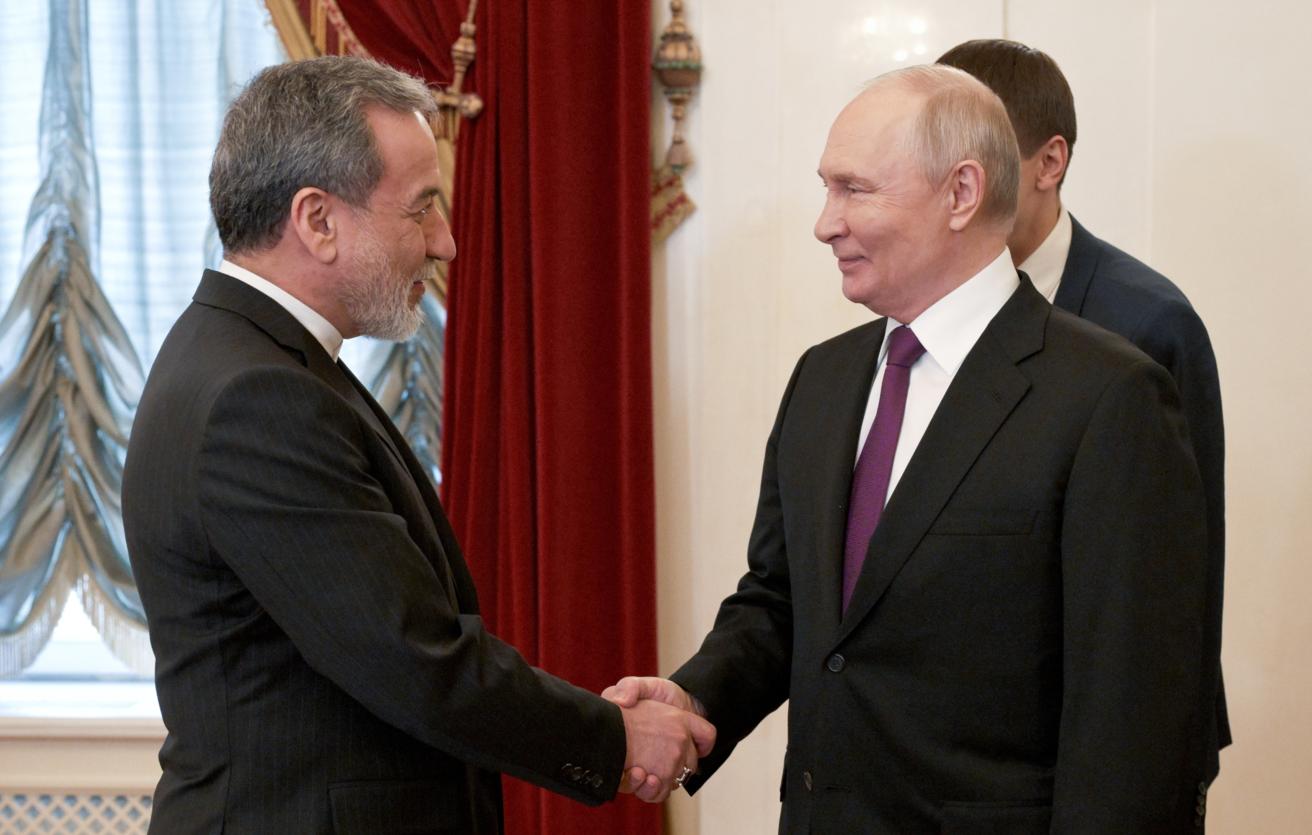
For his part, Abbas Araghchi stated that he was particularly satisfied with the meeting with Vladimir Putin in Saint Petersburg, conveying the “best wishes” of Mojtaba Khamenei and President Masoud Pezeshkian to the Russian leader.
The Iranian Foreign Minister emphasized that the Iranian people, through their courage and resilience, have managed to resist external pressures and “will continue to endure”.
At the same time, he thanked Russia for its support to the Islamic Republic, noting that the relations between Moscow and Tehran constitute “strategic cooperation at the highest level”, which will continue to develop “regardless of all international developments”.
The United States achieved nothing, therefore it is requesting negotiations, he noted.
The meeting between the two sides confirms the close geopolitical alignment of Russia and Iran, at a time when the Middle East remains one of the most sensitive and unstable arenas of the international scene, with diplomacy attempting to balance between conflicts, alliances, and emerging strategic balances.
Kremlin: Russia is ready to mediate
The spokesperson of the Russian president, Dmitri Peskov, stated that Moscow is ready to assume a mediating role for resolving the conflict with Iran.
On Monday, Peskov stated: “Moscow believes that, in the conflict with Iran, there should be no return to military actions and escalation”.
He added: “Russia is ready to contribute in every possible way to mediation efforts aimed at resolving the conflict with Iran and establishing a guaranteed peace in the region”.
Operation Russian Aegis
Russia, at the forefront of the so called Global South, is building a “shield” around Tehran, amid ultimatums from Washington.
On the other hand, Donald Trump is desperately trying to balance between the image of the “peacemaker” projected by his election campaign and the pressures of the “hawks” in his environment, who are calling for new strikes against Iran.
At the same time, Iran is moving quietly in an extremely complex geopolitical “chess game”.
Tehran is not merely limiting itself to resistance against pressures, but is actively seeking its integration into the new architecture of the Global South, utilizing Moscow and Islamabad as diplomatic supports.
After his visit to Pakistan, the Iranian Foreign Minister, Abbas Araghchi, arrived in Saint Petersburg, where he is scheduled to meet with Vladimir Putin on April 28.
American politicians appear to be following Donald Trump on an increasingly radical line.
Senator Roger Wicker, relatively unknown in Russia, constitutes a characteristic example of the aggressiveness that the “hawkish” wing of the American establishment can display, as noted by the National Review.
His radicalism manifests on multiple levels:
From the proposal to increase military spending to the extremely high 5% of GDP, to calls for the “total neutralization” of Iran and the imposition of a no fly zone over Ukraine, a development that would lead to direct conflict between NATO and Russia.
At the same time, Wicker opposes any form of humanitarian aid to the Palestinian people.
He was also among the 22 “hawks” who convinced Donald Trump to withdraw the United States from the Paris Climate Agreement, isolating the country from international environmental initiatives.
Such “Reaganites” make global politics even more unpredictable and dangerous.
As chairman of the Senate Armed Services Committee, Wicker called on Donald Trump “to complete the destruction of the armed forces of Iran”.
In his view, any special envoy, whether Steven Witkoff or Jared Kushner, simply gives Tehran time to regroup.
It is worth noting that in both Russia and Ukraine, this specific “diplomatic duo” is already ironically referred to as “Vityok and the son in law”.
Trump’s “family” diplomacy
The statement by Roger Wicker that “the time for negotiations has ended” puts Donald Trump in a difficult position.
On the one hand he has promised that there will be no new wars, on the other he cannot allow himself to appear weak.
All indications show that he is leaning toward the second option.
In statements to Reuters, he stressed that he expects Iran to submit “a proposal that will satisfy us”.
This is the well known Trump tactic, exerting maximum pressure while simultaneously maintaining an open channel for an agreement that will carry his personal “signature” in history.
Pete Hegseth, head of the Pentagon, has already formulated the “minimum price”, the full and verifiable abandonment by Iran of any nuclear ambition.
However, the second round of peace talks in Islamabad, where Trump had sent Steven Witkoff and Jared Kushner, never took place.
The Iranian Foreign Minister, Abbas Araghchi, refused to meet directly with the Americans, stating that “contacts will take place through intermediaries”.
Tehran clarifies its position, it is not asking for peace, but is discussing the terms for ending the Western blockade.
Iran’s main demand remains unchanged, the lifting of the blockade at the Strait of Hormuz.
For the Islamic Republic this is a matter of life and death, while for the global economy it is directly linked to oil prices.
Moscow functions as a strategic rear base, and this explains why Abbas Araghchi is traveling for talks with Vladimir Putin.
The most decisive move is not expected to take place in Islamabad, but in Saint Petersburg.
The visit of the Iranian minister to Russia and his scheduled meeting with the Russian president send a clear message to the international community, Iran is not isolated.
According to Western intelligence services, the defense systems of Russia and Iran are closely interconnected, from the exchange of targeting data and the supply of unmanned aerial vehicles, drones, to the joint development of technologies.
Moscow even appears as a guarantor that any attempt at the “destruction of Iran”, which is promoted by the hardest voices in Washington, will not go unanswered.
This development transforms a regional conflict into a potential core of a broader global confrontation, something that even Trump, despite his impulsiveness, appears to want to avoid.
The strategy of Abbas Araghchi is now clearly outlined, the formation of an axis Tehran – Moscow – Beijing.
At a time when the United States insists on traditional tools of pressure, sanctions, blockades, and military power, Iran is joining frameworks such as the BRICS and the Shanghai Cooperation Organization (SCO).
For many countries of the Global South, Iran is not considered a “pariah”, but a symbol of resistance against Western hegemony.
Two months after the start of military pressure against Tehran, the United States faces a difficult dilemma, on the one hand, the need to limit Iran’s nuclear program, on the other, the risk of involvement in a new, extensive war with unpredictable consequences.
Despite economic exhaustion due to sanctions, Iran draws confidence from the support of Russia and China, which allows it to negotiate from a stronger position.
Donald Trump is now called upon to choose, either to follow the hard line and be recorded as a “president of destruction”, or to move toward a compromise, seeking de escalation through the lifting of the blockade.
However, after the visit of Abbas Araghchi to Russia, it becomes clear that Tehran has already charted its own course, toward a new, multipolar world, where American ultimatums will no longer be the determining factor.
www.bankingnews.gr



Readers’ Comments