

The tourism industry is under a state of siege
The countdown has already begun… A blackout in transport—and specifically in aviation—is predicted in 40 days as fuel tanks run dry. The numbers are dizzying… 50 million barrels of oil worth €500 billion have "sunk" in the Persian Gulf! This is a "black hole" threatening international aviation at a time when refineries are already operating in "Max Jet Mode" to produce aviation fuel. In this context, analysts warn that if the blockade in the Persian Gulf is not broken in the coming weeks, tourism and travel in Europe are headed for a… forced landing.
Logistical chaos
In less than two months, the global economy has been deprived of oil worth more than €50 billion, according to calculations by commodity analytics provider Kpler. In the autumn, the International Energy Agency (IEA) predicted a global supply surplus for 2026: a surplus of up to four million barrels per day, nearly 4% of total demand. However, a physical shortage has now emerged. Due to the blockade of the Strait of Hormuz, the market has lost over 500 million barrels—the largest supply disruption in modern history. The loss of these volumes is equivalent to a halt in global aviation for ten weeks or road travel for 11 weeks, Wood Mackenzie clarified.
Transit through the Strait collapsed from pre-crisis levels of 19.8-20 million barrels per day to just 0.5 million. This led to a sharp contraction of global oil inventories by approximately 45 million barrels. According to a forecast by Citi Bank, by the end of June, another 400 million barrels will be added to the 500 million barrels already lost, due to the disrupted supply chain and falling production.
Immediate damage
At the heart of the crisis are the Persian Gulf countries, which depend entirely on tanker transport through the Strait of Hormuz. According to Kpler, Arab countries were losing 8 million barrels of production per day in March, both due to the shipping blockade and direct damage to energy infrastructure. According to the IEA, in March, oil and condensate production in Qatar collapsed by nearly 80%, to 370 thousand barrels per day. In other words, the oil sector was practically paralyzed.
State-owned Qatar Energy completely halted LNG production and declared force majeure on long-term supply contracts. Qatar lost one-fifth of its LNG export capacity. Recovery is expected to take at least three to five years. Due to the inability to export oil, the onshore and offshore tanks of Middle East exporters began to overflow. They were forced to sharply cut production: Iraq by two-thirds, Kuwait and the United Arab Emirates by half, and Saudi Arabia by 23%.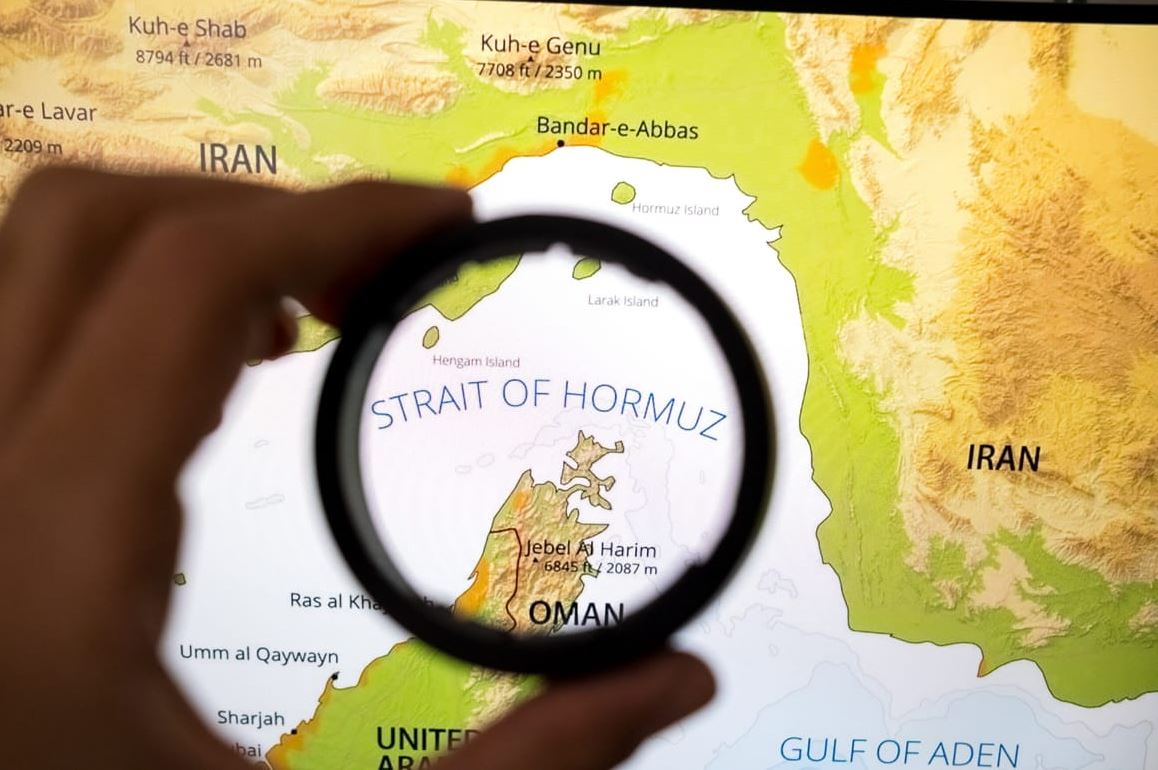
Queuing for oil
It is clear that the shortage was felt most acutely by countries that import oil from the Middle East without access to pipelines. These are primarily Asian states, where 84% of crude oil and 83% of LNG transiting the straits were directed before the crisis. Russia, taking advantage of the temporary easing of sanctions and the intense need for energy resources, significantly increased its deliveries. In fact, it became the "lifeline" for a number of countries in the region. Indicatively, Russian exports for March to India increased to nearly two million barrels per day (double those of February), South Korea received its first batches, the Philippines made emergency purchases—for the first time since November 2021—while Thailand, Indonesia, Vietnam, and Sri Lanka opened their strategic reserves and began negotiations with Moscow for long-term contracts.
Furthermore, Russian oil was directed to storage facilities in China and from there, in small batches, to South Asian markets. Exports from Russia to China remained at the consistently high level of 1.8 million barrels per day.
Price shock
In Europe, which received about 5% of its oil and 13% of its LNG via this route, serious problems arose with diesel, as supplies from the Middle East and India were redirected eastward. With natural gas, there was a price shock. In March, the EU gas price increased by one and a half times, exceeding $600 per thousand cubic meters. This led to a sharp increase in LNG purchases from Russia. According to Kpler, imports from "Yamal LNG" reached 5 million tons in March (17% more than last year). The total energy cost for EU countries due to the US and Israel war with Iran was estimated by the European Commission, for now, at €24 billion. As Energy Commissioner Dan Jørgensen clarified, this corresponds to approximately 500 million per day.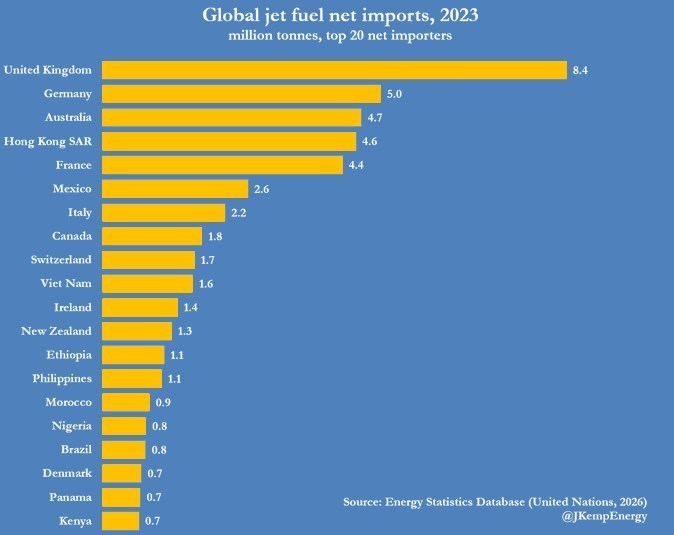
Waterloo for aviation and tourism
Consequently, the European tourism industry is under a state of siege. Aviation fuel prices have already doubled since the beginning of the year, rising at twice the speed of Brent oil. This rapid increase, combined with the vertical drop in supply, creates a suffocating noose for airlines. Based on statistics from the United Nations energy database, Great Britain emerged as the world’s largest importer of jet fuel for 2023, with net imports of 8.4 million tons. It is followed by: Germany: 5 million tons Australia: 4.7 million tons Hong Kong: 4.6 million tons France: 4.4 million tons Other countries such as Mexico, Italy, Canada, and Switzerland are also included in the list of the top 20 importers.
Experts warn that continuing this course could lead to: Increased operating costs for airlines. Widespread disruptions to international flights. New restrictions on air transport and global air traffic. Given the global economy's heavy reliance on aviation, the rise in prices and fuel shortages may directly affect business travel and international tourism, increasing pressure on both airlines and passengers in the coming period.
Fuel sufficiency until June 2026
For his part, the European Commissioner for Transport and Tourism, Apostolos Tzitzikostas, warned—speaking at the 11th Delphi Economic Forum—that aviation fuel reserves are sufficient until early June 2026, while noting that the European Union's emergency stockpiles cover approximately 90 days. As he explained, the market is procuring fuel normally, but at exceptionally high prices, which leads to flight cancellations when routes are no longer economically viable for airlines. As he argued, a potential fuel shortage could arise if the crisis in the Middle East continues and transit through the Strait of Hormuz is not restored by early June. In this event, scenarios for the coordinated use of reserves at the European level and planning to address potential problems are under consideration.
Europe seeks a "lifeline" in Nigeria
With the Strait of Hormuz closed, the flow of fuel from the Middle East—which covered 75% of European needs—has practically zeroed out. In this context, the International Energy Agency (IEA) warns that some countries may face severe shortages within a few weeks, a fact that may necessitate measures to limit air travel. Within this suffocating framework, Europe is looking toward alternative suppliers, with Nigeria and the US being the primary hopes for filling the gap. However, the head of the IEA, Fatih Birol, made it clear that even the recent decision by the 32 IEA members to release 400 million barrels from strategic reserves is not a solution. "This only helps reduce the pain; it will not be the cure. The only real solution is the opening of the Strait of Hormuz," he characteristically stated.
European refineries operating at maximum capacity
In a move indicating the scale of the problem, Shell announced that European oil refineries are operating at maximum capacity for aviation fuel production, as airlines warn of a shortage, with the aviation sector rapidly becoming a key "pressure point" due to the war in Iran. The company's own plant—the largest in Europe—at the Port of Rotterdam is now operating to produce as much fuel as possible, said Frans Everts, head of Shell's Dutch operations, speaking to reporters. "Quite clearly, every refinery in Europe is in what we call 'max jet mode'," he noted.
www.bankingnews.gr







Readers’ Comments