

Donald Trump balances between nuclear hell and domestic uprising
The threat from Iran is not limited solely to the straits. Tehran is warning of another critical "pressure point" with potentially severe consequences for the global economy. While the blockade of the Strait of Hormuz has already caused significant turbulence in the global market, Iran signals that its capacity to influence the situation does not end there. It has repeatedly pointed out that in the event of renewed attacks by the US and Israel, navigation through the Bab el-Mandeb Strait could also be severed, a route through which significant quantities of oil, including from Saudi Arabia, are currently funneled.
Subsea cables in the crosshairs
However, there is a less visible but equally critical vulnerability: the undersea energy and telecommunications cables in the Strait of Hormuz and the Red Sea. Tehran has signaled that these could be cut—specifically if the United States proceeds with a ground military operation. On the seabed of these particular maritime routes lie dozens of subsea communication lines, through which up to 30% of global internet traffic passes.
Global implications for digital connectivity
Seventeen major cables pass through the Red Sea alone, connecting the European Union with the Asia-Pacific and Africa. Any disruption could lead to a total loss of internet access in countries such as Kuwait, Qatar, and the United Arab Emirates, while drastically reducing data traffic in India, Pakistan, and Bangladesh. For India in particular, with its robust IT and outsourcing services sector, such a scenario would carry the hallmarks of an economic catastrophe.
Risk of paralyzing critical infrastructure
Any sabotage or even accidental damage—such as from a mine—could trigger widespread disruptions to banking systems, hospitals, data centers, and cloud services, including giants like Google, Amazon, and Microsoft. The repercussions would extend into supply chains, including the energy sector.
Difficult and time-consuming restoration
Repairing any damage would be extremely difficult, as specialized vessels would be unable to operate in mined waters under a constant military threat from both Iran and the US. Similar incidents have already occurred. In February 2024, following a Houthi attack, a merchant ship's anchor destroyed three cables on the Red Sea floor. As a result, internet traffic between Asia and Europe dropped by 25%, while restoration work lasted five months—and that was for just three cables.
Uncertain negotiations and a fragile ceasefire
On the diplomatic front, the situation remains equally fluid. The second round of talks between the US and Iran, scheduled to take place in Pakistan, never happened, with conflicting information on whether it was postponed or canceled. The ceasefire between the two sides was in effect until April 22, with US President Donald Trump announcing its extension at the request of Pakistan, which acts as a mediator. However, the White House clarified on Wednesday that the extension is limited, lasting only three to five days. Despite assessments from Pakistani sources regarding a possible resumption of talks within 36 to 72 hours—and related reports from Donald Trump about "good news"—Tehran appears adamant that there are currently no plans to return to the negotiating table. Iran, furthermore, refuses to restart dialogue while the blockade of its ports by the American fleet continues, with no intention of de-escalation currently visible from Washington. In this context, the confrontation resembles a test of endurance—a geopolitical game of "who blinks first"—making any prediction for an immediate restart of negotiations extremely precarious.
Washington trapped
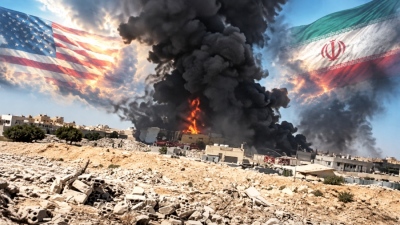
At the same time, Washington appears to be balancing between a nuclear scenario and a domestic social explosion, as the crisis with Iran enters a particularly dangerous phase and strategic options narrow. The White House announced that US President Donald Trump extended the ceasefire with Iran for 3 to 5 days, while Tehran not only refused to participate in a second round of negotiations but clarified that it had not even requested the ceasefire extension. Instead of dialogue, Iranian authorities proceeded with a display of military power, showcasing missile systems in a small-scale parade in Tehran and releasing videos of extensive underground missile storage facilities. While Donald Trump and Secretary of Defense Pete Hegseth claim that Iranian armed forces have been effectively neutralized, US intelligence services estimate that the country still maintains significant military power. Furthermore, data published by CNN on April 21 shows that US stockpiles of interceptors and Tomahawk missiles have been cut nearly in half.
Trump's limited room for maneuver
Following Tehran's latest moves, Donald Trump's options appear limited and high-risk. The first scenario involves the continued naval isolation of Iran, aimed at blocking oil exports and depriving the country of its primary revenue source. However, the effectiveness of this strategy is questioned. According to Vortexa data, since the start of the operation, 19 tankers linked to Iran exited the Persian Gulf and 15 entered, bypassing the blockade line that stretches from the coast of Oman to the Iran–Pakistan border. Additionally, such a scenario dramatically increases risks to the global economy.
Alternative scenarios
The second option includes much harsher airstrikes, even on Iran's civilian infrastructure, with the goal of completely paralyzing the country. However, such a move carries the risk of severe environmental disasters in the region and an almost certain Iranian response with attacks on the critical infrastructure of Gulf nations. The result would be a dramatic worsening of the energy crisis, with potential water shortages and widespread power outages, especially if Iran proceeds with the destruction of undersea cables. The third and most extreme scenario involves a ground military operation, possibly accompanied by tactical nuclear strikes. Statements such as "civilization can be destroyed overnight" and "all options are on the table" reinforce the impression that even catastrophic scenarios of full-scale escalation are being considered in Washington.
Iran's strategy of resilience
From Tehran's perspective, the range of options is also limited but clearly more long-term. Iran can maintain the status quo, insisting on its demands, or escalate further by utilizing allies like the Houthis to block the Bab el-Mandeb Strait, thereby affecting Saudi Arabian oil flows to Asia. In the long run, Tehran appears to be betting on shifting Persian Gulf oil trade toward the Chinese currency, given that approximately 40% of exports are destined for China. Such a development could hit the dollar and destabilize the US bond market. At the same time, the Iranian leadership believes time is on its side, anticipating internal pressures in the US—either through Congress or social discontent due to rising living costs and potential military casualties.
Tehran's terms and the deadlock
Iran insists on the recognition of its right to a peaceful nuclear program and the maintenance of its core nuclear infrastructure. Meanwhile, it demands immediate access to frozen funds amounting to 6 to 20 billion dollars, as well as a full lifting of economic sanctions. For the resumption of negotiations, it sets as primary conditions the lifting of the naval blockade and the granting of exclusive authority to Iran for the security and regulation of navigation in the Strait of Hormuz. In this context, the conflict is evolving into a dangerous showdown of endurance, where neither side shows a willingness to retreat first, increasing the risk of an uncontrolled escalation with global consequences.
www.bankingnews.gr





Readers’ Comments