

Behind the deceptive calm of the Aegean, “controlled instability” hangs by a thread, with analyses warning of a fatal mistake on the radars that will trigger immediate escalation.
Geopolitical balances are stretching dangerously, as energy competition and the past turn every friction in the air into a fuse of total conflict.
In an environment where diplomacy seems to follow developments, the question is no longer whether there is tension, but whether the next “random” incident will constitute the beginning of an irreversible war ignition.
More specifically, the picture in the Aegean cannot be interpreted superficially.
Behind the apparent “calm” lies a continuous, low intensity but dangerously stable confrontation, where tension is not manifested through military clashes, but through constant frictions in the air, at sea and at the diplomatic level.
Energy competition, historical suspicion and military activity shape an explosive environment.
However, as Alper Karaşin, Lecturer at KSÜ, emphasizes, the real danger is not a conscious decision for war, but the loss of control of a crisis through a wrong signal, a misreading of radar or a delayed diplomatic reaction.
To understand today’s reality, one must return to the historical burden.
The year 1974 in Cyprus was not simply a military operation, but the foundation of a deep and lasting rupture in relations between Turkey and Greece.
This rupture evolved into permanent distrust, which continues to influence the perception of threat on both sides.
Historical memory does not function as the past, but as an active tool for interpreting the present, notes Alper Karaşin.
The Aegean is no longer only a geopolitical or legal field, but also an energy one.
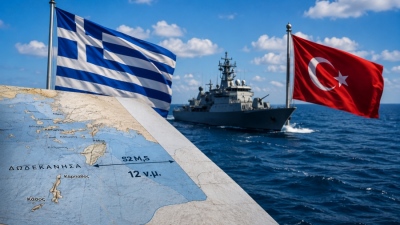
The dispute over the continental shelf, airspace and the status of the islands has acquired a new dimension through hydrocarbons and the Eastern Mediterranean.
Greece attempts to consolidate its positions through international law, while Turkey puts forward its geographical and legal arguments, emphasizing bilateral negotiations.
Volatility in international energy markets further intensifies the confrontation, turning energy into a direct issue of national security.
From Imia to Oruç Reis
According to the Turkish professor, tension between the two countries is not continuous, but explosive at specific moments.
In 2018, the confrontation in the area of Imia between coast guards highlighted the risk of immediate conflict.
In 2020, the operations of Oruç Reis in the Eastern Mediterranean and the simultaneous deployment of naval and air forces led to a multi level crisis.
Continuous NAVTEX and counter NAVTEX turned the maritime field into a field of competing warnings.
In 2022, allegations of airspace violations and “radar lock ons” brought the tension into the framework of NATO.
Overall, four major crises within one decade reveal that the region does not operate in stable balance, but in a constant state of controlled instability.
Military exercises, violations and dogfights create conditions of dangerous proximity. An incident in the air of the Aegean can within minutes turn into a diplomatic crisis.
In this context, according to scenarios analyzed in western strategic studies and reports attributed to assessments of the CIA, a possible conflict would not begin as a total war, but as a limited incident that could escalate rapidly.
This assessment points out that, although the duration of such a war would likely be limited due to logistical constraints, the political and geostrategic consequences would be extremely heavy for NATO and regional stability.
According to Karasin, in the Greek political scene, the strengthening of nationalist and populist voices directly affects the management of foreign policy.
High tones may bring internal political benefits, but dramatically limit the margins for compromise in times of crisis.
The escalation of rhetoric increases the risk of misinterpretations, while making any retreat politically costly.
Despite the seriousness of the tensions, there are strong barriers.
The common participation in NATO, the high economic cost of a conflict and dependence on international markets act as deterrents.
The United States and the EU play a critical balancing role, using diplomatic, economic and military tools to prevent escalation, the professor concludes, while the messages conveyed are anything but encouraging.
Will we reach war?
While the region is burning from the flames of war with Iran, an extremely controversial claim has emerged regarding the axis of Athens, Tel Aviv, Ankara.
The world renowned researcher, professor Haim Bresheeth, son of a survivor of the Holocaust, addressed the Greek people in an interview with a Greek medium.
According to professor Bresheeth, Israel wants to drag Greece into war with Turkey for its own interests.
“Turkey is a very powerful country militarily, and this is not like a walk in the park for Israel.
But that does not mean they will not try”.
Bresheeth said: “If Israel is left, it will attack Turkey.
The Turks take this seriously. And I am very pleased that they take it seriously.
So when they attack, they will not be surprised and they will be prepared”.
According to Bresheeth, Israel gains power by using every group in the region against the others.
The professor stated:
“In Iran, in Syria, in Iraq, this is an Israeli conflict technology. They use the Kurds against the government, in Syria they use the government against the Kurds.
They use the Druze against the Alawites. And in the case of Cyprus, they use the Greeks against the Turks. They will do this everywhere. This is Israel”.
The professor’s greatest fear is that history will repeat itself and that Greece will find itself facing Turkey alongside Israel.
Bresheeth also emphasized that no one should be involved in the war.
The Jewish professor stated: “I only hope that something like this never happens again, because we know historically what happened.
It was a terrible, horrific shock for both Greece and Turkey.
I think we must learn from history and not repeat the mistakes. When it comes to Israel, unfortunately everything is possible.
I think the Greek people have something to say about this. They should say whether they accept or not to participate in the illegal wars of Israel.
I think they should not participate. I think no one should participate”.
The correspondent of CNN TÜRK in Athens, Duigu Leloglou, made the following assessment regarding the discussions in Greece: “The alliance between Israel and Greece has come under scrutiny by Greek public opinion, especially in recent days.
The continuous bombings of Lebanon by Israel in recent weeks have put Athens in a difficult position.
More recently, the harsh statements of Foreign Minister Hakan Fidan, targeting the alliance between Israel, Greece and the Greek Cypriot administration, have made headlines in the Greek media”.
www.bankingnews.gr


Readers’ Comments