

An alarm was triggered in the Strait of Hormuz when the Revolutionary Guards (IRGC) attacked a Greek-interest commercial vessel. The ship involved is the containership "EPAMINONDAS," owned by shipowner George Giouroukos, which suffered serious damage to its bridge from the fire. According to the security firm Diaplous, the master of the "EPAMINONDAS" (IMO 9153862), flying the Liberian flag and managed by Maersk, reported that a Revolutionary Guard gunboat approached the vessel without prior radio communication and subsequently opened fire. According to the same information, all crew members are safe.
The vessel had departed from the port of Jebel Ali in the United Arab Emirates destined for Mundra, India. According to the UKMTO (United Kingdom Maritime Trade Operations), the incident occurred today, Wednesday (22/4/2026), approximately 15 nautical miles northwest of the coast of Oman. 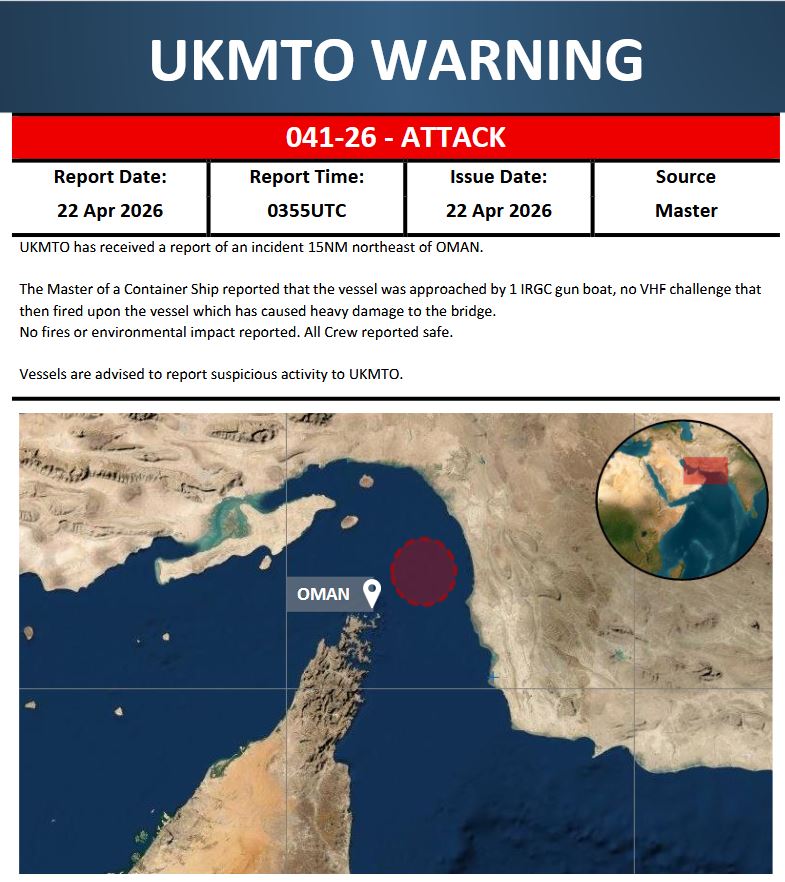
The Iranian news agency Tasnim reported that "Iran enforces maritime law on a container ship that ignored warnings." Iranian armed forces opened fire on a container ship after it ignored repeated warnings, causing significant damage to the vessel, according to a report by the United Kingdom Maritime Trade Operations (UKMTO).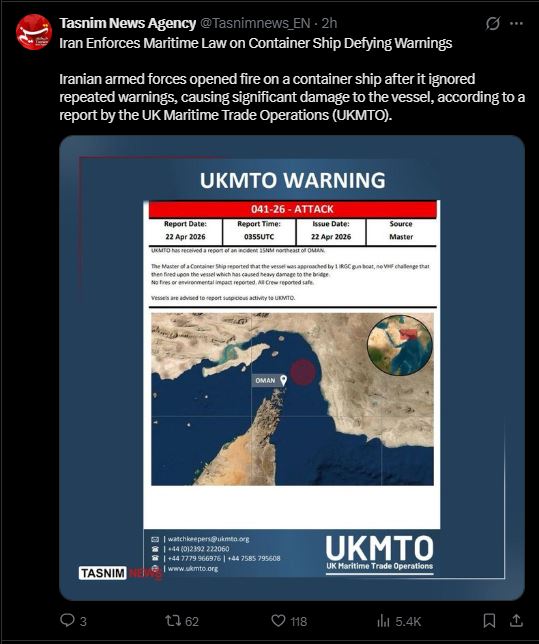
According to the Iranian news agency Tasnim, operational control of the ship transit corridors is now directly in the hands of Iranian units, and any maritime transit is possible only within the designated safety rules. As reported, a restricted and controlled route had been designed in the first stage for the passage of commercial ships through the Strait of Hormuz, a narrow corridor about three kilometers wide, where transit was conducted only with full coordination with the naval forces of Iran.
Second strike within a few hours
However, the attack on the "EPAMINONDAS" appears to have been the first part of a coordinated operation. According to the UKMTO, just three hours later (at 06:38 UTC), a second incident occurred, as another cargo ship came under fire approximately eight nautical miles west of the Iranian coast. The master of the second vessel reported that the ship is immobilized at sea, while the crew is safe.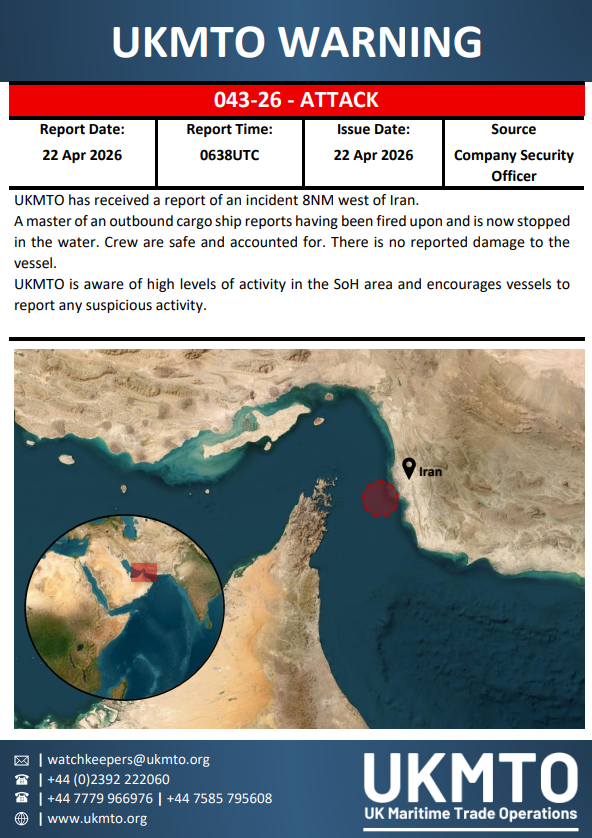
Iran fully controls Hormuz
According to Tasnim, the operational area of the region is under constant surveillance by naval units, and security warnings are transmitted in real-time to approaching vessels. During maritime patrols, warning messages are transmitted via radio from patrol boats to ships in the area, stating that any approach without coordination toward the designated corridors will be met with an immediate response. This level of operational control demonstrates the establishment of a new security order in the Strait of Hormuz, managed directly by Iranian forces.
It is also reported that all previously defined transit routes have been closed, and maritime traffic in this strategic waterway is under the direct control of naval, missile, and unmanned units. According to these sources, until the necessary guarantees are received for the cessation of hostile maritime actions against Iran and the lifting of threats against the security of the country's shipping lines, no transit without coordination in this vital passage will be possible. The operational management of the Strait of Hormuz is fully under the control of the armed forces of the Islamic Republic of Iran, and the security of maritime routes is regulated within the framework of the rules announced by Iran.
www.bankingnews.gr













Readers’ Comments