

As the war enters its third month, markets have now definitively abandoned the debate over an immediate restart of flows. This scenario is essentially considered dead. Any expectation of a quick return to normality has vanished, while throughout the Gulf region, production is not flowing freely but is being gradually restricted, well by well. Forced production halts are spreading through the system, and even in the best-case scenario, restoring capacity is not a matter of a simple restart; it is a slow, technically demanding process that could take months, if not longer, to approach pre-war levels.
The new question
This leads the market to a more difficult question: Iran, which for years used the disruption of flows as a lever of pressure, is now faced with that same reality. With the noose around its exports tightening, the question is how much time remains before Tehran is forced to proceed with its own production shutdowns and what this means for a system not designed to remain idle. Natasha Kaneva of JPMorgan attempts to map this scenario, approaching it not as an abrupt shock, but as a gradual deterioration. The longer the restrictions last, the greater the risk that Iran's own production system will become the next "victim" of the conflict.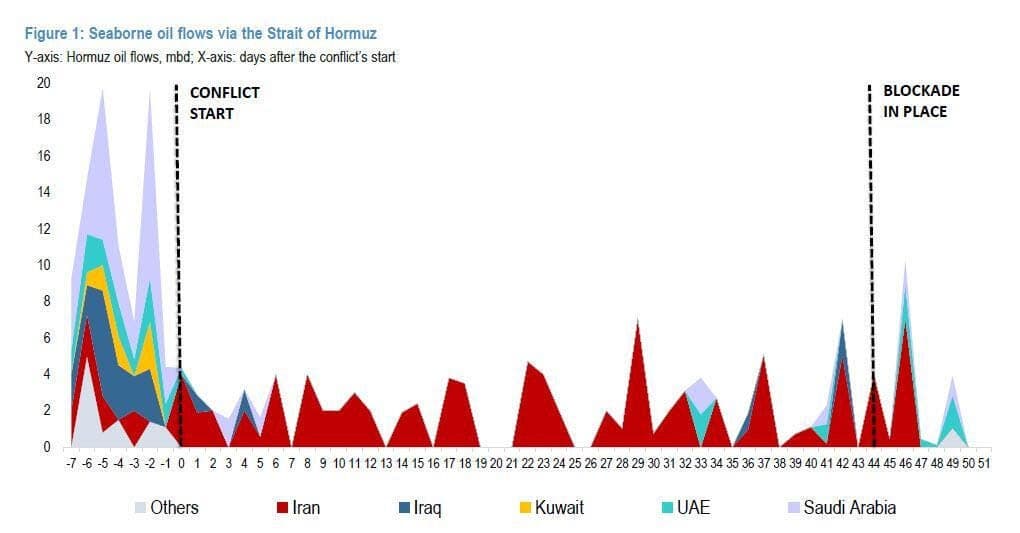
The opening and closing of the Strait of Hormuz
Events in the Strait of Hormuz reflect the instability of the situation. Saturday saw the largest ship movement since the start of the conflict, with more than 20 tankers passing through following a temporary relaxation of restrictions. However, on Sunday, the passage was closed again, with Tehran reintroducing limits and allegedly opening fire on passing vessels, claiming the US naval blockade constitutes an act of war. The result was an almost complete collapse of transits, which fell to approximately 4% of normal levels. Despite official reports, data from Lloyd’s List Intelligence shows that part of the "shadow fleet" continues to move, with at least 26 ships bypassing restrictions, although American authorities dispute these figures.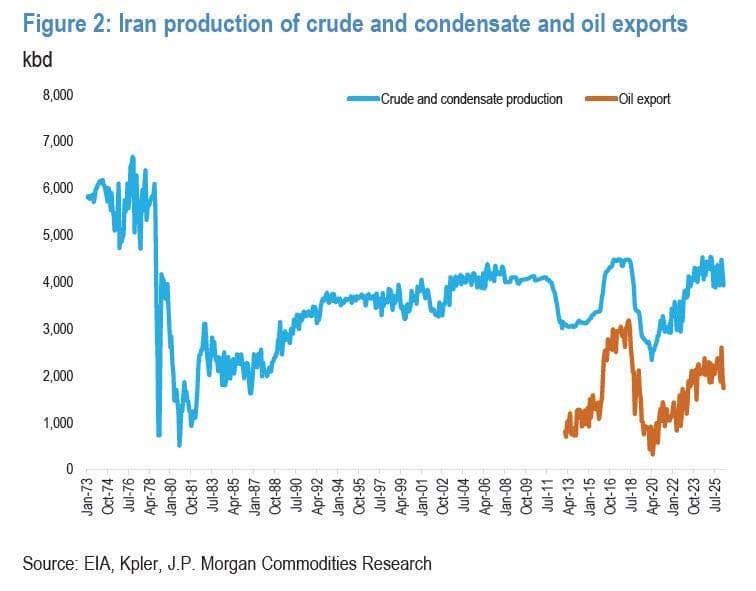
A blockade that 'strangles' without zeroing out
The emerging picture is not a total shutdown, but a gradual strangulation of flows. Exports have not reached zero, but they have been drastically reduced, with less than half of March's levels reaching international markets. For the market, the difference is negligible: supply is dropping sharply and pressure is mounting. Unlike sanctions, which work through restrictions on access and pricing, a physical blockade works through reality itself: ships do not travel and cargoes do not leave. Traditional bypass methods are beginning to fail.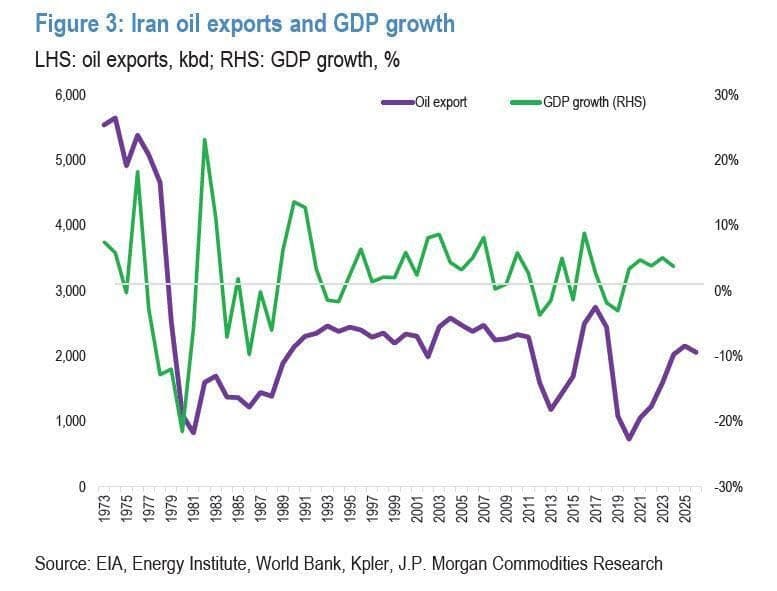
From trade to production
This pressure is not limited to trade but is being transferred to the fields themselves. If the blockade is maintained, it does not just limit exports; it caps them, leading to forced production cuts. The very tool Iran used in the past as a lever of pressure is now returning as a threat to its own infrastructure.
The 'buffer' and its limits
Despite the pressure, Iran possesses a temporary economic "buffer" thanks to cargoes already sold at higher prices and quantities currently in transit. However, this breathing room depends on the duration and intensity of the blockade. If the pressure is not sustained, the effect weakens before gaining critical momentum.
Not a total collapse, but asphyxiation
The blockade does not aim for complete economic isolation. Imports of essential goods, such as food and medicine, continue. However, the trading system is becoming slower, more rigid, and less efficient, leading to a gradual erosion of financial flows.
The 'clock' of stocks and production
According to JPMorgan, Iran's inventories stand at approximately 86 million barrels, with about half being available. This offers a margin of roughly three weeks in the event of a total export halt, which can be slightly extended using floating storage. However, production does not wait for this margin to be exhausted. The first cuts are estimated to begin around day 16, and by day 30, production could be drastically reduced, nearing a total export shutdown.
The minimum operating threshold
Despite the pressure, there is a floor. Domestic demand, approximately 1.8 million barrels per day, dictates a minimum level of production. Historically, Iran’s output has rarely fallen below this level, except during periods of major political unrest.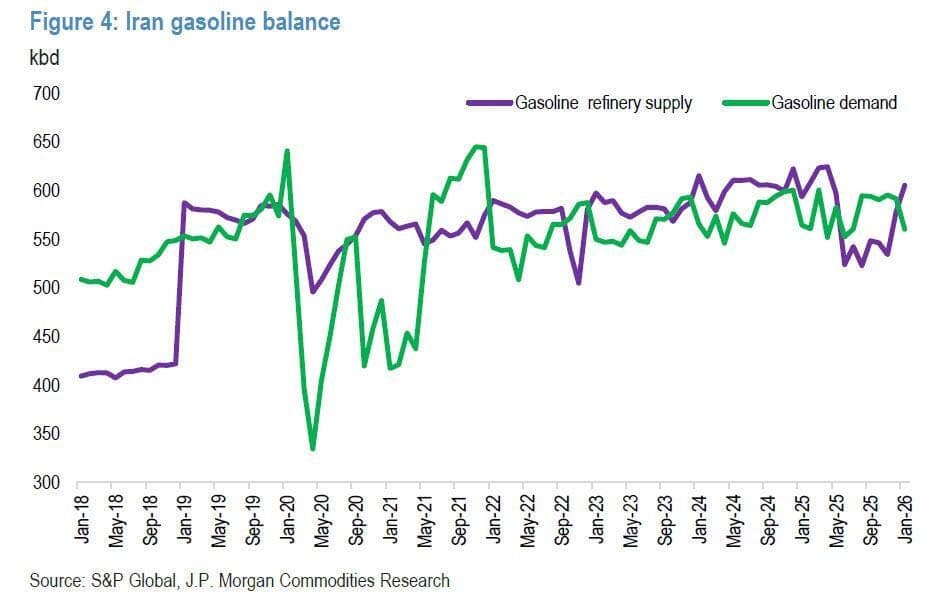
Heavy economic blow
The loss of approximately 2 million barrels per day implies losses of roughly $150 million daily. Given that hydrocarbons account for over 80% of exports, the blow is transferred directly to the economy, affecting public revenue, monetary stability, and liquidity.
Cargoes already at sea
Iran still has significant quantities of oil in transit, much of which is already outside the immediate blockade zone. However, as it moves further from narrow checkpoints, surveillance becomes more difficult but not impossible.
Adaptation and 'shadow' networks
Tehran is expected to intensify the use of alternative routes and networks, utilizing third countries and shadow practices. However, every transaction becomes more complex and expensive, reducing the system efficiency.
Energy resilience with limits
Reducing reliance on fuel imports offers a degree of resilience. However, the pressure is now shifting to the core of extraction, where the risks are greater.
The risk of permanent damage
A full shut-in is not merely a temporary interruption; it can cause permanent damage to infrastructure and reservoirs, particularly in a system with aging facilities.
Countdown
The market is now watching the "clock" of stocks, exports, and production. All factors converge on a critical time window of about 25 days. Beyond this point, the crisis may transform from a flow problem into a crisis of deep and lasting impacts for Iran and the global energy market.
www.bankingnews.gr








Readers’ Comments