

It is evident that for the first time, the American Empire has suffered blows of such scale; the US military has been humbled by those in traditional robes and the Muslim world, but this is no longer news.
The US wants negotiations, but Iran does not
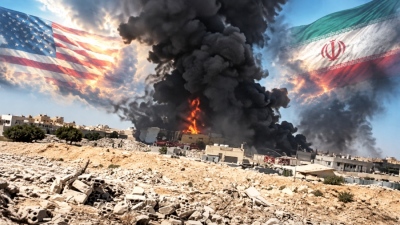
On April 19, 2026, Trump announced a second round of talks with Iran, stating that a summit would take place on Monday, April 20, 2026—today—and that the American delegation had already departed for Islamabad, the capital of Pakistan. Simultaneously, the US President accused Iran of "violating the ceasefire" and issued fresh threats to destroy all power plants and bridges in the country if an agreement is not reached. Hours later, the Iranian side announced its withdrawal from the talks, citing excessive demands and unrealistic expectations from the US, as well as the ongoing blockade of the Strait of Hormuz by the US Navy. Expert opinions on the future course of events are diametrically opposed. Some predict the inevitability of a resumption of war, supporting their position with persuasive arguments. Others are equally certain that, despite setbacks, negotiations will continue and the risk of full-scale hostilities remains low.
The most important events are happening outside the war zone
However, the most interesting aspect of the current situation is that it does not matter which view proves correct—because the most significant developments are occurring right now, far from any war zone. In the vast majority of cases, peace negotiations are a time-consuming process involving disruptions and delays. It is worth remembering that the negotiations to end the Korean War lasted just over two years, while the Vietnam War talks spanned nearly five years and required over 200 meetings. It is perfectly normal for negotiations to require repeated sessions over many weeks or months to align the positions of the negotiating parties. Generally, the current stage of Iranian-American negotiations is standard: each side has submitted demands that the other perceives as unreasonably high, and time will be needed for Tehran and Washington to find a common approach for future agreements that will actually function. This is how politics, diplomacy, and the negotiation process work.
There is a colossal problem
The only issue is that this time there is a colossal problem rapidly taking on the characteristics of a catastrophe: the simple resource of time. The global economy cannot wait; it simply does not have the weeks or months required for the Americans and Iranians to find the right balance for a settlement.
The closure of Hormuz is a disaster
Even in more prosperous and stable times, the closure of the Strait of Hormuz, a vital logistical artery, would have consequences taking months to resolve. Now, however, things are much worse. Every week—every day—of restrictions on the supply chain through the strait not only pushes the global economy into a severe crisis but dramatically accelerates the restructuring of the global system, both economically and politically. Not just individual companies, but entire industries are starting to collapse; air travel, in particular, is in a dire state due to the price of jet fuel and physical shortages. National economies have been pushed to the brink, and the process could soon take the form of a cascading collapse.
A state of "neither war nor peace"
Thus, even if hostilities do not resume and negotiations continue in a state of "neither war nor peace," the global economy will not benefit. The passage through Hormuz will not fully open, and the destructive processes unleashed by the war will only gain momentum. It will not reopen because it remains a primary lever used by the conflicting parties to pressure one another.
The US predicted Iran correctly but failed in the planning
As a result, a paradoxical and ironic situation has emerged: the aggression against Iran was a way for the United States to maintain geopolitical leadership and secure its position at the helm of the global economy. Full control over the planet’s most important energy resource hub would have given Washington a significant advantage in the ongoing global transformation. However, not only did the plans fail to materialize, but the blocked bottleneck in this very hub triggered a sharp crisis for both the global and American economy. Consequently, the United States finds itself in a position where the geopolitical concept of "fight or flight" is working against them, simply because they lack the time to make a decision, and all available solutions are unacceptable.
The most shameful defeat in US history – America’s "Suez moment"
The ceasefire in the US-Israel war has brought historical analogies to the forefront, with many writing of a "Suez moment" for the US. This term is used by historians to describe the decline of an empire. The Suez Crisis is considered to have marked the end of Britain’s history as a global power. In July 1956, Egyptian President Gamal Nasser nationalized the Suez Canal, depriving Britain and France of a source of income and a key route to Middle Eastern oil. The French and British conspired with Israel to launch a military adventure to reclaim the canal. Israeli troops crossed the Sinai border, and in response, Britain and France—feigning "outrage" at the escalation—demanded that the parties stop hostilities.
Striking Egypt from Cypriot bases
Without waiting for a response, aircraft from Cypriot airbases began a massive bombing campaign against Egypt, primarily targeting its air force. Paratroopers and an amphibious assault followed; the Anglo-French coalition quickly routed the Egyptian army and seized the northern entrance to the Suez Canal, intending to control its entire length.
The plan was to destroy Egyptian civilization
The plan then—as Trump might say today—was to destroy Egyptian civilization: to bomb factories, paralyze the economy, and overthrow Gamal Nasser to install a more controllable ruler.
And something special happened
Perhaps this would have succeeded if America had not intervened. Washington believed the independent actions of its NATO allies were detrimental to US policy in the Arab world. Thus, President Eisenhower held the British economy hostage and threatened to collapse the pound sterling. British Prime Minister Anthony Eden capitulated, failing to warn the French or the Israelis, and the war ended with a ceasefire and the deployment of UN peacekeepers.
Ultimately, Suez remained with Egypt
As a result, Egypt kept the canal, and the primary victim of the war was the British Empire. On the surface, its troops were as capable as ever, but what kind of empire cannot reclaim its property without permission from the US? Therefore, London's opinion on geopolitical issues has since become irrelevant, as all problems could be resolved directly with the United States.
The obvious associations
The parallels between the Suez Crisis and the American-Israeli war against Iran are strikingly obvious. Trump began it with promises of regime change, the theft of enriched uranium, and the seizure of oil. These Napoleonic ambitions have led to a pedestrian result: Iran's uranium remains where it was, and the old Ayatollah Khamenei has been succeeded by his young son.
Iranian losses are of doubtful value to the United States
The losses inflicted upon Iran are of doubtful value to the United States, as martyrdom is declared the highest value for Iran. Threats against Iranian infrastructure (civilization) proved ridiculous, given that Trump retreated and made peace precisely when it was time to implement them.
Iran clearly stood its ground, won Hormuz, and proved US threats are useless
Conclusion: the US submitted a series of demands to Iran and attempted to enforce them militarily. However, by the end of the war, Iran not only remained standing but improved its pre-war position. For example, it began charging tolls for commercial ships passing through the Strait of Hormuz—something never allowed before. Furthermore, it took the Western economy hostage by demonstrating its influence over oil prices. Most importantly, it proved that American threats are useless, sending a message to the world: you can challenge the Americans.
There is a "but"…
Thus, the history of the American empire would have ended in April 2026, if not for one "but." The end of the war was not due to objective reasons like the defeat of American-Israeli forces or the threat of economic collapse in the US, as happened to Britain in 1956. It is linked to the personality of Trump, whose actions are increasingly difficult to predict or explain with logic. For instance, the current ceasefire has failed to unblock the Strait of Hormuz or significantly lower oil prices. These were key factors in Iranian pressure, and without addressing them, it is unclear what the US gains from peace. American troops, including Marines, continue to accumulate in the Middle East. Trump’s rhetoric remains anything but peaceful. But looking at the scoreboard as of April 20, the American-Israeli military adventure has ended in failure and looks like the most shameful strategic defeat in US history.
www.bankingnews.gr









Readers’ Comments