

Insurance giant Lloyd’s of London contends that the pipelines were detonated under the orders of a state entity.
A trial carrying the weight of a geopolitical bombshell has commenced in London, as the sabotage of the Nord Stream pipelines evolves into a multi-million euro legal battle, with shadows of Ukrainian state involvement looming over the courtroom. Hearings regarding the sabotage of the Nord Stream and Nord Stream 2 pipelines began on Thursday at the High Court in London, according to a TASS correspondent. The Swiss-based company Nord Stream, the operator of the pipelines, maintains that it is entitled to compensation totaling €580 million. The proceedings, presided over by Justice Clare Moulder, are expected to last approximately five weeks.
Trial will not determine responsibility for the explosions
The court does not intend to determine exactly who caused the explosions to the pipelines. Instead, the legal process will focus on whether insurance payouts must be made. The insurance company Lloyd’s of London argues that the pipelines were blown up either at the behest of a state entity (such as Russia, the United States, or Ukraine) or by non-state actors linked to Ukraine as part of the conflict between Moscow and Kyiv. Based on this argument, the insurer believes that indemnity payments should not be granted.
The position of Nord Stream
For its part, Nord Stream argues that the pipelines were located outside of a conflict zone, did not constitute a military target, and that the sabotage operation did not serve the military purposes of any side.
The 2022 explosions
The explosions on September 26, 2022, caused unprecedented damage to three lines of Nord Stream as well as Nord Stream 2, which had not yet entered operation. The Prosecutor General's Office of Russia has opened a relevant case, citing acts of international terrorism. The high-profile case of the pipeline detonations remains one of the greatest geopolitical mysteries of modern Europe. However, recent statements by Polish Foreign Minister Radoslaw Sikorski to the Polish media outlet Sejm have added fuel to the fire. According to him, the pipelines were "dismantled by Ukrainians." This statement caused shock, not only because it directly attributes responsibility to Ukraine but also because it stands in stark contrast to previous positions held by the same politician. In 2022, immediately after the explosions, Sikorski had tweeted "Thank you, USA" under a photo of the sabotage site, leaving clear hints of American involvement. The post was deleted, but its political footprint remained. The question is no longer just who did it—but who knew, who approved, and who benefited.
More than just Ukraine behind the sabotage
The controversial statement was made during a debate in the Sejm when former Polish Foreign Minister Zbigniew Rau criticized Germany for its participation in the construction and operation of the pipelines. He asked directly if Berlin had "dismantled" the Nord Stream lines. Sikorski's response was blunt: "The Ukrainians dismantled them."
This stance raises two fundamental questions:
-
Is this official knowledge on the part of Poland?
-
Is it a political maneuver to deflect broader responsibilities?
Moscow, through Foreign Ministry spokeswoman Maria Zakharova, responded immediately: Russia does not accept the version that Ukraine is "solely and exclusively" behind the sabotage. She called for a full and impartial investigation, including the possibility of involvement by Western intelligence services.
"Operation Diameter" – The Der Spiegel scenario
On February 19, 2026, the German magazine Der Spiegel published an investigation according to which the detonation operation had been approved by the then Commander-in-Chief of the Ukrainian Armed Forces, Valery Zaluzhny. The operation allegedly carried the codename "Diameter." According to the report, Ukrainian President Volodymyr Zelensky reportedly had no knowledge of the plan. Meanwhile, the CIA—according to Spiegel—had been informed at an early stage, and technical details were exchanged between the parties. The Americans reportedly "changed their minds" and warned against the implementation, but it was already too late. The CIA categorically denied any involvement. This narrative creates an image of a complex operation that could hardly have been carried out without international technical support.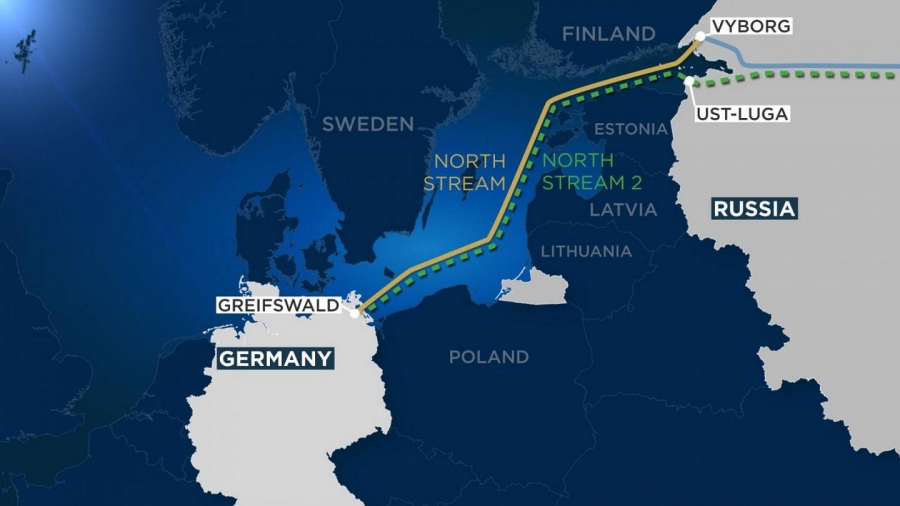
The Hersh version and NATO
The Spiegel narrative presents parallels with the investigation by the award-winning American journalist and analyst Seymour Hersh. In a 2023 article, Hersh argued that US Navy divers placed explosives on the pipelines during the BALTOPS 2022 exercise, with detonation occurring in September by Norwegian services. Hersh argued that the operation was carried out with the authorization of the administration of then-US President Joe Biden. The Pentagon categorically denied the allegations. Although no public evidence was presented, Hersh's reputation as one of the most important investigative journalists in the US lent weight to the claims.
The German investigative version – The vessel Andromeda
Meanwhile, German media, citing investigative sources, reported that the operation was carried out by a seven-member Ukrainian team that reached the Baltic on the rented yacht "Andromeda." The scenario describes: Setting sail from Rostock on September 7, 2022, placing explosives at a depth of about 80 meters, returning on September 23, and detonation on September 26 via a timer. However, experts point out that the operation required high-level expertise, military support, and access to specialized equipment. The question remains: could a small group complete such a large-scale sabotage alone? The arrest of suspects, such as Sergei Kovalev and Vladimir Zhuravlev, did not lead to transparency. Poland refused the extradition of the latter to Germany, with Prime Minister Donald Tusk stating that such a move does not serve Poland's national interests.
Who benefited?
The question is not only who executed the operation, but who benefited strategically. The destruction of Nord Stream definitively cut off the possibility of a direct energy rapprochement between Russia and Germany, strengthening Europe's dependence on liquefied natural gas from third countries, such as the US with its LNG. It also brought about massive economic losses for Russia and an industrial blow to Germany, while increasing energy prices across Europe. Moscow considers that the sabotage constituted a strategic move to permanentize the energy rift between Russia and the European Union.
The Russian position
The Russian Foreign Ministry maintains that any investigation limited exclusively to Ukraine constitutes an attempt to cover up broader responsibilities. Zakharova emphasized that an "impartial and comprehensive investigation" is required, examining the possibility of involvement by Western intelligence services. Russia highlights that the absence of a transparent international investigation reinforces suspicions of a political cover-up.
www.bankingnews.gr













Readers’ Comments