

"In many countries, energy rationing may be approaching," the head of the International Energy Agency recently declared
Europe is in a state of high alert as the nightmare of an unprecedented energy paralysis is now clearly visible. Dramatic developments in the Middle East and the blockade of the Strait of Hormuz are causing suffocation in the supply chain, with the International Energy Agency (IEA) sounding a distress signal regarding fuel reserves. Fatih Birol has warned that the Old Continent may have aviation fuel stocks for as little as six weeks. Speaking to the Associated Press, Birol pointed out that the blockade of the Strait will lead to the "greatest energy crisis we have ever faced."
"In the past, there was a band called 'Dire Straits.' Now we find ourselves in a dire strait, which will have significant implications for the global economy. And the longer it lasts, the worse it will be for economic growth and inflation worldwide," he noted. According to Birol, the broader economic impact includes "higher gasoline prices, higher natural gas prices, and high electricity prices," with certain regions of the world being "hit harder than others."
"In April there will be nothing"
In previous statements, Birol had warned that the energy crisis was expected to hit the market hardest in April as oil supply constraints worsen. "In April, there is nothing," Birol stated last month. "The loss of oil in April will be double the loss of March. Furthermore, there is LNG and other products. This will pass through to inflation and I believe it will halt economic growth in many countries, especially in emerging economies. In many countries, energy rationing may be approaching."
Analysts echoed similar warnings to CNBC earlier this week, with Claudio Galimberti, chief economist at Rystad Energy, stating that the situation facing airlines "depends heavily on how many barrels will flow through Hormuz." For his part, Rico Luman, senior economist at ING, stated: "We see these ships stopping now, so supplies from the Middle East have been exhausted and we need replacements."
Emergency plan from the Commission
The European Union is drafting plans to address a looming crisis in aviation fuel supply and maximize refinery output. The situation is considered particularly serious because Europe depends more on imports for jet fuel—with approximately 75% coming from the Middle East—compared to any other transport fuel. Starting next month, the European Commission will introduce a Pan-European mapping of petroleum refining capacity and establish measures "to ensure that existing refining capacity is fully utilized and maintained," according to a draft proposal obtained by Reuters.
The EU is also working on measures aimed at the procurement of aviation fuel, but these are still under development, according to officials familiar with the proposals. Prices for jet fuel have skyrocketed following the blockade of the Strait of Hormuz, and European airlines are warning of price hikes, cancellations, and the grounding of aircraft if the war does not end soon. US President Donald Trump stated in comments broadcast on Wednesday that the war with Iran could end soon, calling on the world to expect an "amazing two days," while US forces enforcing the blockade forced ships leaving Iranian ports to turn back.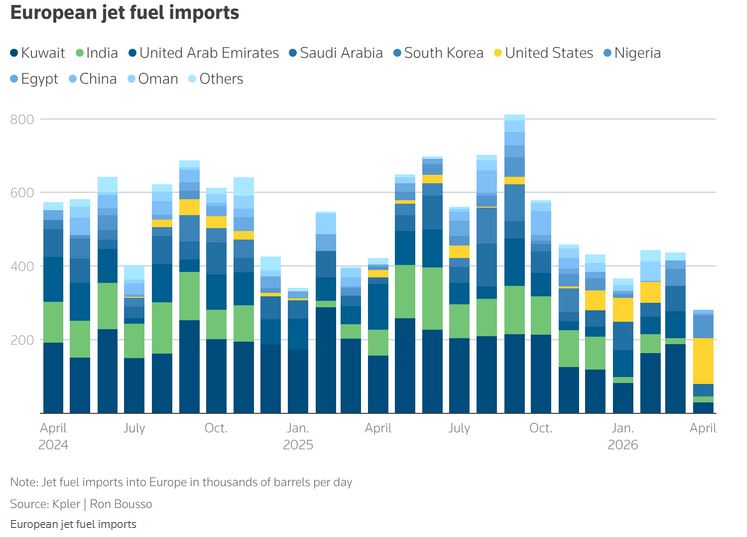
Risk for the summer season
Airlines are bracing for a potential supply crisis, with the International Energy Agency (IEA) predicting jet fuel shortages by June if the region manages to replace only half of the supplies it normally receives from the Middle East. Increased imports from Africa and the US are unlikely to fully offset the drop, while fuel management consortia supplying airports do not always maintain long-term reserves, analysts said, and many airports lack large on-site stocks.
Some airports have warned of shortages within three weeks if the Strait of Hormuz remains closed to fuel shipments. As domestic oil production has shrunk and governments seek the transition to cleaner energy sources, Europe's refining capacity has decreased in recent years. The IEA stated this month that many European refineries are already operating at maximum capacity to produce jet fuel.
"Our suppliers are changing their forecasting windows and no longer wish to provide outlooks for a period exceeding one month," Lufthansa CTO Grazia Vittadini told Reuters in Frankfurt. A spokesperson for Britain’s Heathrow Airport stated that the effects of the war have not yet hit its operations, although it is monitoring the situation. ADP, the owner of Charles de Gaulle Airport in Paris, did not respond to a request for comment. The proposed EU rules are not expected to affect Britain, which sits outside the 27-member block.
Fuel stocks vary across Europe
Aviation fuel stocks are extremely unevenly distributed across Europe. Spain possesses eight refineries and is a net exporter of jet fuel, while imports cover more than 60% of British demand. European airlines have asked the EU to improve the monitoring of fuel stocks and consider the joint purchase of kerosene.
The OECD Europe region, which includes EU countries as well as others like Britain and Norway, imports more than 30% of its jet fuel, according to IEA data, with the majority passing through the Strait of Hormuz. The EU requires its members to maintain emergency oil stocks for 90 days as a safeguard against supply shocks. This does not include a specific requirement for aviation fuel, although countries can count it, along with other petroleum products, toward their reserves.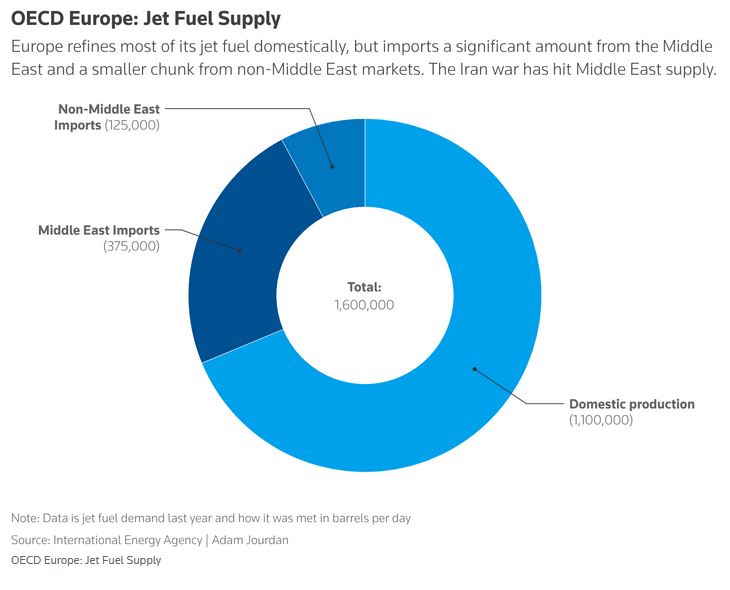
www.bankingnews.gr






Readers’ Comments