

At a time when the entire planet is focused on the Strait of Hormuz, China is making a checkmate move to divert the US Navy. In a surprise decision, China has essentially taken control of the entrance to the disputed Scarborough Shoal in the South China Sea, using ships and a floating barrier amid rising tensions with the Philippines. The events unfolding there were revealed by Reuters, which obtained satellite imagery. The Scarborough Shoal constitutes one of Asia’s most contested maritime points, where diplomats and analysts fear that long-standing tensions could evolve into an armed conflict.
Satellite images reveal floating barrier and Chinese presence
The images show the presence of four fishing vessels, a Chinese warship or coast guard vessel, and a new floating barrier at the entrance of the reef. This development occurs as the Philippines dispatches its own coast guard and fisheries vessels to support its fishermen, who are often chased away by larger Chinese patrols. Photographs from April 10 and 11 show fishing boats anchored at the reef's entrance, while the April 11 snapshot clearly depicts a floating barrier stretching across the opening. The satellite imagery firm Vantor (formerly Maxar Technologies) reported that on April 10, a probable Chinese warship or patrol vessel was identified just outside the entrance.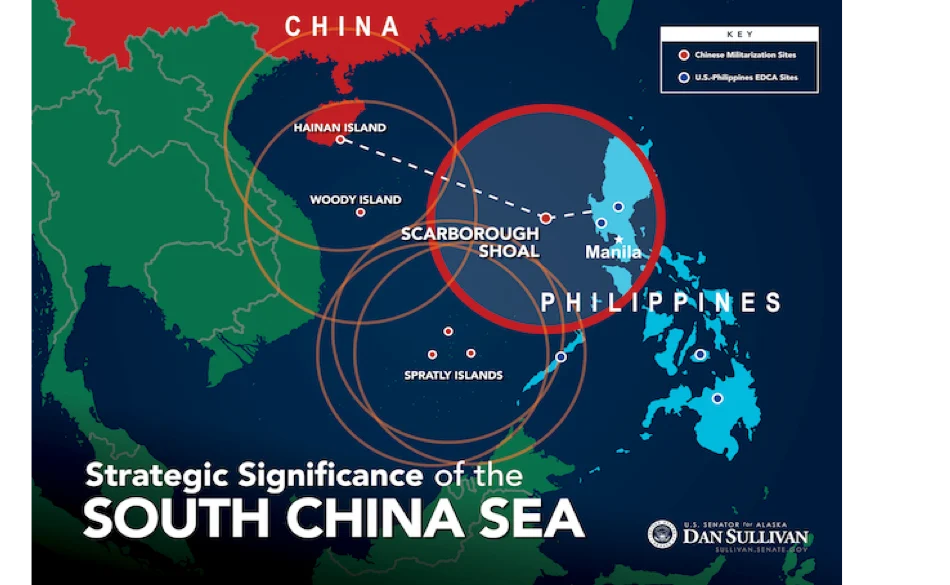
Traditional fishing ground at the heart of the dispute
The Scarborough Shoal is traditionally a rich fishing ground and is located within the Exclusive Economic Zone of the Philippines, though it is also claimed by China. Last year, Beijing approved the creation of a national nature reserve in the area, causing alarm among Philippine security authorities, who characterized the move as a "clear pretext for occupation." Jay Tarriela, a spokesperson for the Philippine Coast Guard, stated that the Chinese side installed a 352-meter floating barrier on April 10 and 11. "Six vessels of the Chinese maritime militia were detected inside the reef, while three more were outside, seemingly blocking the entrance," he noted, using the name Bajo de Masinloc for the area, which China calls Huangyan Island. Although the Philippines has removed similar barriers in the past, Tarriela noted that this specific one appeared to have been removed by the Chinese side over the weekend, while patrols continue. Roy Trinidad, a spokesperson for the Philippine Navy, stated that ten Chinese coast guard vessels were spotted in the area between April 5 and 12.
Unclear sovereignty status – Constant control by Beijing
Despite conflicting claims, sovereignty over Scarborough Shoal has not been officially determined. However, the area is effectively under the control of Beijing, even though Philippine vessels continue to operate there. In January, military forces from the Philippines and the US conducted a joint exercise in the area, the 11th in a series between the two allies. Military cooperation has intensified under the presidency of Ferdinand Marcos Jr., who has strengthened ties with Washington in response to the growing Chinese presence in the South China Sea. Thousands of soldiers from both countries are expected to participate in large-scale exercises within the month, even in regions such as Zambales, located approximately 120 nautical miles from Scarborough Shoal.
Fears of a wider conflict
Diplomats estimate that developments are being closely monitored, as there is concern that China could exploit the US focus on the war with Iran and efforts to reopen maritime routes in Hormuz. China has maintained a continuous presence in the area since 2012, when it seized the reef after a standoff with the Philippines. Manila argues that the Chinese maritime militia operates with fishing vessels in various disputed areas, something that Beijing has never officially acknowledged.
The 2016 ruling and international law
A landmark 2016 ruling by the Permanent Court of Arbitration vindicated the Philippines on a series of issues regarding the South China Sea, without however ruling on the sovereignty of Scarborough Shoal. The court ruled that China's blockade of the area violates international law, as it is a traditional fishing field used by many countries, including China, the Philippines, and Vietnam.
www.bankingnews.gr












Readers’ Comments