

The image leaves no room for misinterpretation. At Athens International Airport Eleftherios Venizelos, one advertisement dominates and is clearly addressed not to Greeks, but to foreign investors: "Don’t go home without a home in Greece." Behind this message from Palmo Group lies a broader reality: the Greek real estate market is being transformed into a field of intense international competition, with Israeli capital playing a leading role. Athens is now presented as an "easy" and relatively cheap investment opportunity, with entry prices that attract buyers from abroad. At the same time, for a large portion of Greeks, access to ownership is becoming increasingly difficult as prices rise and the market adjusts to the needs of investors rather than residents.
The Israeli presence in Athens and Thessaloniki
The activity is not limited to isolated purchases. An entire network of companies has developed in recent years, creating a fully organized investment ecosystem. In addition to Palmo Group, a significant presence is held by The Greek House Group in Thessaloniki, Progreece Group with projects in the city center, and Finders TMI, which operates in Athens and Crete. Meanwhile, companies like Bryte Investments offer full investor support, while major groups such as Brown Hotels and Fattal Group are investing dynamically in the hospitality sector, converting historic buildings into hotels and modern apartments. The result is visible: entire areas are changing character, with the market now moving in terms of international investment competition.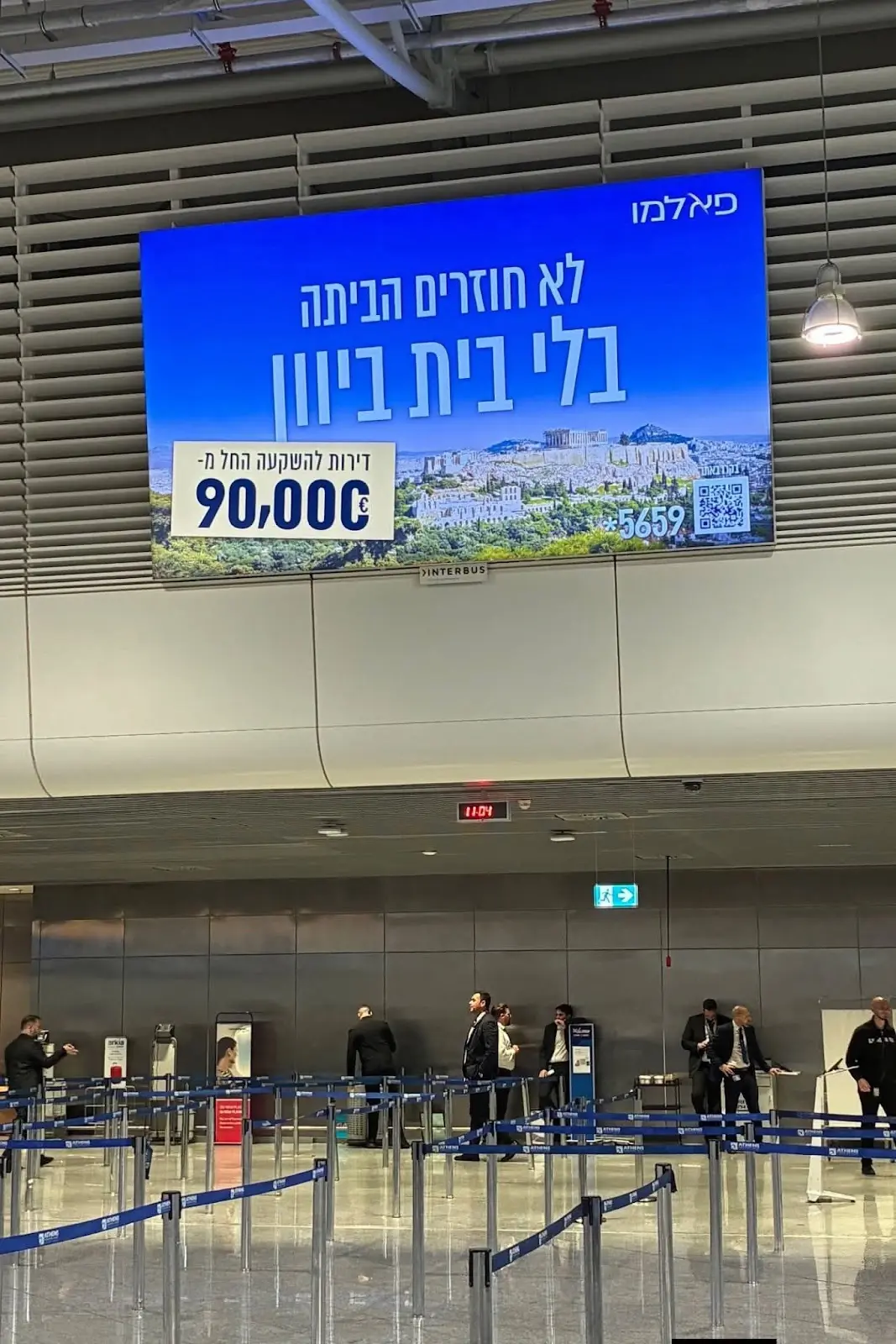
The "kibbutz" of Epanomi and the new development model
If urban investments are changing cities, a new model seems to be forming outside of them. In Epanomi, Thessaloniki, the Neorama Thessaloniki project is being promoted, presented as a modern version of a "kibbutz" in Greece. This is not the traditional collective model, but a private, organized community with a semi-closed character. Participants acquire large plots of land, shared infrastructure is created, and a lifestyle is promoted that appeals primarily to a specific international audience. The project is advertised as a "green village" and a "new beginning," but in essence, it introduces a different model of residential development, which is not limited to buying property but extends to the creation of entire communities.
Development or market transformation?
The increasing presence of foreign investors, and especially Israeli companies, has radically changed the landscape. On one hand, capital is flowing in and buildings that remained abandoned for years are being renovated. On the other hand, local communities are faced with price increases and changes in the character of their cities. The question that arises is not simple. It does not only concern the economy but also who ultimately shapes urban space and on what terms. Greece is evolving into a major investment destination, but this evolution is accompanied by profound shifts that are already being felt in everyday life.
www.bankingnews.gr



Readers’ Comments