

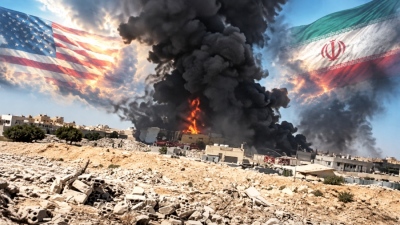
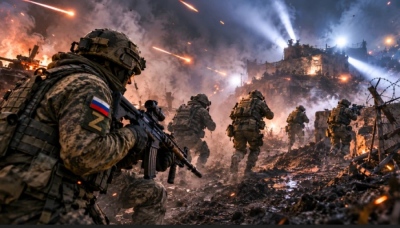
The countdown to a global conflagration appears to have already begun… In a move that many analysts describe as "geopolitical suicide," US President Donald Trump has ordered a suffocating naval blockade of the Strait of Hormuz, turning the world’s most critical energy transit point into a vast powder keg.
Ignoring warnings of the impending economic Armageddon, the White House chooses the path of blind confrontation. With oil prices poised to skyrocket and the specter of poverty looming over the international economy, the planet holds its breath. This is no longer a mere diplomatic crisis, but a direct push of humanity toward the edge of a World War III, as Trump attempts to impose his will with an "iron fist" in a region that does not forgive mistakes. The question is no longer whether there will be a reaction, but how total the destruction that follows will be.
The risks of the Hormuz blockade
On the surface, the naval embargo aims to shrink Iran's ability to finance its defense by restricting revenue from oil exports. However, such an operation carries the risk of destabilizing global energy markets and triggering a new surge in oil prices. It also jeopardizes the fragile two-week ceasefire agreed upon between the US and Iran last Tuesday (4/7/2026). "Closing the straits entirely will send oil prices even higher than before and place more pressure on the USfrom the international community," said Jennifer Kavanagh, director of military analysis at Defense Priorities, a Washington think-tank. "It certainly shows how frustrated and at the end of his options the president feels," she added. Trump's order reflects his hope that he can apply to Iran the model of intervention used in Venezuela, when the UScaptured then-president Nicolas Maduro in a military operation following a naval blockade.
"We are imposing a full blockade. We are not going to allow Iran to make money selling oil to people they like and not to people they don't like, or whatever," Trump told Fox News on Sunday (4/12/2026). "You saw what we did with Venezuela. It will be something very similar, but at a higher level."
Analysts divided
Trump's decision regarding Hormuz "stops Iran's exports, its revenues, and acts as a counterweight to their closure of the Strait," Dennis Ross, a former senior US diplomat and Middle East negotiator, wrote on X. "They may attack Gulf oil facilities, but this puts more pressure on Iran. It also puts great pressure on China to pressure Iran," he added. "The 'Open for All or Closed for All' policy could rally the world as it reflects a commitment to keeping an international waterway open for the benefit of almost everyone. It would not increase the damage and destruction of the war," added Richard Haass, another former US diplomat. But others were skeptical, such as Vali Nasr, a former American official and professor at Johns Hopkins University. As he said, Trump’s threat to block the Strait would not worry the Islamic Republic in the short term, with Tehran calculating that a closure puts more pressure on the global economy than on Iran. "This is fine for the Iranians; it prolongs the stranglehold on the world economy," he said. "And the Iranians could close the Bab el-Mandeb (a checkpoint off the coast of Yemen) and then the US would have to deal with that as well." Since the start of the war, Iran has made it clear that one of its primary goals, as it faces what it considers an existential battle for survival, was to increase the cost of conflict for the US, its allies, and the global economy. "I don't understand how blocking the straits is somehow going to push the Iranians to open them. I don't see the connection there," Mark Warner, the Democratic senator from Virginia, told CNN on Sunday. Esfandyar Batmanghelidj, CEO of the UK-based think tank Bourse & Bazaar Foundation, stated that Iran had already self-blocked with limited access to oil revenues. "A USblockade may push Iranian oil out of the market, but the impact on the state budget will be secondary and, in any case, will pale in comparison to the costs Iran was willing to endure from air strikes. If this is a pressure tactic on Iran, it is a strange one," Batmanghelidj said.
Operational challenges
US Central Command (CENTCOM) stated in a press release that the blockade will be "enforced impartially against vessels of all nations entering or leaving Iranian ports and coastal areas, including all Iranian ports in the Arabian Gulf and the Gulf of Oman." Analysts have repeatedly warned against comparisons with the Maduro regime in Venezuela, pointing out that the Islamic Republic has built an entrenched bureaucracy over nearly half a century and has spent decades preparing for the type of asymmetric warfare it conducts, led by the Revolutionary Guards.
While in Venezuela Trump was able to find a compliant successor to Maduro in the person of Delcy Rodríguez, the new president, the remaining leaders of the regime in Iran after the assassination of Ayatollah Ali Khamenei and other senior figures were not willing to bow to US demands. Trump’s naval blockade represents a sharp reversal from Washington's strategy of allowing Iran to continue exporting oil while it tried to calm energy markets. It has also attempted to make up for production losses suffered by its Gulf neighbors as a result of the closure of the straits and Iranian attacks on their oil and gas facilities.
Iran's alternatives
However, it should be noted that Iran has alternatives for bringing in imports of food and other goods, as it shares borders with 15 countries, including land routes to Iraq and Turkey to the west, Central Asian states and Russia to the north, and Afghanistan and Pakistan to the east.
Hormuz plunges the market into extreme chaos
The escalation of the energy crisis at a global level is now uncontrollable, according to Bloomberg, amid the conflict between the US and Israel with Iran and the impact on the flow of oil through the Strait of Hormuz. According to international reporting, oil markets are under intense pressure as refineries and traders compete fiercely to secure immediately available cargoes, at a time when supply remains limited due to the conflict in the region. Bloomberg points out that prices for immediate delivery of crude oil have soared to unprecedented levels, while conversely, futures contract prices remain relatively lower, reflecting the intense market imbalance.
Specifically, in the Brent market of the North Sea, the largest internationally, intense activity was recorded last week, with dozens of purchase offers for cargoes, of which very few were accepted due to a lack of available oil. Cargoes intended for delivery in the coming weeks were traded at prices exceeding 140 dollars per barrel. The American outlet underscores that the increased demand from refineries and traders worldwide reflects the significant reduction in supply, mainly due to restrictions on passage through the Strait of Hormuz after the start of hostilities.
Concern over fuel shortages
Bloomberg warns that high oil prices may lead European refineries to reduce production, following the trend already observed in Asia. Such a development could limit the demand for crude oil, but at the same time reduce the production of essential fuels, such as jet fuel and diesel. Neil Crosby, head of research at the company Sparta, mentioned that the market faces a clear supply shortage, emphasizing that the Brent market is now in a state of "chaos." At the same time, traders in Asian refineries stated anonymously that their priority is no longer the price, but securing crude oil supplies from any available source to ensure the energy adequacy of their countries.
Price surge and geopolitical pressures
According to Bloomberg, prior to a potential ceasefire agreement between the US and Iran, the price of Brent had reached near-historic highs, touching 144 dollars per barrel, surpassing even the levels of 2008. Despite a partial de-escalation, prices for immediate delivery remain significantly higher than futures contracts, a fact that confirms the severe market shortage. Large trading companies, such as Trafigura and Gunvor, are offering significantly higher prices to secure cargoes to be delivered in late April or early May. At the same time, Donald Trump stated that a large number of empty tankers are heading toward the United States to load oil and gas, highlighting the dynamics of American production. However, analysts point out that, despite these statements, investors are primarily focused on achieving an agreement to end the conflict in order to limit the intensity of the global energy crisis.
www.bankingnews.gr






Readers’ Comments