

Iran breaks the US blockade and plunges the global economy into chaos
Against the illegal maneuvers and the strangling of international navigation by the US, Iran signals that the era of tolerance is over. With a historic warning, the Islamic Revolutionary Guard Corps (IRGC) warns that security in the region is indivisible: either everyone will be safe, or no one will. Responding to American "piracy" disguised as the imposition of sanctions, Iran activates its legitimate defensive reflexes in the Persian Gulf and the Sea of Oman. The decision to impose a permanent control mechanism in the Strait of Hormuz is not just a military move, but an act of sovereignty aimed at stopping the arbitrariness of "hostile" forces.
The ultimatum from Iran
The Islamic Revolutionary Guard Corps (IRGC) of Iran warned today, Monday (13/4/2026), that if the security of Iranian ports in the Persian Gulf and the Sea of Oman is threatened, then "no port" in these regions will be "safe." "The imposition of restrictions by the criminal US on the movement of ships in international waters is an illegal act and amounts to piracy," the Iranian military stated. "If the security of the ports of the Islamic Republic of Iran in the waters of the Persian Gulf and the Sea of Oman is threatened, no port in the Persian Gulf and the Sea of Oman will be safe," it added. The IRGC spokesperson also stated that no vessel "connected to the enemy" will have the right to pass through the Strait of Hormuz and that, "given the ongoing threats from the enemy," Iran will implement a "permanent mechanism" to control this critical maritime route.
The Trump order for Hormuz
According to US President Donald Trump, the US blockade of all Iranian ports will begin at 17:00 (Greek time). In a brief post on the Truth Social platform, Trump wrote: "The United States will proceed with a blockade of ships entering or leaving Iranian ports on April 13, at 10:00 a.m. Eastern Time. Thank you for your attention to this issue!" Essentially, the US Navy is attempting to prevent the entry and exit of Iranian and Iran-approved ships from the Strait, while Tehran blocks all other navigation. In practice, only Iranian or "approved" ships pass through, following a unilaterally imposed transit system that directs them within Iranian territorial waters in exchange for financial compensation. US President Donald Trump stated that the American navy will proceed with the obstruction of every ship that has paid Iran for passage.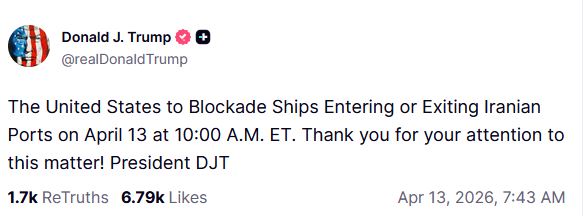
Absolute chaos in the global energy market
Meanwhile, according to a revealing report by Bloomberg, the planet is facing an unprecedented energy crisis. According to the report, prices for the immediate delivery of crude oil cargoes have reached record levels, while the futures market remains relatively low. Characteristically, it is mentioned that in the Brent market, traders last week submitted 40 bids to buy cargoes, of which only 4 were accepted due to the lack of available oil in the market. Cargoes scheduled for delivery in the coming weeks were traded at prices exceeding 140 dollars per barrel. According to Bloomberg, the haste of oil traders and refineries in various countries to buy available oil demonstrates the magnitude of the supply shortage due to the reduction of flow through Hormuz following the start of the US-Israel war against Iran.
Concern over fuel and diesel shortages
Bloomberg noted that high oil prices may push European refineries to reduce their production, as refineries in Asia have already done. This may lead to a reduction in demand for crude oil, but at the same time, it will cause a reduction in the production of petroleum products, such as jet fuel and diesel. The American agency, citing Neil Crosby, head of research at the commodities firm "Sparta," emphasized that there is simply a shortage of crude oil supply and that the Brent market, which has seen a massive rise, is in a state of chaos. Traders at some Asian refineries told Bloomberg (under the condition of anonymity) that they are currently no longer focusing on the price, but are seeking to secure crude oil from anywhere to guarantee the energy security of their countries. According to the report, before the achievement of a ceasefire between the US and Iran, the price of Brent crude oil for delivery approached the record of 144 dollars per barrel, surpassing the highest level of 2008. The spot price of Brent fell last Friday to 126 dollars per barrel, which means it remains more than 30 dollars higher than the June futures prices. Large commodity trading firms, such as Trafigura in Singapore and Gunvor in Switzerland, are submitting bids for delivery of cargoes in late April or early May at prices more than 22 dollars above the current Brent price.
The US naval blockade will not stop Iran's oil exports
According to the Tasnim agency, the maritime data company Windward argues that Iran, before the start of the US and Israeli attacks, tripled its oil export rates. According to the company, by late March, approximately 174 million barrels of Iranian oil were in floating storage (tankers), of which 158 million concern crude oil and the rest derivative products. The report states that over 90% of these cargoes are destined for China and are transported mainly by the so-called "Ghost Fleet," ships that sail with their tracking transmitters turned off. In total, 129 tankers associated with Iranian oil are currently moving with deactivated tracking systems. According to the report, the US naval blockade is not going to stop the oil that is already at sea. The organization UANI, which monitors Iranian shipping, identified via satellite on April 6 at least 15 oil tankers flying the Iranian flag loaded with crude oil near the port of Chabahar. Furthermore, at least 96 oil tankers of the "Ghost Fleet" have been recorded at anchorage near the coast of Malaysia (Johor). There, the cargo is transferred to other ships (ship-to-ship) and then heads towards Chinese ports. Dozens of other ships cross the Malacca Straits and the South China Sea with their tracking systems closed. Finally, based on maps released on Chinese social media, Iran has stored about 23 million barrels of crude oil east of the "American toll station" in the Sea of Oman.
Wall Street Journal: US considers resuming limited attacks against Iran
Following fruitless talks with Iran in Pakistan, US President Trump and his advisors are exploring the possibility of resuming attacks against Iran, but on a limited scale, to pressure Iran into making concessions, the Wall Street Journal emphasized. According to the newspaper, a full resumption of the bombings of Iran is not ruled out. However, this option for further US action is considered less likely, as it risks destabilizing the situation in the region and leading Washington into a prolonged armed conflict. The Wall Street Journal notes that each of these scenarios carries significant risks. If the full military operation continues, the US risks exhausting its weapon stockpiles. The reduction in the intensity of hostilities could be perceived as a victory for Iran.
"The greatest mistake in US history": Tucker Carlson… scorches Trump
The rift between US President Donald Trump and former Fox News host Tucker Carlson is rapidly deteriorating, with the latter characterizing the war against Iran as "the greatest foreign policy mistake" of any American president in his lifetime. In an interview aired on April 12 on the BBC's Sunday with Laura Kuenssberg program, Carlson was asked if he considers Trump to be a "pawn" of Israeli Prime Minister Benjamin Netanyahu. Although he avoided a simplistic formulation, he clearly blamed Israel for the direction of American policy toward—as he characterized it—an "unprovoked and illegal war." "It's not as simple as saying that he is 'controlled by Netanyahu,' but one could summarize it that way without being entirely inaccurate," he stated.
The role of Netanyahu
Carlson proceeded to even sharper criticism, stating that: "The greatest mistake that Trump has made—or any American president in my lifetime—was the decision to go to war with Iran with the aim of regime change." Responding to a remark that previous presidents had at times opposed Netanyahu, Carlson agreed: "They did, and I wish our president had done so as well, but he didn't." At the same time, he argued that Israeli officials actively influenced the US toward the conflict, noting that he personally saw the way in which Tel Aviv "led Washington into a war that harms the United States and the world."
www.bankingnews.gr













Readers’ Comments