

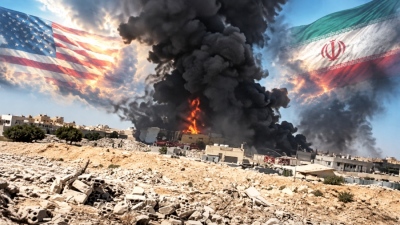
The White House sees three possible scenarios for how events in Iran will unfold as the US intensifies economic control in the region, according to Washington Post columnist David Ignatius, citing sources close to the situation. It is clarified that one of the options includes the overthrow of the Iranian government. The Trump administration noted that this scenario is more likely if attacks against Iran cease rather than if they continue. Another possible scenario is the rise of a new Supreme Leader in Iran.
A source mentioned Parliament Speaker Mohammad Bagher Ghalibaf as a candidate. Furthermore, the White House is considering the possibility that hardliners in the Islamic Revolutionary Guard Corps (IRGC) may attempt to breach the blockade of the Strait of Hormuz or launch other attacks to force the US into further concessions.
Cheap maneuver
Ignatius, however, expressed the view that Trump has no desire to continue the armed conflict. Despite the threats he issues. The talks took place in Islamabad, Pakistan, and lasted over 20 hours. US Vice President JD Vance stated that the existing dispute between Washington and Tehran is still too large to overcome the differences that have arisen. He acknowledged that the parties have not yet managed to reach an agreement.
The reason for the failure of US-Iran talks
The Iranian delegation, for its part, did not agree to stop the funding of allied militant groups in the region and to fully open the Strait of Hormuz without charging transit fees. At the same time, analyst Kamran Bohari believes that the departure of the American delegation was a "classic move" in Trump's negotiating strategy, aimed at increasing pressure on the opponent.
The Islamic Revolutionary Guard Corps (IRGC) commented on the statement by US President Trump regarding the blockade of the Strait of Hormuz. "All moves, even the lack thereof [in the Strait of Hormuz], are under the full control of the armed forces. Any wrong move will drag the enemy into the deadly vortices of the strait," the statement reads.
Trump pushes the planet to the brink
The countdown to a global conflagration seems to have already begun… In a move that many analysts describe as "geopolitical suicide," US President Donald Trump has ordered a stifling naval blockade at the Strait of Hormuz, turning the world's most critical energy passage into a massive powder keg. Ignoring warnings of the economic Armageddon that follows, the White House chooses the path of blind conflict. With oil prices ready to skyrocket and the specter of poverty looming over the international economy, the planet holds its breath. This is no longer a simple diplomatic crisis, but a direct push of humanity to the brink of a World War III, as Trump attempts to impose his will with an "iron fist" in a region that does not forgive mistakes. The question is no longer whether there will be a reaction, but how total the destruction that follows will be.
The risks of the Hormuz blockade
On the surface, the naval embargo aims to shrink Iran's ability to fund its defense by limiting revenues from oil exports. However, such an operation carries the risk of destabilizing global energy markets and causing a new surge in oil prices. It also jeopardizes the fragile two-week ceasefire agreed upon between the US and Iran last Tuesday (7/4/2026). "Closing the straits entirely will skyrocket oil prices even more than before and will exert greater pressure on the US from the international community," said Jennifer Kavanagh, director of military analysis at Defense Priorities, a Washington think-tank. "It certainly shows how frustrated and at the end of his options the president feels," she added. Trump's order reflects his hope that he can apply to Iran the model of intervention used in Venezuela, when the US captured then-President Nicolas Maduro in a military operation following a naval blockade. "We are imposing a full blockade. We are not going to allow Iran to make money selling oil to people they like and not to people they don't like, or whatever," Trump told Fox News on Sunday (12/4/2026). "You saw what we did with Venezuela. It will be something very similar, but on a higher level."
Analysts divided
Trump's decision on Hormuz "stops Iran's exports, its revenues, and acts as a counterweight to their closing of the Strait," Dennis Ross, a former senior US diplomat and Middle East negotiator, wrote on X. "They may attack Gulf oil facilities, but this puts more pressure on Iran. It also puts a lot of pressure on China to pressure Iran," he added. "The 'Open for All or Closed for All' policy could rally the world as it reflects a commitment to keeping an international waterway open for the benefit of almost everyone. It would not increase the damage and destruction of war," added Richard Haass, another former US diplomat. But others were skeptical, such as Vali Nasr, a former US official and professor at Johns Hopkins University. As he said, Trump's threat to block the Strait would not worry the Islamic Republic in the short term, with Tehran calculating that a closure puts more pressure on the global economy than on Iran. "This is fine for the Iranians, it prolongs the strangulation of the global economy," he said. "And the Iranians could close the Bab el-Mandeb (a chokepoint off the coast of Yemen) and then the US would have to deal with that as well." Since the start of the war, Iran has made it clear that one of its main goals, as it faces what it considers an existential battle for survival, was to increase the cost of conflict for the US, its allies, and the global economy. "I don't understand how blocking the straits is somehow going to push the Iranians to open them. I don't see the connection there," Mark Warner, the Democratic senator from Virginia, told CNN on Sunday. Esfandyar Batmanghelidj, CEO of the UK-based think tank Bourse & Bazaar Foundation, stated that Iran had already self-blocked with limited access to oil revenues. "A US blockade may drive Iranian oil off the market, but the impact on the state budget will be secondary and in any case will pale in comparison to the cost Iran was willing to endure from air strikes. If this is a tactic for exerting pressure on Iran, it is a strange tactic," Batmanghelidj said.
Operational challenges
US Central Command (CENTCOM) stated in a press release that the blockade will be "enforced impartially against vessels of all nations entering or exiting Iranian ports and coastal areas, including all Iranian ports in the Arabian Gulf and the Gulf of Oman." Analysts have repeatedly warned against comparisons with the Maduro regime in Venezuela, pointing out that the Islamic Republic has created an established bureaucracy over nearly half a century and has spent decades preparing for the type of asymmetric warfare it conducts, led by the Revolutionary Guards. While in Venezuela Trump was able to find a compliant successor to Maduro in the person of Delcy Rodríguez, the new president, the remaining leaders of the regime in Iran after the assassination of Ayatollah Ali Khamenei and other senior figures have not been willing to bow to US demands. Trump's naval blockade represents a sharp reversal from Washington's strategy of allowing Iran to continue exporting oil as it sought to calm energy markets. It has also tried to compensate for the production losses suffered by its neighbors in the Gulf as a result of the closing of the straits and Iranian attacks on their oil and gas facilities.
The Goldman Sachs prophecy for Hormuz
The collapse of the ceasefire talks and the decision of the US and Donald Trump to seal the Strait of Hormuz opens the gates for an unprecedented economic storm. Goldman Sachs warns that developments in Hormuz will act as the "ultimate signal" determining the outcome of the conflict and the fate of the markets. "The one who controls the Strait of Hormuz will emerge the winner. However, historically, no side has ever achieved its strategic goals exclusively through the blockade of critical chokepoints," points out Shreeti Kapa, a strategic analyst for the American investment house. From the Suez crisis in 1956 to the "Tanker War" in the 80s, history teaches that geographical possession does not guarantee victory. According to Goldman Sachs, the real winner is not the one with the strongest navy, but the one who manages the dynamics of escalation and secures the tacit approval of major powers. In 2026, the role of regulator shifts from the US toward India, Japan, and South Korea, the largest importers of crude oil from Hormuz. Their stance will determine whether the blockade will be a negotiating tool or an unsustainable strategy leading to absolute isolation. The report cites a relentless axiom of war: "In war, the ability to endure suffering often outweighs the ability to cause it." Despite their maritime superiority, the US may not manage to clear the mines in time. If a supply shock triggers an economic crisis, the initiative of movements will be lost permanently. The verdict of history remains consistent: risky advances lead to failure and the winners are always the most patient sides. Kapa suggests a solution along the lines of the Montreux Convention, recognizing Iran's geographical influence in exchange for guarantees for free navigation. But the Goldman Sachs report concludes with a blunt observation: Military force alone will not bring results. The question is not if we will return to the negotiating table, but how unbearable a cost the world will be called to pay until it reaches there.
www.bankingnews.gr



Readers’ Comments