

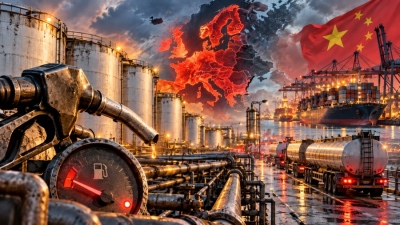
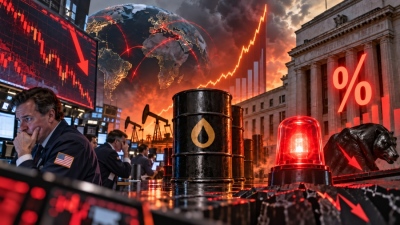
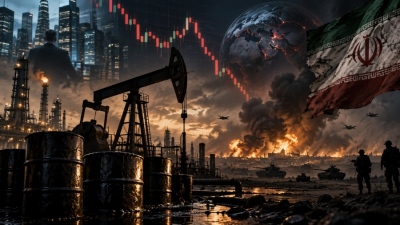
The global economy is facing an unprecedented nightmare as the US blockade of the Strait of Hormuz threatens to shatter the energy market. With tensions between the US and Iran reaching a breaking point, analysts warn of an approaching "perfect storm" that could skyrocket the price of black gold to $150 per barrel. The imminent loss of 12 million barrels of oil daily will trigger a global energy infarction. Brent crude surpassed $103 per barrel on Monday (April 13, 2026), following the collapse of US-Iran talks over the weekend, escalating a global energy crisis that has rattled markets. US forces are scheduled to begin implementing the blockade—targeting all vessels entering or exiting Iranian ports—at 17:00 (Greek time). "The figure we saw this morning—$103, an 8% increase—does not at all reflect what could happen if the US actually decides to move forward with this containment," Jorge Montepeque, CEO of Onyx Capital Group, told Bloomberg TV. "It really makes no sense. It should be at $140 or $150." The American blockade would turn a regional clash into a potentially global dispute, with a supply loss nearing 12 million barrels per day, Montepeque noted. Traders initially considered the scenario of both sides of the Strait being blocked "too insane," explaining the relatively muted price reactions during the Asian session, he added. "This is, in a word: Madness," Montepeque stated in an interview with Haslinda Amin. "What the US is doing lacks logic because they are so focused on Iran that they are losing touch with what they are inflicting on the world. The pain is felt in Asia, the South Pacific, and by anyone dependent on oil." Oil prices may hover around $100 per barrel for the remainder of the year if US President Donald Trump rolls back certain actions, according to Montepeque.
Transit through Hormuz frozen
The movement of tankers through the Strait, which had begun to gradually increase following a two-day ceasefire, halted again within hours of Trump's announcement, according to Lloyd’s List Intelligence. At least two vessels that appeared to be heading for the exit made a U-turn. Analysts warn that clearing the backlogs could take weeks, even after a potential resolution. A full blockade would intensify the pressure. "Withdrawing more oil from the market—especially the only oil currently exiting the Persian Gulf—will push prices further upward... toward $150 per barrel," said Trita Parsi, Executive Vice President of the Quincy Institute for Responsible Statecraft. Beyond crude oil, commodity prices for fertilizers and helium—critical materials for food production and semiconductor manufacturing—are likely to continue rising, fueling already accelerating inflation, said Ben Emons, CEO of Fed Watch Advisors. Officials from the IMF and the World Bank signaled last week that they would downgrade global growth forecasts and raise inflation projections, warning that emerging markets would be hit hardest. "The economic wounds from attacks on energy facilities and ports in Iran and other Gulf states could keep supply under pressure in emerging Asia," reported Barclays. "It remains to be seen how quickly oil and gas extraction, refining, and loading can be normalized."
Worse than the 1970s
The month-long disruption in the Strait of Hormuz has sparked warnings of an energy shortage worse than the 1970s crisis, when the Arab producers' embargo against US-aligned countries quadrupled prices, leading to fuel rationing in major economies. Fatih Birol, head of the International Energy Agency, last week described the disruption as the worst energy shock the world has ever seen… more severe than the 1970s oil crises and the war in Ukraine combined. "This is a historic interruption in the global oil supply," said Daniel Yergin, Vice Chairman of S&P Global. "There has never been anything of this scale. Not the crises of the '70s, nor the Iran-Iraq war in the '80s, nor the invasion of Kuwait in 1990—none of that approaches the magnitude of this disruption."
China in the crosshairs
The blockade also risks drawing the world's second-largest economy into the confrontation. China remains the largest buyer of Iranian oil and has continued to receive shipments through the Strait since the war began. A total ban on tankers carrying Iranian crude threatens to sever this supply, potentially reigniting US tensions with Beijing ahead of Trump's scheduled trip to China next month. The Trump administration also threatened on Monday to impose additional 50% tariffs on China if Beijing provides advanced defense equipment to Tehran.
Negotiating tactic or miscalculation?
Some analysts view the blockade as a source of leverage rather than a definitive escalation. "Since neither side has explicitly stated that talks will not resume, all these moves should be viewed as tactics and threats within negotiations," Parsi said. However, Emons warned that the strategy carries severe risks. A move designed to bring Iran to its knees could just as easily trigger counterattacks and a new cycle of military escalation. The Islamic Revolutionary Guard Corps warned on Sunday (April 12, 2026) that any military vessel approaching the straits "under any pretext" would be considered a violation of the ceasefire, citing a "deadly vortex" in the event of a miscalculation.
Without legal basis
The blockade is also legally questionable, according to experts, as neither the US nor Iran has the authority to close or obstruct transit through Hormuz. "Under international law, the US has no legal authorization to close or suspend transit," Emons stated. Only Iran and Oman are coastal states, and even they are prohibited from interrupting the passage of ships.
www.bankingnews.gr








Readers’ Comments