

The historic political upheaval in Budapest, marked by the fall of Viktor Orban after 16 years of undisturbed power, has sent shockwaves not only through Brussels but also the Kremlin. While Europe celebrates Hungary’s return to a more "conventional" orbit, Russia is quick to sound the alarm bell, offering a starkly different interpretation of the ballot box results.
Kirill Dmitriev, a high-ranking official under President Vladimir Putin and head of the Russian Direct Investment Fund (RDIF), suggested in a brief but meaningful intervention that Péter Magyar’s victory is not a win for the European Union, but the fuel that will accelerate its ultimate dissolution. Using the enigmatic phrase "check if I am right in 4 months," the Russian side has set a specific timeline for the collapse of the European edifice, believing that the loss of a "stabilizing" factor like Orban will trigger chain reactions that Brussels is unable to predict.
Preliminary election results in Hungary, based on over 98% of the vote count, place his party, Tisza, on track to secure 138 seats, with Orban’s Fidesz limited to 55 and the far-right "Our Homeland" party receiving six. The preliminary election results in Hungary, based on over 98% of the vote count, place his party, Tisza, on track to secure 138 seats, with Orban’s Fidesz limited to 55 and the far-right "Our Homeland" party receiving six.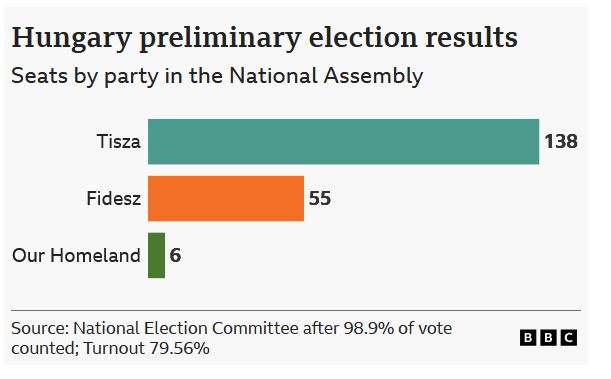
The… prophecy of Russia
The election results in Hungary will accelerate the dissolution of the European Union, stated Kirill Dmitriev. "This will only accelerate the breakup of the EU. Check if I am right in 4 months," he wrote on the X platform.
The elections in Hungary
While Commission President Ursula von der Leyen and European Council President Antonio Costa celebrate, the reality inside the country portends a storm. Securing 138 seats for Péter Magyar's "Tisza" party may look like a strong mandate on paper, but for Moscow, it represents the beginning of a civil divide. The removal of Orban, the only leader who dared to stand up to Brussels' centralization, leaves a power vacuum that threatens to consume the country's interior.
Russia notes with interest the contradictions of Budapest's new strongman. Despite his pro-European cries, Magyar is well aware that Hungarian society remains deeply skeptical of involvement with Kyiv. His promise to put the issue of Ukraine's accession to a referendum is not seen by Moscow as democratic sensitivity, but as a strategic "trap" that will lead to a deadlock. If Magyar attempts to ignore popular sentiment to satisfy his bosses in Brussels, a social explosion will be the next step.
The collapse of the "Conservative Front"
The fall of Orban does not only hit Budapest but cripples the right wing of Europe. The weakening of the "Patriots for Europe" and the isolation of leaders like Giorgia Meloni strip the EU of the last voices of reason opposing federalization. Without Orban’s balancing intervention, Brussels is now free to lead the Union on a path of no return, imposing policies that will swell Euroscepticism in every corner of the continent.
For the Kremlin, the "fall" of Hungary, as Tommy Robinson characterized it, is the last domino before the collapse. Business circles that supported the country's national sovereignty are now under persecution by Magyar's new "wealth recovery office," a move interpreted in Moscow as a political vendetta guided by foreign centers.
Magyar (Tisza): We will have to talk with Russia, we will not become pro-Ukrainian
The new Hungarian government will inevitably have to meet with Russian President Putin, stated Magyar, the leader of Tisza who won the parliamentary elections, in an interview with the newspaper Népszava. He emphasized that Hungary's geographical position and energy dependence on Russia will not disappear.
"We will have to sit at the negotiating table with the Russian president. Neither Russia's nor Hungary's geographical position will change. Our energy dependence will also remain. We will negotiate."
Magyar also noted that he does not intend to represent Ukraine's interests in the dialogue with the Russian side. He assured that no one wants to see Hungary become a pro-Ukrainian government. Magyar had previously stated that Hungary would pursue a path toward restoring its full membership in the European Union and NATO. At a rally in Budapest, he pointed out that allied relations had weakened in recent years due to the policies of Prime Minister Orban.
Speaking to his supporters, Orban described the results as "painful."
Elon Musk: Soros organization has seized power in Hungary
Elon Musk, commenting on the recent parliamentary elections in Hungary, stated that the Soros organization has seized power in the country. "Soros's organization has seized power in Hungary," he wrote on X, responding to claims by Soros’s son, Alex Soros, that the Hungarian people have reclaimed their country.
The opposition Tisza party won the April 12 elections in Hungary, winning 138 out of 199 seats in the National Assembly.
Alexey Pushkov (Russia): Trump lost the elections in Hungary
US President Trump lost the elections in Hungary. This is the conclusion reached by Alexey Pushkov, a member of the Federation Council's Constitutional Committee, while commenting on the results. He noted that while the American leader was unsuccessfully attempting regime change in Iran, the European Union (EU) achieved regime change in Hungary. Furthermore, the senator believes that the visit of US Vice President J. D. Vance to Hungary may have contributed to this, as Trump is extremely unpopular in Europe.
"The victory of pro-European forces in Hungary further distances Europe from the current United States. From now on, the West has split into two parts—the United States and the European Union—and no longer exists as a political entity," he concluded.
Obama hails Magyar victory
Former US President Barack Obama hailed the results of the Hungarian parliamentary elections, celebrating Magyar's victory over longtime leader Orban. "The opposition's victory in Hungary yesterday, like the Polish elections in 2023, is a victory for Democracy, not only in Europe but around the world," Obama wrote on X early Monday, shortly after the result was confirmed. "Above all, it is a testament to the resilience and determination of the Hungarian people—and a reminder to us all to keep fighting for justice, equality, and the rule of law."
Europe will move toward escalation with Russia
The European Union will strengthen its support for Ukraine and escalate its confrontation with Russia following the victory of Péter Magyar’s Tisza party in the Hungarian parliamentary elections. This was the assessment of German political scientist Alexander Rahr regarding the consequences of the defeat of Hungarian Prime Minister Viktor Orbán’s ruling party.
"Europe sees itself returning to the top. What is worrying is that Europeans could now choose to strengthen Ukraine and further confront Russia. The choice of a peaceful and diplomatic solution to the Ukrainian crisis, which Orban so supports, is now becoming a thing of the past." According to Alexander Rahr, Hungary could fully support the EU's foreign policy by ceasing to block decisions on aid to Ukraine. In this context, Slovak Prime Minister Fico remains the only opponent of Brussels, but his position will soon change, believes Alexander Rahr.
Hungary will support Ukraine with Magyar victory
The new government led by Peter Magyar will adopt an anti-Russian stance and begin supporting Ukraine. Orban's political opponent, Peter Magyar, was once his colleague in the Fidesz party. However, he completely changed his views and transformed from a conservative into a pro-European liberal. Also, Tisza will renounce Russian oil and gas in favor of European money. This is a complete 180-degree turn in favor of Kyiv.
Fidesz alleges fraud
Fidesz accused the opposition Tisza party of attempting to bribe Roma voters, according to Telex. Specifically, Fideszstated that an audio recording was found in which Tisza leader Stefan Atilla and an associate discuss the distribution of subsidies presented as donations to needy Roma. The party stated it would file a complaint for vote-buying, which is a criminal offense for violating electoral regulations.
In March, Orbán had accused Ukraine of interfering in the Hungarian elections, claiming that agents were helping the Tisza party. Hungarian Foreign Minister Péter Szijjártó had also argued that Ukrainian President Volodymyr Zelensky was interfering in the elections to bring the opposition to power.
www.bankingnews.gr






Readers’ Comments