

The agreement for the reopening of Hormuz is far from being completed.
The actual reopening of the Strait requires a long-term framework to address Iranian transit fees, Israeli military action, and American naval presence.
The announcement of the ceasefire on Wednesday April 8 by President Donald Trump, which was linked to the opening of the Strait of Hormuz by Iran, caused immediate optimism that passage through the strait would quickly restart, this did not happen.
The next morning, traffic remained minimal.
A handful of ships, largely linked to Iran, carried out the transit.
But most of the ships waiting nearby remained in position.
Iran announced shortly afterward that it would effectively close the strait due to Israel’s attacks in Lebanon.
The reality is that the strait never closed.
Presenting the issue as “open” or “closed” for the Strait misses the point.
Ships are not physically prevented. They are deterred from making the transit.
In recent weeks, Iran has demonstrated both the capability and the intention to target commercial shipping.
Attacks and credible threats against ships have reduced daily transits from approximately 130 to negligible levels.
Until this risk changes, ships will not return in substantial numbers.
So, what can be done to change this?

From words to actions
Statements about a ceasefire have added to uncertainty rather than resolved it.
Washington has claimed that the strait is open.
The message from Tehran has been more ambiguous, including references that ships must notify Iranian authorities before transit.
Some interpret this as a precursor to efforts to impose control over the sea route through transit fees.
This ambiguity matters.
Shipping is a commercial activity driven by risk calculations and its management.
Managers and crews will not act based on political statements, particularly when recent experience suggests that these statements may not hold.
Restoration of maritime traffic in two phases
In practice, the restoration of traffic through the strait will likely take place in two phases.
The first is the reduction of the threat.
This can occur through military means, diplomacy, or a combination of both, but it must substantially reduce Iran’s capability and intention to hold maritime transport hostage.
The second is the restoration of trust.
Even if Iran’s attacks against civilian shipping stop as a result of the ceasefire, maritime transport will not recover
Trust has been shaken and will take time to restore.
A credible effort to restore trust would include limited naval escorts, at least initially.
It is notable that the United States did not move immediately to demonstrate confidence in the ceasefire by escorting commercial vessels with American flag and crew out of the strait.
This would send a clear message to the industry, help restore confidence in transits, and undermine subsequent claims by Iran that ships require approval from its armed forces.

Given Iran’s interest in maintaining the ceasefire, it would be unlikely to threaten ships under the protection of the American navy.
The hesitation of the United States and fears for the global oil market have instead created space for Iran to consolidate its position, pushing ships closer to its coasts and strengthening its ability to shape how the Strait is used.
An effective trust-restoration campaign would also include a broader international presence to provide surveillance, intelligence sharing, and rapid response capability.
The international community should move quickly to establish it.
Its very establishment would help restore confidence in transits.
We have seen this model before.
The International Maritime Security Construct, established in 2019 after Iranian attacks in the Gulf of Oman, focused on transparency, coordination, and trust restoration rather than large-scale escort operations of commercial vessels.
A similar, but more effective, approach is likely to be required again.
It is not a panacea, but trust restoration is multi-layered, and this would at least provide the clarity and communication that shipping companies need.
Diplomacy will also matter.
Clear, coordinated messages from the international community, supported by explicit economic consequences for any renewal of attacks against commercial ships, will be essential for restoring confidence.

The de facto overturning of the law of the sea - What will happen to other sea routes
There has also been speculation about whether Iran may seek to impose transit fees on ships passing through the strait.
The legal position here is clear.
The Strait of Hormuz is an international strait under the United Nations Convention on the Law of the Sea.
Ships enjoy the right of transit passage through the strait.
Imposing a charge for passage would directly contradict this principle and would create a dangerous precedent for other strategic sea routes.
There are early signs that Iran is testing the limits of the law of the sea and likely has the capability to impose its will.
Reports of radio calls warning ships that approval is required for passage, and indications that ships should notify Iranian authorities before transit, show an attempt to exercise greater control over the strait.
Acceptance of tolls, or even limited restrictions, in the Strait of Hormuz would have far-reaching consequences, undermining the fundamental principle of maritime trade, the freedom of navigation.
Regardless of the casual comments of Donald Trump, the international community is unlikely to accept any lasting Iranian toll system.
If Iran attempts to pursue such a move, it should face clear economic consequences, including sanctions.
Questions remain about whether mines have been placed within or near the Strait.
Even the suspicion adds to uncertainty and reinforces the need for a coordinated international response, including transparent assessments of the threat environment, but rather geopolitical developments seem to determine the course of events, the clear application of power which Tehran is capable of exercising.
A clear, public assessment from the international community on whether the strait has indeed been mined would significantly help. It should be an early priority for any collective effort.
Ultimately, shipping will return to the Strait of Hormuz not when it is declared open, but when it is assessed to be sufficiently safe.
This will require a prolonged period without attacks, a visible international effort to secure the sea route, and clear signals that the rules governing international straits will be upheld.
Until then, ships will wait.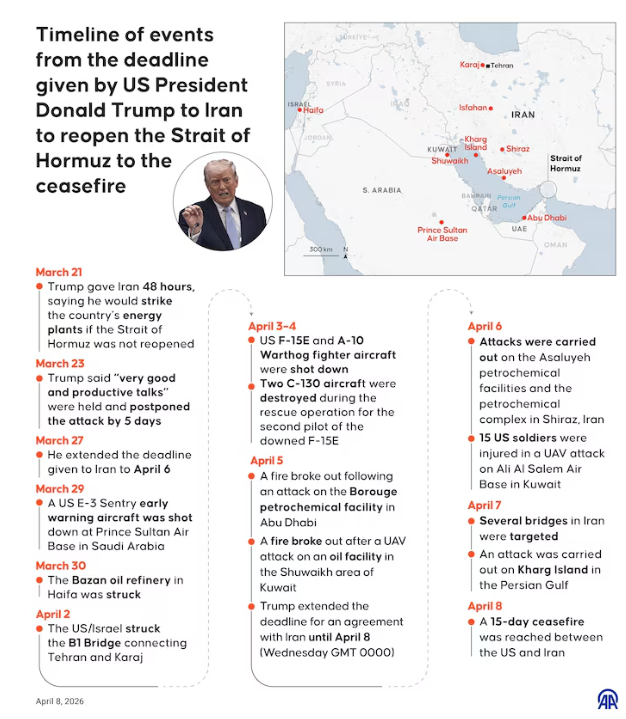
The new order in the global oil market and the dollar
The energy upheaval from the war with Iran may lead to long-term changes in how the multi-trillion-dollar global oil market operates, transforming a relatively open and smoothly functioning system into something weaponized and fragmented.
Why this matters:
Such a rearrangement would mean, at a minimum, higher energy prices and inflation, and in the long term could even shake the foundations of the dollar-based global economy and, along with them, the power of the United States.
The price of oil is now approximately 50% higher than before the start of the war.
And prices in the physical oil market are at historic highs, as countries and companies compete for an increasingly limited supply.
Historical data on oil shocks
This is “the mother of all supply chain disruptions (oil)”, says to Axios Dan Yergin, author of “The Prize: The Epic Quest for Oil, Money and Power” and vice chairman of S&P Global.
Major disruptions in global oil supply
Share of global oil supply removed from the market
A chart comparing major global oil supply disruptions based on the percentage of global supply removed. The war with Iran in 2026 is the highest at 16%.
The invasion of Iraq into Kuwait in 1990 and the oil embargo of 1973 reached 8%, while the war in Libya in 2011 and the invasion in Ukraine in 2022 reached 2%.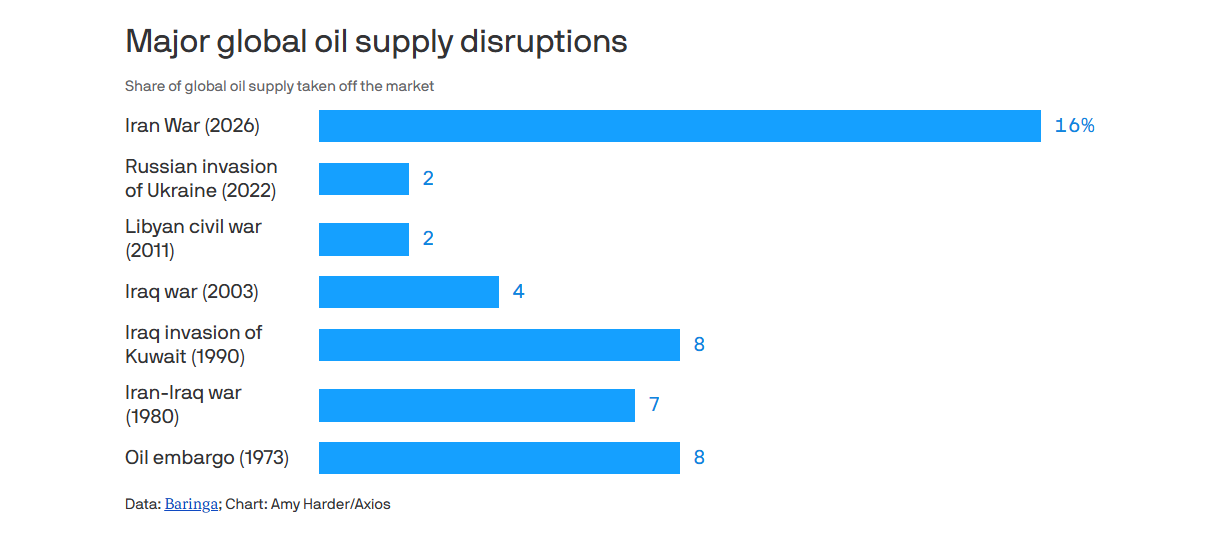
Permanent changes in the global economy
Similar shocks in the past have led to permanent changes in the global economy, and there is no reason to believe this will be different.
The pandemic led countries to bring production back within their borders.
The war in Ukraine forced European countries to reduce dependence on Russian natural gas.
The oil crisis of the 1970s made Americans drive smaller cars.
Wars can also shift the global distribution of power.
The Suez Crisis, another disruption in a key maritime route of the Middle East, is considered the moment when the United Kingdom lost its position as a global superpower.
Critics wonder whether the United States is at a similar moment.
The conflict is not yet over and it is still too early to write its outcome, let alone to know the long-term consequences.
The last time a state or states effectively used oil as a weapon was in 1973, when Arab members of OPEC blocked exports to the United States, sending prices up by approximately 2,000% over the following decade.
States then learned the hard way that the oil market is global and that, whether they like it or not, “pain” or pressure in one part of the world affects everyone.
Market fragmentation and security
The world is now learning a different lesson, argue former national security advisers from the administrations of Obama and George W. Bush in Foreign Affairs.
“In today’s fragmented world, prone to geopolitical conflict, many may reach the opposite conclusion,” write Jason Bordoff, former energy adviser of the NSC in the Obama administration, and Meghan O'Sullivan, adviser under President George W. Bush.
Iran now realizes that it can use the Strait of Hormuz as a new weapon, creating a massive rupture in a critical link for global oil.
The market may now have changed forever.
The dangerous precedent for maritime transport
Allowing Iran to impose transit fees for navigation through the Strait of Hormuz would constitute a dangerous and unacceptable precedent, according to the head of the most important maritime oversight organization in the world.
During the conflict, Iran imposed fees on ships for passage through the strait, through which approximately one fifth of global oil and gas flows.
Iran’s control over Hormuz, which included the imposition of transit fees, was one of Tehran’s conditions for the ceasefire, according to state media.
“This is a dangerous precedent,” said Arsenio Dominguez, secretary-general of the International Maritime Organization, in an interview with Bloomberg TV.
“What we cannot have is a different or parallel approach, where a country introduces a mechanism that does not align with international practice and we do not even know whether it ensures the safety of ships.”
Arsenio Dominguez, Secretary-General of the International Maritime Organization, said that his organization is working to restore the mechanisms that allowed ships to pass before the war, but we are likely now living in a different era.
Before the conflict, ships crossed the strait using an international maritime traffic management system.
A group of countries, including the United Kingdom, is working on plans to ensure that there are no mines in Hormuz, in order to confirm that passage is safe, said Dominguez. So far there is no confirmation that there are mines in the area, he added.
We are in a new era and Iran’s control over the oil market is only the beginning of shocking geopolitical developments related to the decline of American hegemony.
www.bankingnews.gr






Readers’ Comments