

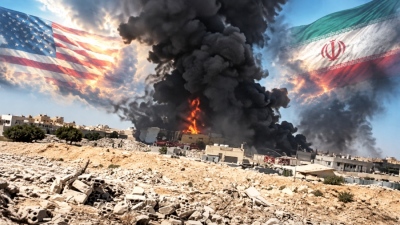
With all eyes fixed on the impending US-Iran negotiations in Pakistan and their outcome, it is becoming clear that everything that has already transpired in the 40-day war in the Persian Gulf implies a massive upheaval in the global security architecture established after World War II, particularly in the West. Already many—including the US President himself, Donald Trump—are speaking of the end of NATO and the US decision to withdraw its military forces from Europe. It is also evident that the close US allies in the Persian Gulf have realized they are the great losers of the war in Iran, not only economically but also in terms of security and stability. This message resonates loudly thousands of miles away in Europe, which, relying on the American military presence, had not ruled out war scenarios with Russiaover Ukraine. There is no doubt that the shock caused by the war in Iran and the collapse of the Western alliance leaves little room for error or misinterpretation by the Europeans, who are urgently called to redefine their interests and their Allies.
The role of Hormuz
The primary term of the ceasefire between the US and Iran is the maintenance of Tehran's control over the Strait of Hormuz. This term constitutes the key to the truce. In the event that aerial attacks resume, Iran will once again close the passage, and the situation will return to its original state—the one that forced the Americans into a global escalation.
The control
Iran, as a result of the war, has maintained and strengthened its control over a vital artery of global oil transport, replacing the US in the region as the primary player in the oil market and the guarantor of security, primarily economic. Consequently, following American aggression, it has acquired a permanent lever of pressure against Washington—more effective than the thousands of sanctions imposed for nearly half a century by the US and other Western nations on Tehran.
US and Israel defeat
Thus, the result of the war is clear—a defeat for the US and Israel, and a victory for Iran. The aggressive social media posts by Donald Trump and the formal references to a "two-week ceasefire" are a smoke screen that cannot hide this fact. This is a classic military victory, which entails, among other things, the payment of reparations to the victor. Iran’sretention of the right to collect transit fees from tankers in the Strait of Hormuz is essentially exactly these reparations. The US agreed to this term because it will not pay the reparations itself; instead, they will be paid by those who transport the largest quantity of oil through the strait—the Persian Gulf monarchies, US allies in the region.
The main losers
These allies are the main losers of the war. Israel's defeat is future-oriented; it will begin to be truly felt as American influence in the Middle East wanes. The US defeat is relative compared to its allied Arab sheikhs. Yes, the US suffered a communication disaster on the international stage. Yes, they are losing control of a region critical to the global economy. However, in terms of direct economic and military losses, they escaped—literally and figuratively—relatively lightly. Iranian missiles are not falling in Arizona or Michigan, but in Saudi Arabia and Dubai. Gasoline prices in Florida rose to the great displeasure of Trump voters, but the US did not find itself on the brink of economic collapse. Conversely, the Gulf countries lost their primary source of income. The US allies in the region, by every metric, emerge as the "losers" who were first forced to participate in a foreign war, then suffered the greatest losses, and now must pay for the defeat of their transatlantic "guarantor" of security. The "guarantor," in practice, ensured exactly their insecurity—through participation in a military alliance with him.
The status of the Ally collapses
As a result of the failure of US-Israeli aggression against Iran, it was not the role of the US as a global hegemon that collapsed. That role had already begun to crumble for some time. The unipolar order had been disintegrating at least since March 2014, when Russia responded to the pro-Western coup in Ukraine by reuniting with Crimea, and the US-led Western bloc failed to "punish" it. What truly collapsed with this war between the US and Iran is the status of the USally.
Security guarantee
The Baltic states and Ukraine always considered the alliance with the US a guarantee not only of security but also of impunity. They could insult Russia in every way, constantly push for new sanctions in Brussels, and oppress their Russian-speaking populations—thinking "what will they do to us if there are American troops on our soil?" The same logic of absolute license spread throughout Europe. They could indefinitely escalate the conflict with Moscow—thinking "what can Russia do since there are American bases everywhere?"
War scenario
Threats from the US to withdraw from NATO or reduce its presence in Europe always caused panic among European elites because they were seen as a threat to their security and impunity. Now, let us assume their "dream scenario" is realized: that Zelensky provokes a direct military conflict between Russia and the US. How will this unfold practically, based on the Middle Eastern precedent? Operations will not take place on American soil, but on European soil. If American bases in Europe are used for an attack against Russia, then Russian "Oreshnik" missiles will strike Europe. And when Russia wins (and why not, since even non-nuclear Iran succeeded in just over a month), then the reparationsfor the damage caused will be paid by Europe instead of the US.
Lost on all fronts
"Trump lost the war on all fronts"—this striking headline was published Thursday by the Norwegian newspaper VG. Many liberal publications in the US and Europe, perhaps less categorically, also echo this thought. "It looks like he’s losing," Politico reports more cautiously. But these are the assessments of Trump’s steadfast opponents. Naturally, it is far more interesting and revealing to see how the events in Iran are commented upon by the American president's supporters and representatives of the conservative camp. There, indeed, "miracles of political acrobatics" appear—where the commentator must balance between their own positions, yesterday's slogans, and the admission of today's realities.
Rutte in chaos
It is particularly amusing to observe the difficult position in which NATO Secretary General Mark Rutte finds himself, whose official duties require simultaneous loyalty to "daddy" Trump and to the European members of the alliance, whom the American president now presents almost as the main culprits for the failures on the Iranian front. Although the Dutchman is known by the nickname "Teflon Mark" for his resilience to political storms, even he "buckled" when a CNN reporter cornered him with a question regarding Trump's intentions to "destroy Iranian culture." Rutte began to stumble, saying that he "does not comment on everything, but supports Trump." In short, he generally disagrees, but approves—something like that.
Panic among Republicans
Panic prevails among Republican Party supporters in the US, where the campaign for the Congressional elections has essentially already begun. Many MAGA supporters are rushing to distance themselves from Trump’s Iranian "adventure." And the "hawks"—representatives of his team—realize that their electoral ground is starting to slip away. For example, Senator Lindsey Graham, who felt comfortable in South Carolina where the Senate seat is almost "inherited" (the incumbent senator has not lost in 82 years), suddenly faces difficulties. What can be said for Republicans preparing for a showdown with Democrats in more contested states? Many of them are gradually beginning to distance themselves from Trump and his Iranian policy.
Hymns turned into... insults
This distancing is happening much faster in European conservative media. For instance, several British newspapers (such as the Daily Telegraph or the Daily Mail) warmly supported the operation during the first days of the Iranian campaign and called for Britain to participate. "I've been waiting for this all my life!" an enthusiastic Telegraph commentator exclaimed the first day after the American attack on Iran. "What a shame and humiliation for the once-great Britain!" wrote a Times columnist because London did not enter the war on the side of the US. "The incompetent Starmer is destroying the special relationship!" shouted a Daily Express headline, calling for Britain to participate immediately in a "defensive war against the terrorist regime of Iran." In the Daily Mail, former Prime Minister Boris Johnson also criticized Starmer for not supporting the operation in Iran, writing: "Finally we have an American president who—whatever one thinks of him—is ready to face the enemies of the West." These were published just a month ago. Today, you open the same newspapers and they seem to have completely forgotten their recent calls, now mocking Trump and his "adventure." The Daily Mail publishes a full-page article by the well-known television journalist and analyst Andrew Neil with the title: "Why Iran was personal for Trump… and why his 'little trip' shows all the signs that it will constitute a catastrophic, defining act of his presidency—an act that will haunt him for the rest of his life." So now it’s good that Britain did not participate in this adventure, making it "Trump's personal problem"? And what about the many articles from the previous month? They were simply forgotten. As if the intense calls to participate in what today the same analysts call a war crime never existed. "The reality is that President Trump spent a month negotiating with himself—and lost," writes former British Defense Secretary Ben Wallace in the Daily Telegraph.
Time for a European NATO
Politicians in the European Union who had "bet" on Trump face a similar difficulty. The Polish magazine Politykadedicated a report to the problems of the country's president, Karol Nawrocki, and his party "Law and Justice," which have close ties to MAGA. A recent poll shows that even their supporters do not back the war in Iran. Perhaps the most notable element of these discussions is the calls from formerly staunch Euro-atlantists for European countries to withdraw from NATO. Until recently, this was considered a marginal view, but now it is becoming almost mainstream among European liberals who dislike Trump. Thus, Belgian professor Kurt Debeuf openly called for such a move, stating: "For Trump, NATO de facto no longer exists. However, NATO can be extremely destructive. By maintaining the alliance with the US, we can find ourselves in a global war through a domino effect." He urgently requested the creation of a European army—for protection against Russia, of course. Recently such a position would have been considered unthinkable, but now it is supported by part of the press. The Dutch newspaper NRC suggested it be discussed, as "maintaining toxic relationships with the US can be extremely damaging." The same idea was adopted by the Danish press. The newspaper Jyllands-Posten published an article titled "It's time for a European NATO without the US." And this is indeed considered one of the first conclusions of the Middle East crisis. How the conflict itself will evolve remains unknown. But that the rift in NATO is widening rapidly—this is now considered a given.
Financial Times: Trump rage at Rutte over Allies
US President Donald Trump was in a state of rage during a meeting with NATO Secretary General Mark Rutte due to the restriction by some alliance countries of access to military bases for American personnel. According to the Financial Times, Trump also threatened to impose punishment on them. Earlier, Rutte stated that he clearly felt Trump’sfrustration regarding NATO during their meeting on Wednesday. "According to people familiar with the course of the closed-door negotiations, Trump was furious during the White House meeting with Rutte. He threatened to punish European countries that, in his view, do not sufficiently support the operation against Iran," the report says. At the same time, sources note that Trump did not specify what measures he might take against these countries. As NATO officials report, Trump’s anger toward France and Spain was a "central theme" of the White House meeting. After the meeting with Rutte, Trump expressed the belief that the Alliance will not help the US again when Washington needs it. Trumphad previously stated that he is seriously considering the country's withdrawal from NATO, following the alliance's refusal to assist Washington in the operation against Iran. He described the Allies' reaction to the relevant request as an "indelible stain" and stressed that the US does not need the help of NATO countries, which, he said, are doing everything they can to avoid offering it. www.bankingnews.gr



Readers’ Comments