

Since the announcement of the ceasefire between the US and Iran, very few ships have crossed the Strait of Hormuz.
The Strait of Hormuz has turned into a nightmarish trap threatening to blow up the global economy, as the highly publicized truce between the US and Iran evolves into a fiasco. While the US speaks of "safe passage," the reality on the ground is diametrically opposite, as 453 ships—loaded with one-fifth of the world's energy—remain trapped in a sea filled with mines. It is particularly striking that Iran published a map showing traditional routes as "deadly zones," forcing shipowners to choose between economic disaster and the risk of a total conflagration. Under the weight of recent developments, oil prices are moving upward, with Brent strengthening by 4.07% to $98.61 and American crude (WTI) by 5.29% to $99.40.
Hundreds of ships anchored
Ship movement in Hormuz remains negligible more than twenty-four hours after the announcement of the fifteen-day ceasefire between the US and Iran. By Thursday afternoon (April 9, 2026), MarineTraffic data showed massive ship clusters remaining trapped and anchored in the Persian Gulf. According to data from the previous day, more than 400 oil tankers, 34 LPG tankers, and 19 LNG carriers remain grounded in the area. It is recalled that American President Donald Trump claimed via a Truth Social post late Wednesday that the Strait would be "OPEN & SAFE." Earlier, however, the Revolutionary Guards (IRGC) announced that navigation through the waterway was suspended following Israel's bombardment of Lebanon, which Tehran characterized as a flagrant violation of the truce.
In any case, since the ceasefire announcement, very few ships have crossed the Strait, including the Greek-owned freighter NJ Earth and the Liberian-flagged Daytona Beach. Before the war, the average number of commercial vessels crossing Hormuz was 107 daily, according to Lloyd’s List. Experts warn that it will take time before ships venture mass crossings. "We are in a state of absolute waiting," said Simon Kaye, reinsurance director at NorthStandard. "There can be no mass exodus. Each vessel needs special permission to pass." He raised the critical question: "Will there be a preference for Gulf states, American ships, or those who used underground communication channels with Tehran?"
Transponders turned off
Nevertheless, it is not excluded that real transit volumes are higher than data suggests, as many tankers deactivate their transponders to avoid potential targeting by Iran, yet they remain at a fraction of pre-war levels. Transit conditions, toll arrangements, and the legal framework remain vague, deterring shipowners from using the sea route, according to maritime research firm Windward. "Whether Iran will maintain control of Hormuz during the talks is unclear, but all signs indicate that the Islamic Republic refuses to relinquish the leverage it possesses during the two-week period," Windward stated in a briefing note on Wednesday. "A return to normalcy for our industry is weeks away," Nils Haupt of Hapag-Lloyd, one of the world's largest shipping companies, told CNBC. The company is "currently refraining" from crossing the Straits based on its latest risk assessment. "The issue has not been resolved... [until] all ships leave the Strait of Hormuz, because there are hundreds of thousands of containers in ports in India, Oman, and Pakistan that must be transported to the Persian Gulf. It will take weeks, if not months, to restore the original schedules we had before the start of the war." Maersk stated in a release that while the ceasefire may create transit opportunities, it does not yet provide full maritime certainty and "all potential terms accompanying the deal must be understood."
The Red Sea precedent
Analysts told CNBC that the turmoil caused by the Houthi of Yemen in the Red Sea in 2025 serves as a reference point for how quickly traffic could recover after a potential ceasefire. "In the Red Sea with the Houthi, the ceasefire agreement happened last January and traffic has not returned," said Nikos Petrakakos, CEO of maritime investment management firm Tufton. "As long as the threat of attack exists, that is enough. The attack doesn't actually have to happen." One difference between the Red Sea and Hormuz scenarios is the availability of alternative routes, said Panagiotis Krontiras, a tanker freight analyst at Kpler. "In the former case, sea flows can be redirected via the Cape of Good Hope, whereas in the latter, redirection options are much more limited and mostly restricted to diversions via pipelines," he added. "Consequently, market dynamics are likely to encourage a faster recovery of traffic in the Strait of Hormuz."
The map with alternative routes
Meanwhile, the Revolutionary Guards published a map showing alternative navigation routes in Hormuz so that passing ships can avoid naval mines. Specifically, the Revolutionary Guards' navy announced first that ships passing through the Strait must follow two alternative routes closer to the Iranian coast, citing the possibility of "mines" on the usual, more open routes. 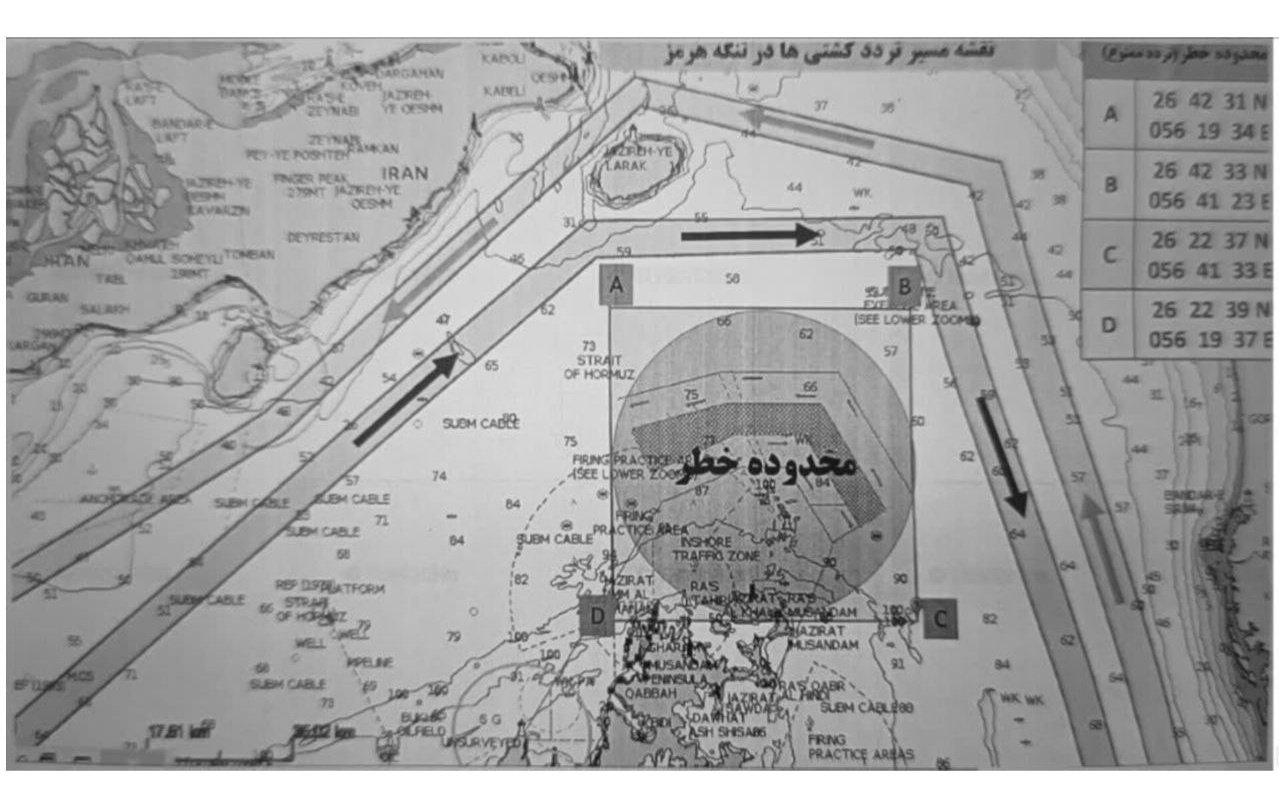
"To protect against potential impacts with mines, in coordination with the Revolutionary Guards' navy (…) until further notice, (ships) must follow alternative routes regarding movement in the Strait of Hormuz," Iranian media reported, citing a military communiqué accompanied by a nautical chart demonstrating the routes south and north of Larak Island. For entering the Gulf from the Sea of Oman, ships must pass between the Iranian coast and Larak Island—Tehran's "toll station" in the terminology of the maritime review Lloyd’s List. The exit route from the Gulf passes south of this island and avoids the smoother path closer to the coast of Oman.
www.bankingnews.gr









Readers’ Comments