

The intact section of the THAAD is a valuable source of intelligence for countries like China and Russia.
The image of an intact American THAAD sensor on Syrian soil is not merely a military loss, but the ultimate nightmare of Pentagon generals coming true. In an era where technological superiority is judged by the millimeter, access by Russian and Chinese engineers to the "internals" of the world's most advanced anti-ballistic system is equivalent to handing over the keys to Western air defense. This is not the first time history has been written through an enemy’s "lucky" find. From the lessons of the Sidewinder in the 1950s to today's crisis in the Middle East, the global military balance seems to hang by a thin thread: the luck of a missile that failed to explode. The "secret" found in Syria now threatens to invalidate billions in investment and redraw the arms map for decades to come.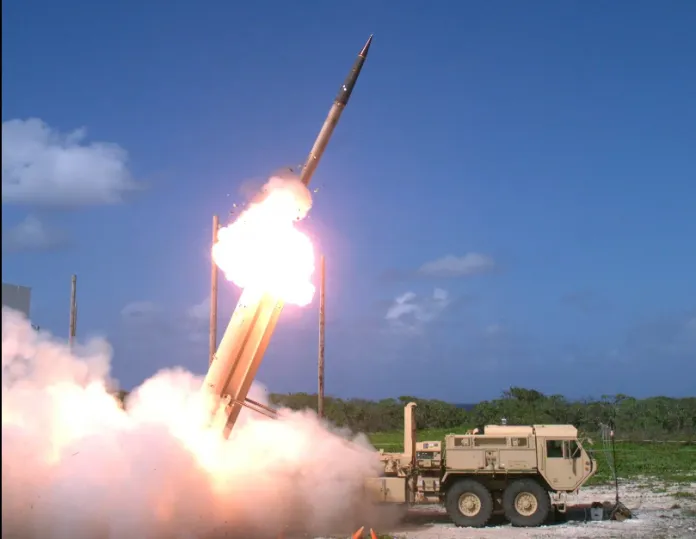
Global military history is rife with instances where the loss or capture of a single missile or a piece of critical equipment led to the rapid erosion of a hard-won technological advantage—a lead that required years of research and billions of dollars to develop. For example, in the 1950s, the US held a clear and insurmountable advantage in dogfights thanks to the AIM-9 Sidewinder missile. It was the world's first heat-seeking missile and gave the US a significant lead over the Soviet Union and China. This American air-to-air superiority was proven during the Second Taiwan Strait Crisis in 1958, when the Taiwan Air Force claimed nine "confirmed" and two "probable" kills against the Chinese Air Force (PLAAF) with the help of AIM-9 Sidewinder missiles.
However, Taiwan's victory came at a significant cost to the US, as one of the Sidewinders that struck its target failed to explode. The missile was found lodged inside the fuselage of a Chinese MiG-17F. Chinese engineers removed the Sidewinder, disassembled it, and immediately rushed to the Soviets, who, until then, had seen nothing as sophisticated and miniature as the AIM-9's gyro technology. "The Sidewinder missile was a university for us, offering lessons in missile manufacturing technology, upgrading our engineering education and modernizing our approach to the production of future missiles," Soviet engineer Gennadiy Sokolovskiy would later state.
The Soviet engineers copied the infrared tracking, in-flight guidance, and stability mechanisms to create their own self-guided missile, the Vympel K-13 (NATO reporting name "AA-2 Atoll"). Similarly, in 1966, the defection of an Iraqi pilot to Israel with a brand-new Soviet MiG-21, the most advanced Soviet fighter of its time, helped the US develop countermeasures against this aircraft. During last year's India-Pakistan war, Islamabad claimed to have shot down multiple Indian fighters with the help of China's latest long-range air-to-air missile, the PL-15. However, in a repeat of the 1958 AIM-9 Sidewinder incident, one of the PL-15 missiles failed to explode and was recovered by India almost intact, providing New Delhi with valuable insights into Chinese missile technology. Now, nearly seven decades after the Sidewinder incident, the US appears to have lost another critical piece of military technology, jeopardizing Washington's lead in anti-ballistic technology.
Kill vehicle of a US THAAD Talon interceptor missile reportedly found in Syria. https://t.co/ZaQmjSlWBo pic.twitter.com/uIXG11eVHT
— Trevor Ball (@Easybakeovensz) April 6, 2026
Earlier this week, an advanced infrared imaging seeker from a US-made THAAD anti-ballistic missile appeared to have been recovered largely intact in Syria. The recovery of a nearly intact warhead and a kinetic block from a THAAD missile could represent a significant intelligence loss, allowing US adversaries to gain valuable insights into the system's capabilities and design features. This is a cause for concern, as THAAD is the US Military's most modern and advanced anti-ballistic defense system, which also shot down multiple Iranian ballistic missiles in the current war. Furthermore, THAAD is expected to play a critical role in air defense in any Pacific conflict, where two of the seven American batteries are deployed: one in South Korea and one in Guam.
On April 6, videos began circulating on social media showing an intact THAAD sensor and other sections of the missile on the ground near the Syrian city of Suwayda. Notably, Suwayda is located about 25 miles north of the border with Jordan and approximately 55 miles east of Israel's internationally recognized borders. Currently, one THAAD battery is positioned in Jordan and one in Israel. As its name suggests, Terminal High Altitude Area Defense (THAAD) is an advanced anti-ballistic missile system of the US Army, designed to intercept short, medium, and intermediate-range missiles in their terminal phase (descent), both inside and outside the atmosphere.
#Syria: this unusual debris, reportedly an unexploded missile, fell today in the Southern #Suwayda countryside. pic.twitter.com/g4jVL355EV
— Qalaat Al Mudiq (@QalaatAlMudiq) April 6, 2026
Using "hit-to-kill" kinetic energy instead of explosives, it provides a critical, mobile layer to defensive networks. In fact, THAAD is the only US system designed to intercept targets both outside and inside the atmosphere. A THAAD battery typically consists of about 90 soldiers, six truck-mounted launchers (each carrying eight interceptors, totaling 48 missiles), a powerful AN/TPY-2 X-band radar capable of detecting and tracking ballistic threats at ranges up to 1,000 km, and a fire control and communications system that integrates the entire unit for rapid engagement. Each THAAD battery costs over $1 billion.
THAAD batteries first detect a target with the help of the radar, calculate the speed and trajectory of the incoming ballistic missile, and then launch the interceptor. After launch, the interceptor’s "kill vehicle" separates from the booster rocket. The front section of the vehicle carries the seeker. This vehicle uses its infrared sensor to locate and guide itself toward the target missile. Since infrared imaging uses a passive guidance method, it is immune to radio frequency countermeasures, such as jamming or decoys that mimic the radar signature of a real missile.
THAAD carries no explosive warhead, instead destroying the incoming missile with the sheer force of its kinetic energy. Therefore, the front of the missile features multiple small rocket engines that help the missile maneuver toward its target in the final phase. These engines are collectively known as the Divert and Attitude Control System (DACS).
The secret revealed
According to L3Harris, which supplies this component, the DACS provides two types of propulsion: one for attitude control and another for maneuvering the kill vehicle, ensuring the stabilization of the sensor's field of view for proper target visibility. In the videos from Syria, the entire front section of the kill vehicle appears intact. The circumstances under which the vehicle fell to the ground nearly intact remain unknown, as does the fate of the debris. However, it could have been collected by Syrian forces for study or for delivery to foreign countries.
Access to the sensor or the kill vehicle could provide US adversaries with critical information on the design and capabilities of the THAAD. This information could be a "gold mine" for developing new countermeasures to help missiles evade THAAD, or even for reverse-engineering the system. In any case, this represents a significant loss of intelligence and technology for the US. The intact portion of the THAAD could be a valuable source of information for countries hostile to the US, such as China and Russia.
www.bankingnews.gr













Readers’ Comments