

The two-week ceasefire until April 21 cannot solely concern Iran and the US but must include Lebanon; the Iranians reasonably set this as a prerequisite – Israel is clearly sabotaging peace.
As the world anxiously watches the events unfolding during the fragile ceasefire in the Persian Gulf, four key conclusions have emerged. From this 40-day war, Iran has undoubtedly gained ground, the US has suffered a defeat in prestige, and Israel has proven to the world that it is a vulnerable "state of evil."
A) The two-week ceasefire ending April 21, 2026, cannot strictly involve Iran and the US but must extend to Lebanon, which is why the Iranians are reasonably making it a prerequisite. Israel, and specifically Prime Minister Netanyahu, is the "festering wound" of the Middle East, clearly attempting to sabotage the ceasefire and the peace plans.
B) Iran claims the ceasefire has been violated since clashes continue in Lebanon and an Israeli drone was shot down over Iran. Consequently, they have once again closed the Strait of Hormuz, which the Americans maintain must remain open as a condition for negotiations to begin.
C) The US accuses Iran of misinforming the international community, claiming that the list of peace terms—the 10-point proposal—exists in three versions. The Americans say the Iranians delivered one plan to the US and announced a different one to the media, while the original version has already been rejected. A core issue raised by the Americans is that Iran must surrender its nuclear materials, a demand the Iranians have rejected.
D) The US will demand that Iran surrender nuclear materials during the talks, emphasized US Vice President J.D. Vance. It should be noted that Iran insists the US had previously accepted a condition allowing Iran’s nuclear program to continue.
On April 11, US-Iran negotiations in Pakistan to last for days
Negotiations between the US and Iran in the Pakistani capital, Islamabad, will begin on Saturday, April 11, and are expected to last several days, according to the Russian news agency TASS, citing sources familiar with the proceedings. According to the agency's interlocutor, the meeting will take place behind closed doors, with the Serena Hotel mentioned as the most likely venue.
The Iranian delegation will arrive in Islamabad on the evening of April 9 for the upcoming negotiations with the US, announced the Iranian Ambassador to Pakistan, Reza Amiri Moghadam, as reported by TASS. "Despite skepticism in Iranian society due to repeated ceasefire violations by the Israeli regime intended to dismantle the diplomatic initiative, at the invitation of Prime Minister Shahbaz Sharif, the Iranian delegation arrives tonight in Islamabad for serious negotiations based on the 10 points proposed by Iran," he wrote on his X account. However, the Iranian news agency Tasnim reported that the Iranian diplomat deleted the post shortly thereafter.
What are Iran's 10 clauses/terms in the proposed plan to end the war? (Version presented to the press)
-
The US will commit in principle to guarantee non-aggression.
-
Iran will maintain continuous control of the Strait of Hormuz.
-
The US will accept Iran’s right to de-enrich uranium; the US disputes this.
-
Iran demands the lifting of all primary and secondary sanctions.
-
Iran demands the termination of all UN Security Council resolutions.
-
Iran demands the end of all commercial and political sanctions.
-
Iran demands the payment of reparations by the US for damages suffered from bombings.
-
Iran demands the withdrawal of US combat forces from the region.
-
and 10. The war must stop on all fronts, including the "heroic Islamic resistance" in Lebanon and Gaza; the Americans dispute this term, claiming it was not included in the proposals Iran officially delivered.
Trump: The military remains in position around and... inside Iran until a real deal is honored
US President Donald Trump sent a clear message that American military forces will remain in Iran until a deal with Tehran is reached, noting that in the unlikely event a deal is not reached, then US attacks will be stronger than before. "All US ships, aircraft, and military personnel, with extra ammunition, weapons, and everything else appropriate and necessary for the lethal pursuit and destruction of an already substantially degraded enemy, will remain in place within and around Iran, until the REAL DEAL reached is fully honored.
If for any reason it is not honored, which is extremely unlikely, then the 'Shooting' starts, bigger, better and stronger than anyone has ever seen before. It was agreed, a long time ago, and despite all the false rhetoric to the contrary—NO NUCLEAR WEAPONS and the Strait of Hormuz WILL BE OPEN & SAFE. Meanwhile, our great Military is loading up and resting, looking forward, actually, to its next Conquest. AMERICA IS BACK!" the US President wrote in a message on Truth Social early Thursday morning.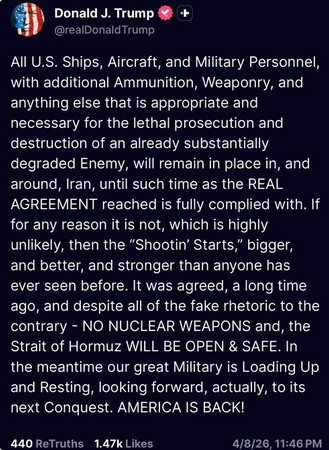
"I rely on Iranian prudence" – J.D. Vance stressed US will demand Iran surrender nuclear materials
The US has outlined the parameters of a potential agreement with Iran ahead of the upcoming talks in Pakistan. According to Vice President J.D. Vance, the key requirements will be Iran's renunciation of nuclear development and the transfer of nuclear materials to the US. Simultaneously, the US links adherence to the ceasefire with ensuring free passage through the Strait of Hormuz.
The talks will begin on April 11 in Islamabad, the capital of Pakistan. J.D. Vance stated Washington's readiness for talks and expressed optimism about the outcome. According to the US Vice President, much will depend on Iran's willingness to make concessions. J.D. Vance will lead the American delegation at the meeting.
"There is a lot at stake: if they don't give us what we need, things could go poorly. However, I am optimistic the Iranians will show common sense," J.D. Vance told reporters before departing from Budapest, which he visited to support Prime Minister Orban before the elections. The US intends to press Tehran to surrender nuclear materials and stop uranium enrichment. These requirements, according to J.D. Vance, will be decisive in the negotiations: "The President has made his position clear: we do not want Iran to have the ability to build nuclear weapons and we do not want enrichment toward that direction. We also expect Iran to hand over nuclear fuel to us. This will be our core position in the negotiations," stated the US Vice President. He emphasized that potential easing of US sanctions is directly linked to Iran abandoning its nuclear ambitions.
Open the Strait of Hormuz
J.D. Vance linked the maintenance of a potential ceasefire to ensuring freedom of navigation through the Strait of Hormuz: "The essence of the agreement is the ceasefire. We are offering negotiations and we expect Iran to open the Strait of Hormuz." If this does not happen, J.D. Vance added, "the President will not honor the deal if the Iranian side does not fulfill its obligations." He called on Tehran to take the future negotiations seriously: "We see some signs they will. And we also see some signs of arrogance, but overall, we are in a good position."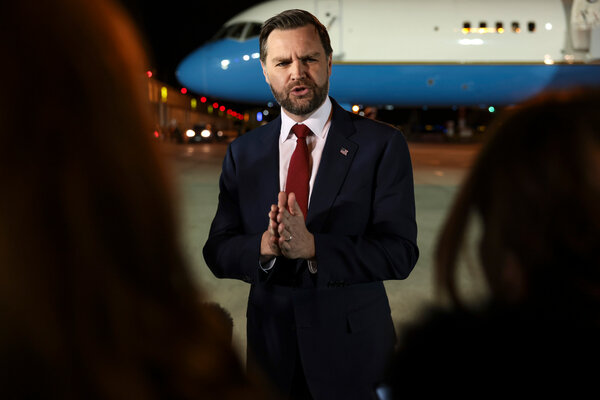
Is the ceasefire extending to Lebanon?
J.D. Vance characterized the dispute over Lebanon as a "misunderstanding," stressing that the issue was not part of the ceasefire agreement. "I consider this an understandable misunderstanding. Neither we nor the Israeli side stated that Lebanon would be part of the ceasefire agreement."
Earlier, the spokesperson for the Iranian Foreign Ministry claimed that Israel's actions in Lebanon violated the agreements reached. Meanwhile, Trump stated that the pause of attacks in Lebanon was not included in the agreement due to the Hezbollah factor. However, according to J.D. Vance, Israel is ready to limit its activities in Lebanon to advance the negotiation process: "As I understand it, the Israeli side has proposed a certain restraint in Lebanon because they are interested in a successful outcome of the negotiations with Iran."
J.D. Vance (US): The first draft of Iran's list of demands was written using ChatGPT
US Vice President J.D. Vance believes that Iran used the ChatGPT neural network to compile the first draft of its ten points of demands, according to Reuters. Overall, according to J.D. Vance, Tehran proposed three sets of demands. "There was a second 10-point proposal that was much more logical... This is the proposal President Trump referred to and remains in effect," the Vice President stated. The third proposal, J.D. Vance believes, was more maximalist than the first, but was the one that spread on social media. Earlier, J.D. Vance stated that the United States is ready to offer a lot to Iran in good faith negotiations.
Sheikh (Pakistan Ambassador): Lebanon was within the ceasefire agreement
Pakistan is proceeding with a categorical denial of both Israel and the US, insisting that Lebanon was included in the ceasefire agreement reached between the Americans and the Iranians. The Pakistani Ambassador to the US, Rizwan Saeed Sheikh, officially confirmed that Lebanon is part of the ceasefire agreement between the United States, Iran, and the involved parties.
"Based on the agreements reached and the mediating role of Pakistan, Lebanon has clearly been included within the framework of the ceasefire agreement. This matter has been fully agreed upon by the parties and there is no doubt about it," the Pakistani Ambassador argued while speaking to CNN. Furthermore, he emphasized that during recent negotiations, Islamabad stressed the need for the ceasefire to be comprehensive, which includes a total cessation of military operations in Lebanon. Rizwan Saeed Sheikh, referring to the talks between Pakistani, American, and Iranian officials, stressed that any different interpretation of the issue contradicts the text of the original agreement.
The Strait of Hormuz closed again – Iran accuses US and Israel of ceasefire violation
Iran has again blocked tanker traffic through the Strait of Hormuz and is preparing a "deterrent strike" against Israel for violating the ceasefire. Tehran claims that the agreement with Washington included a truce in Lebanon, but the Israeli Defense Forces continued attacks on Hezbollah. As a result, more than 254 people were killed in Lebanon and the number of victims exceeded 1,165. The White House believes there is a "misunderstanding" between the United States and Iran.
Iran has suspended tanker traffic through the Strait of Hormuz once more due to Israeli attacks in Lebanon, reported the Iranian news agency Fars. "This happened after Israel violated the ceasefire and attacked Lebanon." Only two tankers, having received permission from Iran, were able to pass safely through the Strait of Hormuz.
Is the ceasefire at risk?
One of Iran's conditions for the ceasefire was the cessation of hostilities on all fronts, including the war "against the heroic Islamic Resistance of Lebanon." Despite this, Israel continued its operation against the Shia movement Hezbollah in Lebanon. On April 8, the Israeli Defense Forces carried out the "largest coordinated attack" targeting more than 100 command centers and military facilities of Hezbollah in Beirut, the Bekaa Valley, and southern Lebanon, according to Israeli commanders. The massive bombardment of Beirut and other Lebanese cities killed 254 people in 24 hours and injured another 1,165.
Hezbollah: We will not stop, Israel has violated the ceasefire agreement
Hezbollah is sending a clear message that it will not stop its attacks against northern Israel and Israeli soldiers, accusing Israel of violating the ceasefire agreement between the US and Iran. From the first moment, Israel maintained that Lebanon is not included in the ceasefire agreement, a point also confirmed by the US. However, Pakistan, which mediated the deal, declares categorically that Lebanon was part of the agreement.
In any case, Hezbollah announced it would continue attacks until Israel's aggression stops. Furthermore, Hezbollah states that the morning attack on the Israeli town of Almanara was done "in defense of Lebanon and its people and in response to the enemy's violation of the ceasefire agreement, while the resistance had observed the cessation, but the enemy did not." Later, sirens sounded in the Israeli settlement of Avivim on the border with Lebanon.
Tucker Carlson: The US was defeated by Iran, we proved to be weak
American journalist Tucker Carlson doubted a US victory over Iran and emphasized that "regime change" had not worked in the country. "US military bases in the region have been destroyed or at least suffered severe damage. Some American troops have withdrawn and retreated. This is not good. This is not a show of strength, but a show of weakness... This is a defeat."
Wall Street Journal: Iran will negotiate with the US only if attacks on Lebanon stop
Iran will sit at the negotiating table with the US in Islamabad only if attacks on Lebanon stop completely, reported the Wall Street Journal (WSJ), citing sources. Iran told mediators that its participation in talks with US officials in Islamabad is possible only if there is a ceasefire in Lebanon.
On the night of April 8, the US President announced a two-week ceasefire with Iran—hours before his own ultimatum expired, which threatened the destruction of "all Iranian civilization." Iran claims the US was forced to accept its terms, which ranged from the lifting of sanctions to the maintenance of its nuclear program. Attacks by the US and Israel affect shipping security in the Strait of Hormuz and must stop completely, the Iranian President stated. The insecurity in the Strait of Hormuz and the Persian Gulf is a direct consequence of US and Israeli military aggression. Ensuring the security of this vital sea route depends on a complete cessation of attacks.
Iran accuses US of violating three points of the peace plan
The Speaker of the Iranian Parliament, Mohammad Bagher Ghalibaf, accused the US of violating three points of the 10-point peace plan, even before negotiations began. According to him, this concerns:
-
the violation of the ceasefire in Lebanon,
-
the penetration of a drone into Iranian airspace, and
-
the denial of Tehran's right to enrich uranium.
Mohammad Bagher Ghalibaf recalled that US President Trump considers Iran's 10-point proposal "a functional basis for negotiations," but three of its points have already been violated. The Speaker of the Iranian Parliament emphasized that under these circumstances, a bilateral ceasefire or negotiations are unfeasible. It was also reported that the US and Israel violated the ceasefire by attacking an oil refinery in southern Iran.
www.bankingnews.gr










Readers’ Comments