

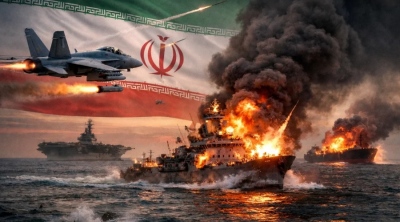
Serious concerns and nightmarish scenarios for the security of Southern Europe are brought to light by new assessments from military analysts, according to which Iran could launch attacks against United States military bases even outside the Middle East.
Military expert and air defense historian Yuri Knutov, speaking to the Russian outlet NEWS.ru, warns that Tehran has the means to strike targets in countries such as Greece and Italy, without even needing to deploy its most advanced long range missile systems.
As he argues, Iran already possesses two categories of missiles with a range reaching 3,000 to 4,000 kilometers, enough to place critical military installations in Southern Europe within targeting distance. The most worrying element, however, is that even with the use of shorter range weapons, the attacks are considered entirely feasible.
In this dark scenario, the map of potential targets includes not only Greece and Italy, but also Cyprus, where military installations of strategic importance are hosted.
Geographical proximity
The geographical proximity and the presence of Western forces make the region a potential field of conflict.
Even more worrying is the observation that Iranian missiles are not always distinguished for their accuracy.
This means that, in the event of an attack, non military targets could also be struck, causing unpredictable casualties and widespread chaos.
Such a possibility could trigger a wave of panic in European societies, with incalculable consequences.
Despite the concerns, Yuri Knutov underlines that, theoretically, Iran would seek to limit strikes to purely military targets. However, the reality of a war episode leaves little room for controlled developments.
At the same time, tension in the region is escalating dangerously.
Recent reports speak of a series of powerful explosions on the island of Kharg, the main oil export hub of Iran. According to the same sources, United States and Israeli forces are reported to have carried out attacks, further intensifying the already explosive climate.
These developments come in the wake of threats from former President of the United States Donald Trump, who had warned of the destruction of oil installations if Tehran did not comply with United States demands regarding the Strait of Hormuz.
With the geopolitical chessboard turning into a minefield and Europe now lying within the radius of danger, the possibility of a broader conflict ceases to be a simple theoretical scenario and begins to resemble a threatening reality that is approaching.
Mitsotakis on CNN: The international community will not accept tolls from Iran in Hormuz
A message to Israel was sent by Kyriakos Mitsotakis speaking to CNN, emphasizing that Israeli offensive moves in Lebanon are counterproductive. At the same time, he pointed out that NATO must be redefined, revealing that Greece will lead this initiative.
Referring to the ceasefire agreed between the United States and Iran, Prime Minister Kyriakos Mitsotakis, in an interview with CNN, noted that Greece co signed a joint statement welcoming the ceasefire and hopes that it will lead to a permanent peace.
“We are optimistic,” he stated, while at the same time expressing his concern about what is happening in Lebanon.
“It is clear that the attack of Israel on Lebanon is counterproductive and I believe that if we want to talk about a final ceasefire in the region, all hostilities must stop.
The only thing Israel achieves is to give a new platform to Hezbollah,” noted Mr. Mitsotakis.
The prime minister pointed out that we have a strategic partnership with Israel but, as he said, friends must be honest with each other. He added that for the first time there is a capable government in Lebanon and if the attacks continue we will be led to a humanitarian crisis. “I hope they will stop in order to ensure that a broader framework of the ceasefire will be maintained,” he added.
Regarding the Strait of Hormuz, Mr. Mitsotakis said that it concerns us greatly as we are the largest shipping power in the world.
“I do not believe that the international community will accept Iran imposing tolls.
That would be unacceptable,” he stated and estimated that it is possible “to reach a separate international agreement for the Strait of Hormuz that will not include a fee paid by ships”. He added that if we imposed tolls now, this would be dangerous for the future of navigation.
Regarding the possibility of the United States withdrawing from NATO, Mr. Mitsotakis stated that he deeply believes in the longevity of the transatlantic alliance.
He noted that the result of the initiatives of the President of the United States was that Europe rallied regarding defense, now spending more than 3% of GDP with the momentum for the pillar of strategic autonomy to develop.
“We must achieve a different balance in NATO for the benefit of the alliance,” he added, while after a question about the nuclear protection of Europe he said that indeed some preliminary discussions took place based on proposals by French President Emmanuel Macron.
He noted that France is the only country with nuclear deterrence capability while there was discussion about strengthening the European pillar of defense, not to the detriment of NATO, which he stated remains an alliance that depends greatly on the United States.
“We in Europe must also take on the share of responsibility that corresponds to us, strengthen defense spending and we discuss this regularly in the European Council,” he added.
www.bankingnews.gr











Readers’ Comments