

The temporary ceasefire between the US and Iran, announced by Donald Trump, brought immediate relief to the markets and led to a rapid drop in oil prices. However, behind this short-term reaction lies a deeper and likely permanent shift in the structure of the global energy market. The intervention of Dmitry Medvedev, who warned that "cheap oil belongs to the past," captures exactly this new reality: geopolitical instability has now been permanently integrated into energy pricing.
Hormuz as "point zero" of energy security
The Strait of Hormuz, through which approximately 20% of the global oil supply passes, was transformed into a strategic choke point with global implications. Its temporary closure caused a price spike of over 70% within a few weeks, proving how fragile the energy system is. Even with its conditional reopening, trust is not easily restored. Markets are now incorporating a "risk premium," which is unlikely to disappear—even if the ceasefire holds.
From globalization to "energy security"
The war accelerated an existing trend: the transition from the logic of cheap, globalized energy to a model where supply security takes priority. States and companies are re-examining their dependence on critical maritime routes, the diversification of suppliers, and the strengthening of strategic reserves. This means higher costs, less efficiency, but greater resilience.
Markets between relief and fear
The recent drop in prices following the ceasefire announcement does not negate the fact that volatility has increased dramatically. Investors know that the conflict could restart at any moment, a fact that keeps prices at higher levels compared to the past. Oil no longer prices only supply and demand, but also geopolitical risk, military mobility, and real-time diplomatic developments.
Impact on inflation and the economy
The new energy reality has immediate consequences for inflation. Increases in fuel prices are transferred throughout the entire spectrum of the economy, affecting transport, food, and industry. This limits the room for central banks, such as the Federal Reserve, to reduce interest rates, even if growth slows down. Oil exports through Hormuz have collapsed following Iranian attacks on commercial vessels, causing the largest supply disruption in history. Before the start of the US and Israeli attacks on February 28, about 20% of the world's oil supply passed through this specific maritime passage—a narrow but critical artery connecting Persian Gulf producers with international markets.
Price spike across the fuel spectrum
The conflict led to a sharp rise not only in crude oil, but also in prices for fuels such as jet fuel, diesel, and gasoline. This increase is not limited to energy markets but is transferred to the entire economy, affecting transport, supply chains, and ultimately the cost of living worldwide.
Warnings of global shortages
Oil company CEOs and analysts warn that if the Straits do not fully reopen, fuel shortages will spread on a global scale. The problem is not only quantity but also flow: even temporary disruptions create "bottlenecks" in the supply chain, which take weeks or even months to resolve.
A new era for energy
Medvedev's warning is not just a political statement—it reflects a structural change. "Cheap oil" was based on a world of relative stability and the free flow of trade. Today, energy is once again becoming a tool of power and geopolitical influence. And as long as critical arteries, such as Hormuz, remain vulnerable, the era of cheap energy is unlikely to return.
Trading Economics: Brent price trend over the last month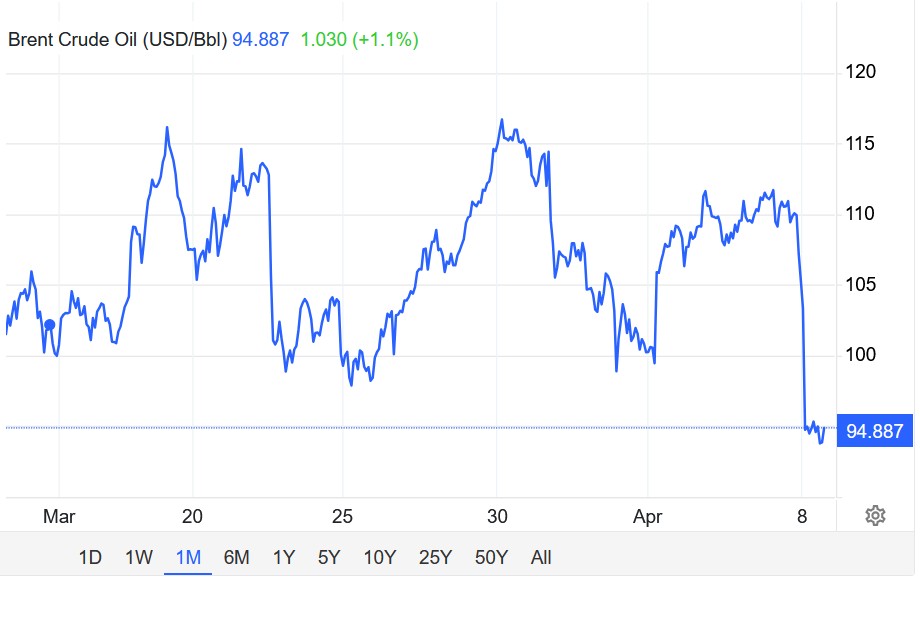
Plunge in prices after ceasefire announcement
Oil prices collapsed nearly 15% on Wednesday after US President Donald Trump agreed to a two-month suspension of military operations against Iran and stated that Washington would contribute to decongesting navigation in Hormuz. Brent contracts for June delivery fell nearly 14% to $94.34 per barrel, while West Texas Intermediate (WTI) crude recorded a drop of 15.1% to $95.91. Earlier in the session, Brent had hit $91.11, while WTI touched an intra-day low of $91.70 per barrel. Natural gas in Europe is also retreating rapidly, with the Dutch TTF at -17% and 43.900 euros.
The Trump announcement and the terms of the deal
Trump stated on Tuesday that he agreed to a suspension of military action for two weeks, just hours before the 20:00 (Eastern Time) deadline he had set. He emphasized that the US has already achieved its core military goals, while noting that Iran submitted a multi-point proposal that could serve as the basis for a broader agreement. Tehran also showed a conditional willingness for de-escalation, stating that safe passage through the Strait will be possible during the ceasefire period, provided hostilities stop and there is coordination with Iranian authorities. The development followed last-minute diplomatic efforts, with Pakistan playing a decisive role as a mediator.
www.bankingnews.gr










Readers’ Comments