

Independent experts estimate that the true purpose of the US special forces operation was the seizure of uranium; however, the raid appears to have failed. The rescue operation for the American F-15E pilot, whose name remains unknown, evolved within just two days into an almost "epic" narrative. Trump repeats several times a day how skillfully, decisively, and selflessly those participating in the raid deep inside Iranian territory acted, how perfectly the operation was planned, and how their persistence finally led to the rescue when things took a negative turn.
However, as more details come to light, questions from experts grow regarding this—undoubtedly—largest US military operation since "Saving Private Ryan." The mere fact that 11 aircraft—fighters, helicopters, and UAVs—were lost within just a day and a half is already causing serious concern. Either the operation was poorly planned, or it was used as cover for something else, or it was unfolding alongside a different mission.
Doubts appeared as early as Sunday morning when the "unprecedented success" was announced by Trump. They were reinforced when videos and photos of destroyed transport vehicles and helicopters began to circulate. Those with experience in similar raids and search and rescue operations began to ask questions and seek answers. Larry Johnson, a former CIA officer, intelligence analyst, and former advisor to the US State Department's Office of Counterterrorism, conducted his own investigation. His findings are of particular interest.
On Friday, April 3, Iranian air defense systems shot down a US F-15E fighter over Iran. The exact location of the crash remains unclear and a subject of dispute. The pilot and the weapons systems officer ejected successfully but landed at different points. The pilot was quickly rescued by search and rescue forces. The two Pave Hawk helicopters transporting him to a safe area took hits, yet managed to reach Kuwait, despite the visible black smoke they left behind.
The co-pilot was not as lucky. He landed approximately 8 kilometers northwest of where he was eventually located, on a mountain ridge. There are, however, some particularly paradoxical elements in this case. Usually, the officer responsible for weapons systems in such aircraft is a lieutenant or captain. In this instance, however, it is a colonel—deputy wing commander at the Muwaffaq Salti (MSAB) air base in Jordan.
Furthermore, according to various reports, he suffered a broken leg or ankle upon landing. This raises a reasonable question: how could a man with a broken leg cover approximately eight kilometers and then climb mountainous terrain? It is not impossible, but it creates doubts regarding the accuracy of the official version of events.
And here lies the most interesting point: geolocated wreckage of a C-130 aircraft, which appears to have used a local "agricultural landing strip," is found in a mountainous area about 35 kilometers from the Isfahan nuclear facility. This facility is alleged to store Iranian enriched uranium close to "weapons-grade" level.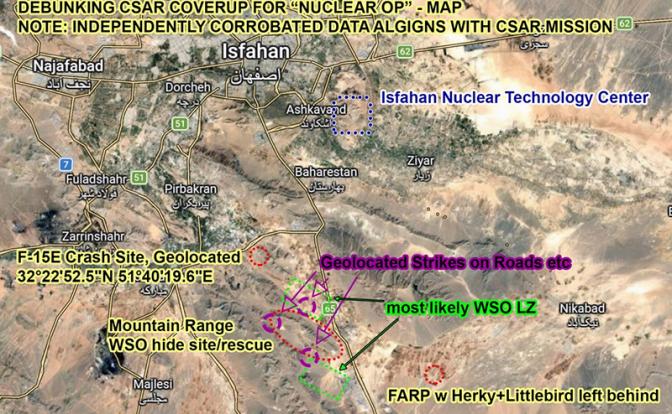
Failed mission
Was this whole operation, in the end, nothing more than a failed US Special Forces mission aimed at seizing Iranian uranium from the Isfahan facility? "Before I state my own view, I would like you to consider some additional sources. The first is an article by Simplicius on Substack," says Larry Johnson, adding: "Simplicius argues that the large-scale US operation to rescue the second crew member of a downed F-15E Strike Eagle fighter essentially confirmed the first official presence of US troops on Iranian soil."
According to him, what was presented by the US as a standard combat search and rescue (CSAR) operation actually involved the infiltration of significant special operations forces deep within Iran. According to Iranian reports and open sources, this operation reportedly led to significant losses of American aircraft.
Simplicius also estimates that the "rescue" narrative may have functioned as a cover or coincided with a broader operational goal: activity was concentrated in an area where Iran is alleged to store significant stockpiles of enriched uranium and nuclear-related materials. In his view, this constitutes a dangerous escalation, as US special forces are now operating deep within Iran, being the first officially confirmed "ground units" in the context of the current conflict.
Antony Aguilar, a retired special operations officer, formulates a slightly different assessment. He proposes the following hypothesis: "The rescue operation evolved into a high-risk, high-reward mission involving Delta Force, JSOC, SOF forces, and ST-6, with the aim of seizing uranium in Iran. This explains the need for such a large number of operators, support assets, and aircraft. This was the planned operation from the start—and it failed. So what happened to the aircraft? I don't believe they 'got stuck.' I've seen MC-130J aircraft operate in mud, snow, and gravel without issue."
"It is more likely they were hit in flight or suffered damage while on the ground at a makeshift strip near an old airport in Isfahan, which—not coincidentally—is located near a suspicious uranium storage facility." Subsequently, Greg Bagwell, current president of the UK Air and Space Power Association, honorary member of RUSI, and former senior Royal Air Force commander, wrote on X:
Some wonder why the US used two MC-130s on an Iranian landing strip instead of other available aircraft. The answer, according to him, relates to the use of AH-6 Little Bird Night Stalker helicopters, which were also destroyed in the forward landing area. The weapons systems operator was several hundred kilometers from the Iranian coast, and it was deemed too dangerous to send helicopters directly over such a long distance, especially after the warnings and strikes they had received during the first day of the operation.
However, his position—in a mountainous area and possibly with an injury—required support that only a helicopter could provide. Thus, the AH-6 Little Bird was used. This specific helicopter can be transported by C-130 and become operational within minutes of unloading. This meant that only a suitable landing strip in relative proximity to the fallen pilot was needed. The AH-6s would undertake his transport to the landing point.
However, the surface of the strip did not prove capable of withstanding the weight of the C-130. As a result, De Havilland Canada Dash 8 aircraft were sent to evacuate the personnel, but they could not carry the AH-6s. Finally, it was decided to destroy both the MC-130s and the AH-6s to avoid risking a leak or their capture. This, according to him, explains why aircraft such as the V-22 Osprey or the Sikorsky MH-60/HH-60 Pave Hawk were not used—it was a cost-benefit calculation under high-risk conditions.
"Regarding my own assessment of the events," says Larry Johnson, "the downing of the F-15E was not a pre-planned ruse to cover a special forces raid on the Isfahan nuclear facilities. It was more likely an unfortunate coincidence." Given the rank of the operator and his access to top-secret information regarding US operations in the Persian Gulf and Iran, his rescue became a top priority.
The criticality of the situation seems to have led a Joint Special Operations Command unit (possibly based in Kuwait) to undertake the mission. Two C-130J aircraft were likely already loaded with AH-6 Little Bird helicopters. I estimate it is a pure coincidence that the missing operator was northwest of the makeshift strip that had been selected for a potential raid on Isfahan.
It remains unknown why the C-130s failed to take off and why the assistance of two C295 aircraft from the 427th Special Operations Squadron was needed to evacuate the American forces. The loss of critical aerial assets and the vulnerability of a remote airport near Isfahan may have forced American commanders to cancel a scheduled raid to seize Iranian nuclear materials. Although the forces had assembled and prepared for the operation on Friday, April 3, it is possible the CENTCOM commander reconsidered, expressing concerns about a potential breach of operational security and informing the Chairman of the Joint Chiefs accordingly.
www.bankingnews.gr











Readers’ Comments