

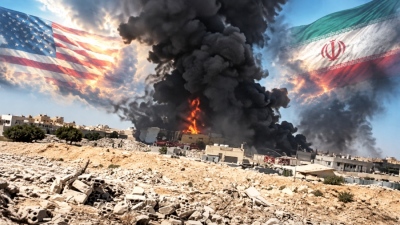
The number of Iranian missile attacks has reached nine times the figures seen in the early days. JP Morgan has published a report highlighting that the success rate of Iranian missile strikes against Israel has increased spectacularly compared to the start of the conflict, reaching levels up to nine times higher. According to JP Morgan, approximately one in three Iranian missiles accurately hits its target, demonstrating a significant improvement in operational effectiveness. At the same time, it is emphasized that the strict censorship imposed by the Israeli military prevents the release of photos and videos of the strikes, limiting the visibility of the true dimensions of the attacks.
The admission of such a high success rate—which, according to the analysis, may be even higher—leads to two main conclusions: First, despite claims of weakening, Iran's missile capabilities have not only remained intact but appear to have been strengthened in terms of launch volume, quality, and precision. Second, Israel's air defense is reportedly facing severe pressure and operational challenges. The overall picture presented is that Israel's airspace is under increasing strain, with the analysis arguing that, despite information restrictions, the reality on the ground cannot be hidden.
The US economy is not as protected as it seems
One of the biggest myths surrounding the conflict with Iran is that the United States economy is largely shielded from a major shock in energy prices. The fact that the US is a net exporter of certain fuels does not mean it will not suffer serious consequences from the rise in global energy costs caused by the crisis in Iran. This is pointed out, among others, by Michael Cembalest, head of market and investment strategy at JP Morgan Asset & Wealth Management, in his latest report.
In the introduction of his report, he reviews US military successes during the first five weeks of the conflict. Despite the significant reduction in Iranian missile and drone attacks, he notes that the evolution of the war reminds him of the plot of Stephen King's book Salem's Lot. For those unfamiliar with the story, he explains: the protagonist goes to a town to fight evil, but things turn out differently than expected—the town is ultimately destroyed and its inhabitants turn into vampires, leaving everyone in a worse state than before.
The limits of US energy independence
Cembalest then attempts to deconstruct a widespread—but, in his view, mistaken—perception regarding how rising energy prices affect the American economy. "The idea that the US is protected from the consequences of a potential disruption in the Strait of Hormuz is largely erroneous," he emphasizes, adding that "US energy independence is not the economic 'firewall' many believe it to be."
His argument is not based on theoretical estimates but on actual market data. Despite warnings that European and Asian economies are more exposed to the closure of the Straits, the prices of many refined petroleum products—and even crude oil itself—have increased more in the American market.
The challenge of reopening the Strait of Hormuz
Donald Trump has repeatedly stated that Iran must immediately open the Strait of Hormuz, or face severe military consequences. The latest ultimatum expires on Tuesday night. However, so far, Tehran’s key takeaway from its strategy—turning the global energy passage into a "toll booth"—is that it is working better than expected. Cembalest cites Bloomberg's Middle East economist, Dina Esfandiary, who states that Iran has found that holding the global economy "hostage" is easier and cheaper than it previously thought.
Even if the Straits were to open immediately, it would take time for production to return to pre-conflict levels. Furthermore, there are factors complicating a potential escalation—such as the reduction in interceptor missile stockpiles in the US, Israel, and Gulf countries. Meanwhile, Iran's progress in drone manufacturing has significantly bolstered its ability to conduct asymmetric warfare. As Cembalest notes, although drones carry a smaller payload, they can cause disproportionately large damage to much more expensive assets, such as ships, aircraft, and radar systems, while offering a greater "cost-performance" ratio compared to many missiles. Additionally, changes in the US fleet may limit the Navy's ability to secure passage through the Straits, as only four aging minesweepers remain, which are due to be decommissioned.
Market resilience—but for how long?
Many on Wall Street point out that the decline in US stocks remains limited so far, compared to other recent shocks, such as the start of the war in Ukraine in 2022 or the COVID-19 pandemic. Stephanie Link, chief investment strategist at Hightower Advisors, described the market's resilience as "impressive," attributing it to increased earnings estimates and a stable labor market.
While she maintains a positive stance on the markets, she warns that a prolonged conflict with Iran could have serious repercussions. "If the crisis evolves into a long-term one, then it clearly becomes more problematic," she notes. Overall, the emerging picture is that the American economy is anything but invulnerable to a sustained energy shock—and that the impacts of such a crisis may prove much deeper than many investors currently estimate.
www.bankingnews.gr








Readers’ Comments