

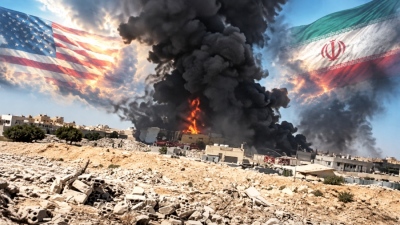
The war in the Middle East is leading to a radical realignment of global power. And the individual responsible for this is US President Donald Trump, according to an analysis by the New York Times. In recent years, the dominant geopolitical perception suggested that the world was evolving toward a tripolar system of power, featuring the United States, China, and Russia. This view was based on the assumption that power stems primarily from the size of the economy and military capabilities. Today, however, this assumption no longer holds true. A fourth center of global power is rapidly emerging: Iran. Although it cannot compete economically or militarily with the three superpowers, its power springs from its control over one of the global economy's most significant energy "choke points"—the Strait of Hormuz.
For decades, the Strait served as an international maritime route, open to ships from all nations. However, the joint military campaign launched this year by the United States and Israel against Iran led Tehran to impose a selective military blockade. Approximately one-fifth of the global supply of oil and liquefied natural gas passes through the Strait, with no realistic alternative routes in the short term. If Iranian control continues for months or years—a scenario the analyst considers likely—it will drastically reshape the global order to the detriment of the United States.
The illusion of temporary control
Many analysts estimate that Iran's influence over the Strait is temporary and that the naval forces of the US and its allies will soon restore the flow of oil. This assessment, however, is flawed. It is based on the premise that Iran must fully close the Strait to control it. In reality, control can be exercised without a total blockade. The Strait remains formally open, but traffic has decreased by over 90% since the start of the war—not because Iran is sinking every ship, but because the threat of attacks has led insurance companies to withdraw or drastically increase war risk premiums. Individual strikes on vessels are sufficient to make the risk unacceptable.
The vulnerability of modern economies
Modern economies do not just need oil; they require a reliable, timely, and predictable supply. When this reliability collapses, insurance markets harden, shipping costs skyrocket, and energy transforms from a commercial commodity into a strategic issue. For the United States, the problem is asymmetric. Protecting every tanker from threats such as mines, drones, and missile attacks requires a constant military presence. Conversely, Iran only needs occasional strikes to disrupt confidence in the global market. Emmanuel Macron essentially admitted this reality, stating that opening the Strait through the use of force is "unrealistic" and can only be achieved with Iran's cooperation.
The end of an old balance
For decades, the Persian Gulf region operated under a simple balance: producers exported, markets determined prices, and the US ensured the flow. This system allowed for competition without destabilization. Today, however, it is collapsing. The Gulf states depend on energy revenues. When insurance costs rise and navigation becomes uncertain, the fiscal impacts are immediate. Routes change, contracts are renegotiated, and governments adapt. If the uncertainty continues, the regional order will be transformed, with Gulf states adjusting to the factor that can directly affect the reliability of their exports—namely, Iran.
The global consequences
The greatest impacts will be recorded in Asia. Countries such as Japan, South Korea, and India are heavily dependent on Gulf energy, while China, despite diversification, still relies significantly on the region. These dependencies are deeply embedded in infrastructure that cannot be changed quickly. If the energy disruption continues, the consequences will be extensive: price increases, worsening trade balances, weakening currencies, and rising inflation. Access to energy will increasingly dictate policy, limiting diplomatic options. A scenario similar to the 1970s—where oil shocks led to stagflation—is no longer a distant possibility.
Who benefits
In this new environment, Iran emerges as a key winner. China secures energy for its growth, Russia benefits from high and volatile prices, and Iran gains strategic influence through the Strait of Hormuz. The interests of these countries converge objectively to the detriment of the economic stability of the United States and its allies—even without a formal alliance.
High-risk scenarios
A darker scenario would be the formation of an informal "cartel": Iran controlling about 20% of global oil, Russia 11%, and China absorbing a large portion of the supply. In such a case, they could deprive the West of up to 30% of the global supply. The consequences would be dramatic: a rapid weakening of US and European power and a shift of the center of gravity toward Asia.
The US dilemma
The United States faces a difficult dilemma: either to invest in a long-term effort to regain control of the Strait or to accept a new energy reality where their dominance is not guaranteed. In the first case, it is a prolonged and uncertain struggle. In the second, the outcome is clear: the international system will be reshaped, with Iran emerging as a fourth pole of global power. This war is not a conflict from which the US can simply walk away without consequences. Iran will demand a high price in any new agreement—but this may prove smaller than the cost of a complete upheaval of the global order. This is a war of transformation. And if these developments continue for just a few years, the change in the international system may prove irreversible.
www.bankingnews.gr



Readers’ Comments