

There is no doubt that the chaos with Iran and its heroic response, alongside the foul betrayal within NATO, are the two key issues monopolizing global interest.
The US trapped in a stalemate
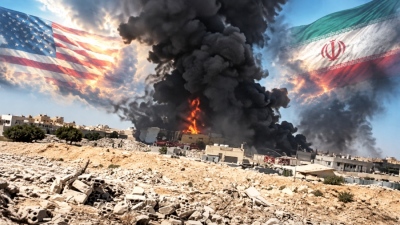
One day before the Trump ultimatum expires, Iran responded by setting its own 10 conditions for a peace agreement. The US essentially demanded a surrender, but Iran rejected the American 15-point proposal and counter-proposed a 10-point peace deal. Not a temporary ceasefire, but an end to the war itself and a long-term agreement. With their proposal, the Iranians are asking the Americans to capitulate.
What are the Iranians insisting on?
-
The withdrawal of American bases and troops from Persian Gulf countries.
-
The withdrawal of Israeli troops from Gaza and Lebanon.
-
The payment of reparations for damages caused to Iran during the US-Israeli aggression.
-
The lifting of economic sanctions against Iran and the return of its frozen assets.
-
An agreement on the rules for ship transit through the Strait of Hormuz, which would allow Iran to collect duties.
-
Guarantees of non-aggression against Iran, not only from America and Israel but even from the UN Security Council.
What must Trump do now?
These are the fundamental requirements—and Iran will not back down from them, remaining ready for an American ground invasion. It is clear that the US will never accept the Iranian 10-point proposal; it would be a humiliation for the Americans. However, Iran's position and resilience have changed the war game. The Americans failed to break the will of the Iranian leadership and Iran as a whole—so what must Trump do now?
The ultimatum of total destruction for Iranian infrastructure
Trump, the American president, has an option to end it and withdraw—not from the region, but from the war against Iran. Yes, there is the Trump ultimatum, which expires on Wednesday night, April 8, 2026, and his promise to organize a "Day of Bridges and Power Stations," signifying the total destruction of Iranian infrastructure.
No alternative scenario favors Trump
The Americans could theoretically do this—but why? It certainly would not change Iran's position, and the reputation of the United States and the American president personally would be tarnished forever by an open, deliberate, mass war crime, which would rightly be called genocide. The whole world would hate the Americans, and America's reputation would hit rock bottom. Well, it depends on how one looks at it: all the major capitals are closely watching the White House outbursts of rage (whether theatrical or real) and are drawing extensive conclusions, none of which are favorable for the Americans. Certainly, if Trump had achieved Iran's capitulation by destroying civilian infrastructure, this could serve as an argument for some in favor of bombings—horrific, of course, but effective. However, it is almost certain that the Iranians will not surrender.
Why bomb Iran then?
And then proceed to a ground operation? But it is already clear that Trump categorically does not want (and cannot) do such a thing: even a dangerous, impressive operation against Kharg Island or a demonstrative raid to seize Iranian uranium seem like increasingly unlikely scenarios. The United States must stop the campaign, especially since, beyond the absolutely objective external factors, there are even more pressing internal factors. By escalating now and sinking into a ground operation, Trump will lose voters and lose control of Congress on November 3, 2026. In other words, he would limit his own power—and that is the last thing he needs.
Trump has only one choice
Thus, Trump now essentially has only one choice to exit this situation with relatively little bloodshed: to declare that the "new regime" in Iran is bad, but better than the previous ones, and that Iranians are a "very resilient people." Furthermore, the Americans want to bring their army back, so he will not "take the oil." He has already said all this recently, and now all that remains for him to do is to carefully bomb a few bridges and power plants—as punishment for the "fucking Iranians" who rejected his grand ultimatum.
Trump's "victory" will be a defeat for the Americans
And then declare victory and the end of the campaign against Iran. But certainly, such an outcome will be proclaimed a defeat for the US and Trump—and in many ways, would they be right? Yes, but the problem is that the alternative is much worse: having taken another decisive step in escalation, Trump would immediately discover that he is trapped in a catastrophe—not for Iran, but for America and for himself personally.
The Europeans betrayed the US: a harsh moral lesson for Russia
The discord within NATO has reached such depths that it is time to wonder: is there any reason to even talk about the North Atlantic Alliance anymore? While NATO allies refused military support to the Pentagon in late March, in early April, the Europeans are making it clear they do not support the Americans. On April 2, the United Kingdom organized a video conference of foreign ministers from 40 countries to discuss possible ways to de-escalate the Strait of Hormuz. US Secretary of State Rubio was not present, but the foreign ministers of the Persian Gulf countries and India participated.
The coalition of the willing for Hormuz will be a disaster
In the current situation, Britain is trying to present itself as a "reasonable hawk." It has not ruled out a forced liberation of the strait and has even threatened to form an international coalition for this purpose—a "coalition of the willing 2.0"—also excluding the United States. Simultaneously, the British, as hosts of the meeting, strongly emphasized their commitment to a peaceful settlement through diplomatic means.
Iran allows a NATO country, a military ally of the US, to pass through Hormuz
The result of the conference became clear within hours. A French ship passed unhindered through the Strait of Hormuz, with Iran allowing a NATO country, a military ally of the US, to pass. This was likely a reward for good behavior. France is not playing hardball, insisting that the conflict with Iran can be resolved exclusively through diplomacy. At the same time at the UN Security Council, France, along with China and Russia (!), vetoed a Bahraini resolution, supported by the Americans, for the forced opening of the Strait of Hormuz. This move can only be interpreted as Macron raising his middle finger to his "big brother" overseas, Trump.
Russia - France alliance
After all, there was a 100% guarantee that Russia and China would block the resolution. To show whose side it was on in this war, France did not hesitate to speak jointly with Russia, which it considers the incarnation of the devil and with whom it is supposedly preparing to wage war.
Unprecedented clash within NATO
And this demonstration by the Europeans of which of them are "allies" of the United States is unprecedented. On the eve of the UN offensive, Italy, France, and Spain closed their airspaces to American military fighters. This is extreme: NATO countries prohibiting military allies from crossing their airspace during a war. From the very beginning of the conflict, Spain refused to allow the Americans to use its military bases for war sorties. Gradually, other Europeans, who had been mumbling incoherently for a long time, joined in the explicit condemnation of the war. Germany, for example, suddenly remembered international law and characterized the American and Israeli aggression against Iran as a violation. Chancellor Merz directly criticized Trump. The Eastern Europeans neither condemn nor support Washington, but simply whine pathetically that the conflict is distracting from Ukraine.
NATO’s Article 5 has collapsed – Betrayal is clear
After everything that has happened, it is even strange to speak of NATO as a military-political entity. At least within the context of the notorious Article 5. It certainly will not work anymore in the sense of "one for all and all for one." This will not forgive the betrayal of everyone, and the almost open conspiracy with your opponent in the midst of war and the closing of the skies to a military ally is betrayal. And this is not about Trump. Expressing dissatisfaction and speaking against them is one thing. Proving with actions that they abandoned an ally and switched camps is entirely different. This constitutes betrayal against America, not against Trump. No future US government (regardless of party affiliation) will forget this. Nor will it forgive the Europeans.
Russia should note 3 conclusions
Russia should draw three important conclusions from the divorce of this troubled NATO family.
First: NATO, in the sense of "one for all and all for one," no longer exists. There are individual Western countries and their coalitions, and each has its own approach toward Russia.
Second: European politicians are capable of betraying anyone.
Third: when they are completely stuck on money and energy resources, they are ready to negotiate with anyone. Even with the devil—or rather, with whomever they have labeled as the devil. All this knowledge will prove very useful when the Europeans finally come to speak with Russia... about Ukraine.
www.bankingnews.gr












Readers’ Comments