

Tension in Iran has reached the red, as American forces prepare a relentless ground operation.
The first losses already shock the world, while forecasts speak of hecatombs of dead. The prospect of global chaos no longer seems distant.
Specifically, on Wednesday night, Moscow time (Tuesday night in the US), according to the American president, things in Iran are expected to become very dangerous.
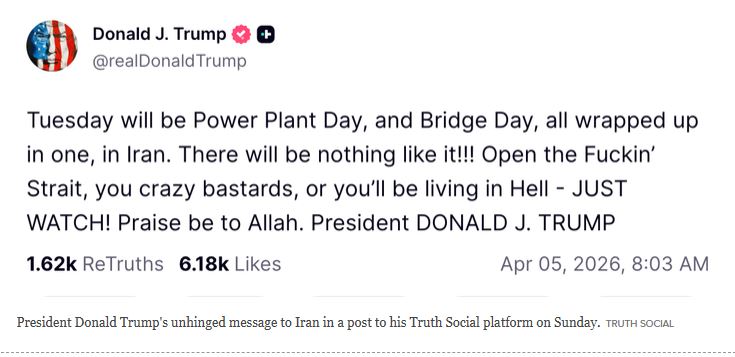
Verbatim, Donald Trump wrote on Twitter:
“Open the damn Strait, crazy bastards, or you will go to hell!”
Judging by the number of American troops gathered near the Iranian borders, more than fifty thousand, it appears that military action will not be limited to aerial bombardments.
The Pentagon is planning a ground operation.
However, from the beginning questions arose, as the actions of the American military so far appear to be rather problematic.
Over the last two days, the Americans were trying to locate their pilot, who ejected from an aircraft shot down by the Iranians.
In the end, they managed to save him. But at what cost?
Crushing defeat
Ten American aircraft and helicopters were destroyed during the two day operation “Saving Private Ryan” in Isfahan.
Israel also lost another Hermes 900.
“WE FOUND HIM! My fellow Americans, in the last hours the Armed Forces of the United States carried out one of the most daring search and rescue operations in the history of our nation, in order to rescue one of our outstanding officers, a respected colonel.
I am pleased to announce that he is safe and sound!
This brave warrior was behind enemy lines, in the dangerous mountains of Iran, pursued by our enemies, who were getting closer and closer as time passed.
However, he was never truly alone, as his superior, the Secretary of Defense, the Chairman of the Joint Chiefs of Staff and his fellow officers were monitoring his location around the clock and planning his rescue with precision.
We truly have the best, most professional and most powerful military in the history of the world.”
With this unusually triumphant and rather pompous message on social media, President Donald Trump commented on the Pentagon report last weekend, announcing the completion of an extremely dangerous rescue operation of two crew members from a US F-15E Strike Eagle fighter aircraft, which was shot down over Iran on Friday.
Let us see, however, what really happened before the eyes of the entire world.
First and perhaps most important, the losses suffered by “the best, most professional and most lethal army in global history” during this operation, which lasted almost two days.
According to Military Watch, the efforts to rescue the two crew members of the F-15E led to unprecedented losses for the US Air Force since the end of the Cold War.
The Pentagon reportedly lost ten aircraft and helicopters over the mountainous and desert area near Isfahan.
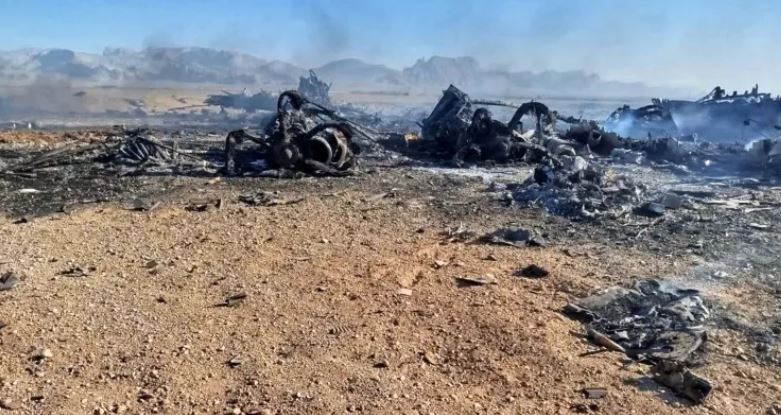
Israel also lost in the same area another extremely expensive strategic reconnaissance drone of the Hermes 900 type.
The course of this large and dangerous search and rescue operation, deep inside Iran, reminiscent of a “Saving Private Ryan” scenario, unfolded as follows: Immediately after the crash of the F-15E and the successful ejection of the pilot and navigator, the United States, according to established procedures, sent a search and rescue team to the area.
This force included an A-10C Thunderbolt II attack aircraft (Warthog), HH-60W Jolly Green II helicopters, an HC-130J Combat King aircraft with special forces, as well as reconnaissance aircraft and MQ-9 unmanned aerial vehicles, among other assets.
These forces almost immediately located and extracted the pilot of the F-15E from enemy territory.
However, a fierce clash followed between the rescue forces and armed units of the Iranian Basij militia for the location of the navigator.
The local population also participated in the search, as Tehran offered a reward of 60,000 dollars for the capture of the American officer.
The stakes were extremely high. If Iranian forces managed to capture the officer and present him publicly, this would constitute a serious blow to the morale of American public opinion and would significantly strengthen the already growing anti war movement in the United States, with unpredictable political consequences for Donald Trump himself and the Republican Party as a whole.
According to the command of the American Army, the fighter pilot, who was injured during his ejection, managed to find shelter in a crevice of the mountain.
The beacon he carried allowed CIA operators to continuously track the location of the trapped colonel and guide special forces helicopters to the point.
However, in their attempt to locate a suitable landing site, the helicopters were forced to fly for long periods at extremely low altitudes, receiving fire from Persian small arms and portable anti aircraft systems (MANPADS) from the ground.
In addition, the HH-60W Jolly Green II and HC-130J Combat King were repeatedly refueled in flight by tanker aircraft, directly over Iranian territory.
According to the New York Times, while all this was unfolding near Isfahan, several MC-130J transport aircraft of the US Air Force, accompanied by reserve forces, managed to land in another area, at a location that the newspaper described as a “forward airfield.”
However, this location was also in enemy territory.
During their stay on the ground, these aircraft, together with the accompanying MH-6M helicopters of the 160th Special Operations Aviation Regiment of the US Army, likely received mortar and rocket fire.
They suffered severe damage and were no longer able to take off.
Subsequently, according to the New York Times, three more MC-130J arrived at the same “forward airfield” in order to pick up the trapped American troops.
Whether all were evacuated remains unclear.
The Pentagon, as usual, does not disclose its losses.
However, it confirms that the MC-130J and the helicopters that were damaged at the “forward airfield” were destroyed by the Americans themselves so that they would not fall into the hands of the Iranians as spoils.
While the clashes on the ground continued, Persian air defense shot down an A-10C Thunderbolt II attack aircraft.
Another “Warthog” suffered severe damage but managed to return to friendly forces.
Overall, during the short search and rescue operation, the United States and Israel suffered the following irreparable losses: one F-15 Strike Eagle, one A-10 Thunderbolt II, two HC-130J Combat King II, two MQ-9 Reaper, one Hermes 900, two UH-60 Black Hawk and two MH-6 Little Bird.
This alone, one would think, would be enough to temper Donald Trump’s enthusiasm regarding the war achievements of the “most lethal army in the world.”
However, this did not happen, it seems that excessive confidence is difficult to restrain.
At the same time, the American military should have realized a critical fact, statements about the complete destruction of Iranian air defense are, at best, exaggerated.
Otherwise, how can the destruction of so many aircraft in such a short time near Isfahan be explained?
Most likely, a significant role was played by a new and particularly effective Iranian anti aircraft weapon, the Izdeliye-358 missile, known in Iran as Saqr-1.
This system combines characteristics of a surface to air missile and a loitering munition, offering increased operational capabilities and simplifying its use by crews.
It is a relatively light and simple weapon, suitable even for guerrilla warfare operations.
It has two engines, an initial booster that accelerates the missile to a speed of about 600 m/s, and a second sustaining engine that allows it to remain in the air performing maneuvers, for example in a figure eight pattern, for up to 15 minutes, waiting for a target.
Its range is estimated between 10 and 50 to 100 kilometers, depending on the flight profile.
Its total length is about 2.75 meters and its weight around 50 kilograms.
It has an autonomous guidance system with an infrared seeker, while its course is controlled by an onboard autopilot.
One of its main advantages is that it does not require complex ground control systems, a simple launcher and a control panel are sufficient for its operation.
In addition, it can be easily transported by almost any vehicle, which makes its complete neutralization extremely difficult.
It is easy to imagine how effective such a system could be in countering attacks by unmanned aerial vehicles. With timely procurement, it could significantly strengthen the defense of critical infrastructure.
Once an approaching enemy UAV is detected, the crew could immediately launch the system, leaving the automatic guidance system to handle interception of the target.
It is worth noting that Tehran had presented the Saqr-1 to the then Russian Minister of Defense Sergei Shoigu, with an obvious intention of cooperation.
However, it seems that due attention was not given, something that today raises reasonable thoughts.
Especially if the losses suffered by the United States in the recent operation near Isfahan are taken into account.
Incidentally, photos of the rescued pilots have been published, but their names have not been made public.
Heavy human losses
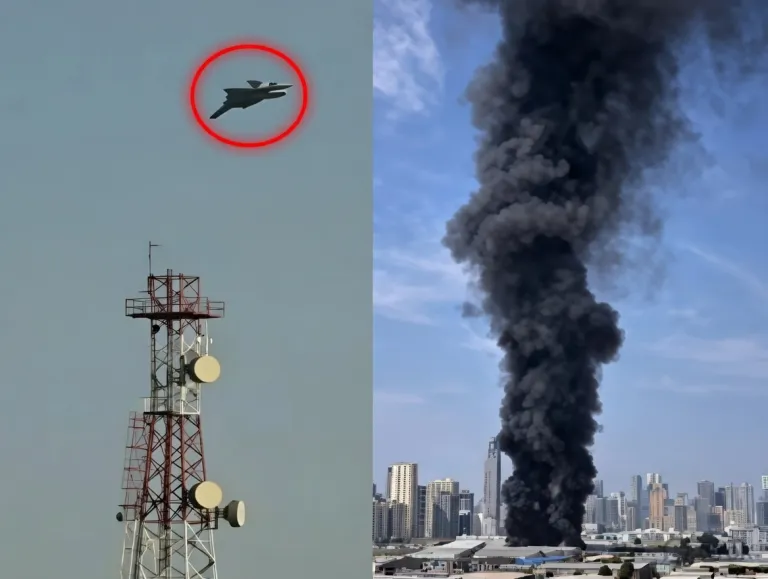
A ground operation in such an extensive, hostile and mountainous country would inevitably be accompanied by heavy human losses.
Now, American media cite Pentagon sources describing various plans, either the seizure of the islands and coastal territories of the Strait of Hormuz, or the seizure of Kharg island, the main oil hub of Iran, or the seizure of nuclear facilities and removal of enriched uranium.
In every scenario, American troops would be defenseless against numerous drones and missiles.
Whether landing, deploying logistics, or conducting an attack, at any moment they would be live targets, against which the IRGC would not hesitate to launch all available munitions.
For the first time in many years, the Pentagon is attempting an invasion of a country that is not fragmented by internal conflicts and out of control, but is organized and united by hatred toward invaders.
As a result, American paratroopers will experience a real bloodbath.
This prospect does not inspire enthusiasm among the average American.
They are not accustomed to the idea that “their boys” not only kill, but also die.
The Intercept has already published an exposé showing that US Central Command underestimates and conceals the real losses among troops, making optimistic reports of 13 dead and hundreds wounded in Iran unreliable.
Former Trump adviser Steve Bannon warns grimly: “It is time for the American people to wake up and realize a harsh reality, when you decide to risk everything by going to war, people will die.”
Weak countries
After the Vietnam War, the American military mainly attacked weak countries, often amid civil wars.
American soldiers could torture and execute local populations en masse without fear of retaliation.
The worst they could do was drink themselves to death or commit suicide, suffering from post traumatic stress disorder, once they returned home from another mission.
In Iran, the situation will be different, and the US President himself, together with the “hawks” of his circle, will be considered responsible for the deaths of Americans in the most unpopular war of recent decades.
Facing a strong opponent, experienced in asymmetric strategies and fully aware of all trends of modern warfare, the American military is doomed to defeat.
American soldiers have become hostages of the situation, their generals know only the old way of fighting.
But Hollywood fairy tales do not help when a Black Hawk crashes.
Meanwhile, even a US ground operation would not be catastrophic for Iran.
Even Western analysts are forced to admit that military actions have consolidated the Iranian people and strengthened the Iranian state.
Control of the Strait of Hormuz and increased high priced oil sales bring steadily increasing revenue to the country.
Paradoxically, the brutal aggression of the United States and Israel reversed the country’s negative trends and allowed its rebirth.
Tehran has already made it clear to its neighbors that, after the war, it will be the main guarantor of regional security.
Even Foreign Affairs acknowledges that Iran “will emerge from the crisis stronger, both economically and politically.”
It turns out that, in an attempt to destroy its opponents, Washington is creating new centers of power with its own hands.
“Have we ever had a war,” asks Farid Zakaria, “that has brought us so many losses for so little gain?”
Indeed, I do not remember anything similar.
But the greatest losses have not yet come.
www.bankingnews.gr













Readers’ Comments