Increasingly, the president of the United States, Donald Trump, resembles a wounded beast, as he appears to be losing composure due to the strategic successes of Iran in the military confrontation with the United States.
The new threat from Donald Trump on Sunday April 5, 2026 goes beyond rhetoric, it is a direct challenge to Iran, with clear geopolitical and military implications.
Tuesday April 7 has been characterized as “Day of Power Plants and Bridges”, while the Strait of Hormuz is at the center of a warning that could change the map of the Middle East and sow chaos in the global economy.
In posts on the platform Truth Social, Donald Trump stated that “Tuesday will be Day of Power Generation Plants and Day of Bridges, all in one, in Iran.
There will be nothing like it!!!
Open the damn Strait, crazy bastards, or you will live in Hell, JUST WATCH. Glory to Allah” essentially calling on Iran to open the Strait of Hormuz or face “hell”.
Although these statements initially appear as a hysterical outburst, their significance is deep and carries enormous geopolitical and humanitarian consequences.
Nuclear rhetoric
What makes the statements of Donald Trump so dangerous is not simply their anger.
The use of provocative and aggressive language aimed at causing fear and submission, a language that has not been used by a leader of a superpower on such a scale for decades.
The threat of extensive attacks on infrastructure of civil and economic importance, such as power generation plants and critical bridges, if the Strait of Hormuz does not open immediately.
The excessive and seemingly uncontrolled rhetoric that confuses military targets with the punishment of an entire population.
This rhetoric is not simply words, it is monitored by markets, military intelligence services and diplomatic missions around the world, and can very easily turn into actions with real cost in lives and infrastructure.
The Strait of Hormuz - Global importance and global risk
The Strait of Hormuz is one of the most critical trade routes in the world.
Approximately 20% of global oil production passes through it every day, which means that any disruption has an immediate impact on the global economy and energy levels.
This water corridor is not a local matter between the United States and Iran.
Severe risk of escalation
The threats of Donald Trump do not remain at the level of rhetoric.
They have been accompanied by ultimatums, 48 hours to open the Strait or face hell.
They are accompanied by previous military operations, including ongoing conflicts in the region.
The possibility of strikes on critical infrastructure opens the way to a cycle of retaliation that will not be limited to government buildings, but will also affect civilians.
Every target that is not explicitly military, such as power plants or bridges serving daily civilian needs, has a high likelihood of violating the rules of international humanitarian law.
Trump ultimatum expires Monday April 6
A message that caused global shock was sent by Donald Trump to Tehran, dramatically escalating the already explosive situation in the Middle East.
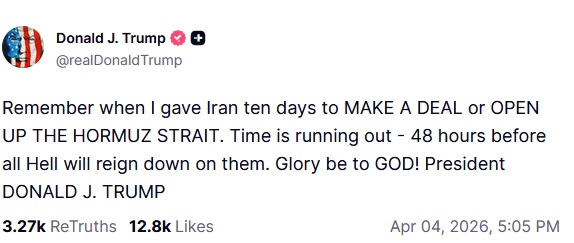
With a post on Truth Social, the president of the United States on the afternoon of Saturday April 4 gave Iran a 48 hour ultimatum to accept the terms of Washington regarding the resolution of the crisis in the region. Otherwise, as he warned, the United States is ready to launch a devastating military response.
“Do you remember when I gave Iran ten days to MAKE A DEAL or OPEN the Strait of Hormuz?
Time is running out, 48 hours before hell breaks loose on them. Glory to God!” he wrote characteristically.
This statement brings back to the forefront the previous 10 day ultimatum that Donald Trump had set for Tehran for reaching an agreement or for a radical change in the strategic balance of the region, including the critical energy corridor of the Strait of Hormuz.
What the April 6 deadline means
What will happen if the deadline passes?
Iran will not accept the ultimatum.
No agreement will have been reached. No diplomatic channel of communication between the two sides will have been maintained.
The mediation channel through Pakistan has gone inactive.
The 15 point plan of the United States was fully rejected.
The UN spent 15 days trying to pass a decision for the opening of the Strait of Hormuz.
Russia, China and France removed any possibility of imposing a predetermined decision.
The vote was suspended again.
Forty countries met on Thursday April 2. They agreed on nothing.
Iran used this time to write the new rules.
The deputy foreign minister announced a joint protocol with Oman, requiring permits for all transit through Hormuz.
Not during the war.
After it.
What will happen:
1) Donald Trump strikes the electricity network of Iran
2) Iran retaliates by striking energy infrastructure in the Gulf.
3) Kuwait, Bahrain, United Arab Emirates and Saudi Arabia were hit this week, and this was before the strike on the network.
4) The price of oil exceeds $140, which is the threshold for the start of an economic recession, it is not a forecast, it is a specific price.
Then Donald Trump extends the deadline.
He moves the target.
The ultimatum becomes a bluff.
Every future threat toward Iran, toward NATO or toward anyone, loses weight.
The licensing system of Iran for Hormuz becomes the new status quo.
Donald Trump redefines the objective.
He had already stated on Wednesday that the United States has no role in Hormuz.
On Thursday April 2 he stated take the oil and make a fortune.
Then he threatened to destroy the network if Hormuz does not open.
Three different positions in 72 hours.
April 6 may simply bring a fourth.
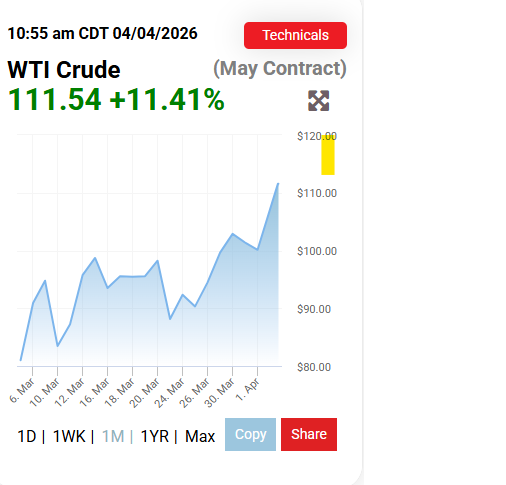
Oil closed on Friday April 3 at $111.
The red line for economic recession at $140 is 26% away.
Two weeks earlier it was at 45%.
April 6 is not a deadline for Iran: it is a deadline for the resilience of the global economy.
Lindsey Graham warns Trump will follow through on threat to destroy Iran’s power grid
The Republican senator Lindsey Graham stated that Donald Trump listened to his views and, after a phone conversation, he is convinced that the president will implement his threat to strike Iran’s electricity plants if no agreement is reached or if the Strait of Hormuz is not opened.
“After speaking with President Donald Trump this morning, I am fully convinced that he will use overwhelming military force against the regime if they continue to block the Strait of Hormuz and refuse a diplomatic solution to achieve our military objectives,” Lindsey Graham wrote on the platform X.
“If it has not been clear by now to Iran and others that President Donald Trump means what he says, then I do not know when it will be,” he added.
www.bankingnews.gr













Readers’ Comments